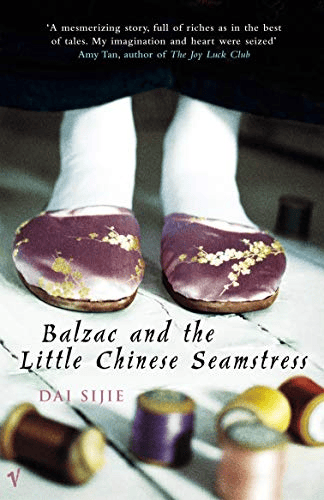
Balzac and the Little Chinese Seamstress is a semi-autobiographical novella written by Dai Sijie, a Chinese French author and film maker. The book was published in 2000 in French and in English in 2001.
The book is set during the Great Proletarian Cultural Revolution that occurred in the People’s Republic of China between 1966 and 1976. The programme was implemented by Mao Zedong after his return to the centre of power in 1966 and followed his period of self-abstention and bowing down to less radical leadership in the wake of the failed Mao-led Great Leap Forward (Second five-year plan to convert China from an agriculturally led society to a communist society through the formation of people’s communes) which resulted in the Great Chinese Famine during which an estimated 15 million to 55 million people died of starvation (1959 to 1961). The purpose of the Cultural Revolution was to preserve Chinese communism by purging any remaining aspects of capitalism and Chinese traditional culture from Chinese society.
The book is the story of two teenage boys, Ma, the narrator, and Lou, his best friend, who are assigned to a re-education programme through labour and are sent to a mountain called “Phoenix of the Sky” near Tibet. The villagers spend their lives growing rice and mining coal, both of which are physically relentless occupations that wear down the boys in body and spirit.
The story begins with the teens having just arrived at their assigned village and suffering through the headman’s inspection of their belongings. He is inspecting Ma’s violin with great suspicion. The reader quickly understands that Lou is the more forward and quick thinking of the two as well as a natural leader, when he saves the instrument by persuading the headman to let Ma play it for him. The reader also discovers that Ma is a good musician.
The boys’ miserable situation has arisen due to both their fathers being named ‘enemies of the state’ due to their education and occupations (Ma’s father is a doctor and Lou’s father is a famous dentist) and both youngsters’ despair of ever returning to the city. The re-education programme is viewed by both as a punishment and a permanent relocation and situation.
Lou has a great talent for storytelling and uses it to ingratiate both youngsters into the community. Over time, the headman sends the boys to the closest town with a cinema to view films and come back and retell them to the villagers. Through their story telling, the pair meet the ‘little seamstress’, the daughter of the local tailor and the ‘reigning beauty’ in the region. Lou ends up having a sexual relationship with her and is in love with her, but he feels she is not sufficiently educated and cultured for him.
The boys meet another youngster, Four Eyes, who is also being re-educated and living in a neighbouring village. Four Eyes is the son of a well-known poet and is finding life in the village even more difficult as a result of his thick glasses and very poor eyesight. By accident, the two boys discover that Four Eyes has a suitcase full of banned books and manage to manipulate Four Eyes into lending them two books. Lou memorises the books so that he can relate them to the little seamstress in a bid to expand her horizons and uplift her.
Balzac and the Little Chinese Seamstress explores the themes of love, coming of age, reading, education, censorship and beauty through the experiences of three teenagers during the period of the Cultural Revolution in China.
While the book is based to a certain extent on the author’s experiences in China during this time, it is a work of fiction.
I found this book to be fascinating. I learned a huge amount about life in China during the Cultural Revolution and the suppression of knowledge and education which always seems to result during social revolutions. The characters are beautifully and sensitively portrayed, and their anxieties, struggles, and experiences were engaging and enlightening.
Quotations that intrigued me
“I was carried away, swept along by the mighty stream of words pouring from the hundreds of pages. To me it was the ultimate book: once you had read it, neither your own life nor the world you lived in would ever look the same.”
“The sheer audacity of our trick did a lot to temper our resentment against the former opium growers who, now that they had been converted into «poor peasants» by the communist regime, were in charge of our re-education.”
“»So are you weeping tears of joy?» I said.
«No. All I feel is loathing.»
«Me too. Loathing for everyone who kept these books from us.»”
Purchase Balzac and the Little Chinese Seamstress here: https://www.amazon.com/Balzac-Little-Chinese-Seamstress-Sijie-ebook/dp/B07XB4CL5Q
If you are interested, this is a 40 second clip from the movie:
 LatinosUSA
Deja un comentario