Literature  ·  Poetry  ·  Essays


Vol. VI · September 2026

Classic Books and Poems – Myths, Legends, Poems, and Books: Here We Go Round the Mulberry Bush

Published by

on

Do you know the nursery rhyme Here We Go Round the Mulberry Bush?

I remember it from when I was a girl. The girls used to hold hands and dance in a circle singing the lyrics and doing the actions.

These are the first two stanzas of the most modern version:

Here we go round the mulberry bush,
The mulberry bush,
The mulberry bush.
Here we go round the mulberry bush
On a cold and frosty morning.

This is the way we wash our face,
Wash our face,
Wash our face.
This is the way we wash our face
On a cold and frosty morning.

The rhyme was first recorded by James Orchard Halliwell, an English Shakespearean scholar, antiquarian, and a collection of English nursery rhymes and fairy tales, as an English children’s game in the mid-nineteenth century.

The song and associated game are traditional in England and different versions are found in Scandinavia and the Netherlands.

R.S. Duncan, a prison governor at HM Prison Wakefield in Wakefield, West Yorkshire, England suggested that the nursery rhyme was about female Victorian prisoners exercising in the yard at Wakefield. A mulberry tree grew in the yard and women inmates would dance around the tree with their children and sing the song. The tree died in May 2019.

About the Victorian prison system

The Victorian prison system was created by men for men. Accommodation for women was usually an after thought and the penal system designed for them as generally a modified version of the men’s prison.

Women convicts were considered to need saving twice, firstly from their criminality and secondly from their deviance from expected female behaviour.

To this end, instead of being subjected to hard labour, women progressed through several disciplinary stages intended to put them on the path to reform. The stages were separate confinement for four months (men had to endure nine months of separate confinement), associated labour and, finally, a transfer to a female-only institution.

Prison authorities had to deal with pregnant and postpartum women. Lying-in wards and nurseries had to be created and the regulations relating to exercise, communication, and dietary provision had to be modified for such women.
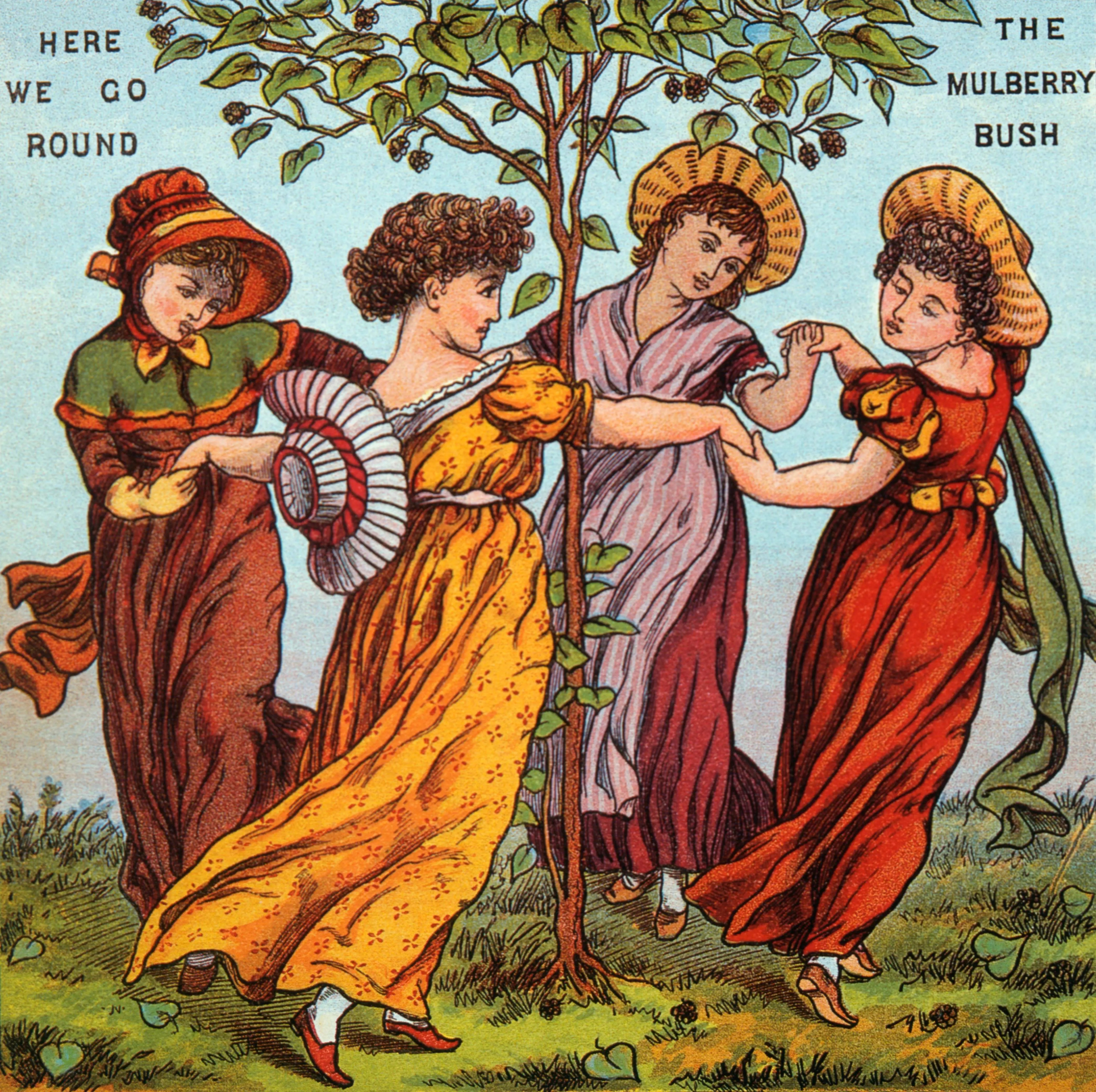
 The rhyme refers to Victorian female prisoners at HMP Wakefield who would exercise around a mulberry tree
Picture credit: https://www.thesun.co.uk/fabulous/8356830/historic-stories-behind-nursery-rhymes/

Another possible interpretation of the rhyme is that it references Britain’s struggle to produce silk. Silkworms eat mulberry leaves and during the eighteenth and nineteenth centuries, Britain tried to emulate the success of the Chinese silk production industry. Britain’s cold winters with frost proved to be to harsh for the mulberry trees to thrive and this hampered the development of a successful silk production industry.

The lyrics: “Here we go round the mulberry bush / On a cold and frosty morning” are thought to be a joke about the difficulties experienced by the industry.

About Robbie Cheadle

Picture caption: Robbie Cheadle author photograph

South African author, photographer, and artist, Robbie Cheadle, has written and illustrated seventeen children’s books, illustrated a further three children’s books, written and illustrated four poetry books and written and illustrated one celebration of cake and fondant art book with recipes. Her work has also appeared in poetry and short story anthologies.

Robbie also has two novels and a collection of short stories published under the name of Roberta Eaton Cheadle and has horror, paranormal, and fantasy short stories featured in several anthologies under this name.

You can find Robbie Cheadle’s artwork, fondant and cake artwork, and all her books on her website here: https://www.robbiecheadle.co.za/

Social Media Links

Bluesky: https://bsky.app/profile/robbiecheadle.bsky.social
YouTube: https://www.youtube.com/channel/UCVyFo_OJLPqFa9ZhHnCfHUA
Goodreads: https://www.goodreads.com/author/show/15584446.Robbie_Cheadle
TSL Publications: https://tslbooks.uk/product-tag/robbie-cheadle/
Amazon: https://www.amazon.com/stores/Robbie-Cheadle/author/B01N9J62GQ
Unsplash profile: https://unsplash.com/@r_cheadle

Reacciones en fediverso

67 respuestas a «Classic Books and Poems – Myths, Legends, Poems, and Books: Here We Go Round the Mulberry Bush»

  1. Avatar de thomasstigwikman

    I know that nursery rhyme very well even though I did not grow up in England or the US. I think I’ve heard later as an adult. Perhaps we sang it to our children. It was interesting to learn a little bit about the background.

    Me gusta

    1. Avatar de robertawrites235681907

      Hi Thomas, I’m glad you enjoyed this post. I loved nursery rhymes as a child.

      Le gusta a 1 persona

  2. Avatar de Dave Astor

    Fascinating information, Robbie!

    Me gusta

    1. Avatar de robertawrites235681907

      I’m glad you think so, Dave 💖

      Le gusta a 1 persona

  3. Avatar de byngnigel

    Huh… I never knew this.
    I remember being dragged into the girls circle during breaks in primary school to sing along and dance around the mulberry bush. I was always up for a laugh. I don’t see any children doing it anymore though. But they do sing along to the song still.

    Me gusta

    1. Avatar de robertawrites235681907

      Hi Nigel, these origins are certainly interesting. I played this game with the dancing as a child too 🩷

      Me gusta

  4. Avatar de brazannemuse

    I remember it well, also – comb our hair – brush our teeth, iron our clothes … as extra verses, I didn’t know the background, thought we were just being reminded to do all these things …. Informative as always Robbie 💞

    Me gusta

    1. Avatar de robertawrites235681907

      Hi Suzanne, it’s lovely to see you. These old nursery rhymes do have fascinating origins. I hope you are managing the heat okay.

      Le gusta a 1 persona

  5. Avatar de Andrew McDowell

    The first time I remember hearing it as a child was on an episode of Barney featuring Mother Goose.

    In the Universal Horror classic The Invisible Man, Claude Rains sings «Here we go gathering nuts in May» to pretty much the same tune with the same last line (in a scene that reminds me of the Dr. Seuss story «What Was I Scared Of?»).

    Me gusta

    1. Avatar de robertawrites235681907

      Hi Andrew, my sons both loved Barney and I thought it was a great show. I’m glad you discovered nursery rhymes through Barney. The movie link is new to me. Thanks for that.

      Le gusta a 1 persona

      1. Avatar de Andrew McDowell

        You’re welcome. Here’s the clip:

        Me gusta

      2. Avatar de robertawrites235681907

        Thank you 💜

        Le gusta a 1 persona

      3. Avatar de Andrew McDowell

        You’re welcome.

        Me gusta

      4. Avatar de robertawrites235681907

        Oooh, I wasn’t expecting all the screaming 😉

        Le gusta a 1 persona

  6. Avatar de marianbeaman6811bce9e7
    marianbeaman6811bce9e7

    Of course I sang «Here We Go Round the Mulberry Bush» when I was a child.

    Perhaps we held hands and danced in a circle. But I did not know the song referred to female prisoners getting exercise. Oh, my!

    Me gusta

    1. Avatar de robertawrites235681907

      Hi Marian, it’s interesting to contemplate possible origins. I also remember playing this game.

      Me gusta

  7. Avatar de martintayler

    Very interesting, Robbie. We live and learn …

    Me gusta

    1. Avatar de robertawrites235681907

      Indeed we do. Thanks, Martin 💞

      Me gusta

  8. Avatar de SelmaMartin

    yes I know it. Interesting background. And the tree died, that’s a sad part. Thanks for sharing.

    Me gusta

    1. Avatar de robertawrites235681907

      Trees dying is always sad. Thanks, Selma.

      Le gusta a 1 persona

      1. Avatar de SelmaMartin

        Always. Xo

        Me gusta

  9. Avatar de beetleypete

    I remember the song well from my childhood, with lots of extra verses added. It had never occurred to me to think of the history of it, and having two versions of that to consider it fascinating, Robbie. Shared on Twitter.

    Best wishes, Pete.

    Me gusta

    1. Avatar de robertawrites235681907

      Hi Pete, I enjoy sharing the origins of nursery rhymes. They are very intriguing. Thanks for sharing.

      Le gusta a 1 persona

  10. Avatar de Annette Rochelle Aben

    interesting possible origins… at least they aren’t horribly frightening

    Me gusta

    1. Avatar de robertawrites235681907

      Hi Annette, yes, these origins aren’t frightening or to horrifying. Thanks 💛

      Le gusta a 1 persona

  11. Avatar de Author Jan Sikes

    So very interesting, Robbie. Both versions have merit, and how horrible to think about what Victorian women’s prisons much have been like. Thanks for sharing.

    Me gusta

    1. Avatar de robertawrites235681907

      Hi Jan, people were badly treated in the past. Thank you 🌺

      Le gusta a 1 persona

      1. Avatar de Author Jan Sikes

        Sadly, they still are.

        Me gusta

  12. Avatar de D.L. Finn, Author
    D.L. Finn, Author

    I used to sing this one too, Robbie 🙂 Interesting history and possible meaning behind it!

    Le gusta a 1 persona

    1. Avatar de robertawrites235681907

      I’m glad you enjoyed this post, Denise.

      Le gusta a 1 persona

  13. Avatar de Liz Gauffreau

    Hmm, why couldn’t it have been developed as a rhyme for little children?

    Me gusta

    1. Avatar de robertawrites235681907

      Perhaps it was and the speculation is unfounded.

      Le gusta a 1 persona

  14. Avatar de Rosie Amber

    I remember this from my nursery days. What fascinating thoughts about its origins.

    Me gusta

    1. Avatar de robertawrites235681907

      Thank you, Rosie. These possibilities are interesting and taught me a few new things about history. I’ve finished pull and will get my review written up.

      Le gusta a 1 persona

  15. Avatar de shehannemoore

    I do indeed remember it. It was a great fav at children’s parties when I was growing up. And I never thought at all about where it was from or what it meant, so thank you for this great post in it and also women’s prisons

    Me gusta

    1. Avatar de robertawrites235681907

      Hi Shey, these origins can be rather shocking. I also played this game as a child.

      Me gusta

  16. Avatar de Jennie

    That’s an interesting backstory to the Nursery Rhyme. I bet there is much truth to it. The only backstory to a Nursery Rhyme that I’m familiar with is Ring Around the Rosie. Definitely dark!

    Me gusta

    1. Avatar de robertawrites235681907

      Hi Jennie, I’m glad you also find these origins interesting. They teach me new information too. Ring a ring a Rosie’s is about the plague so very dark indeed.

      Le gusta a 1 persona

      1. Avatar de Jennie

        Yes, there’s much to learn… like the Black Plague!

        Me gusta

      2. Avatar de robertawrites235681907

        Yes! Shudder!

        Le gusta a 1 persona

      3. Avatar de Jennie

        Indeed!

        Me gusta

      4. Avatar de robertawrites235681907

        🩵

        Me gusta

  17. Avatar de Rebecca Budd

    Thank you, Robbie. It always amazes me how songs preserve more than melodies. They preserve the symbols, traditions, and memories of earlier generations. We don’t always understand their deeper meanings today, but they have quietly helped shape who we are. This was a great look back into history!!

    Me gusta

    1. Avatar de robertawrites235681907

      Hi Rebecca, this is a thoughtful comment. Yes, a lot of history has been preserved through songs and nursery rhymes. Thank you 💖

      Le gusta a 1 persona

  18. Avatar de Tandy (Lavender and Lime)

    That’s very interesting reading about the prison system!

    Me gusta

    1. Avatar de robertawrites235681907

      Thanks, Tandy. I’m glad you enjoyed this post.

      Me gusta

  19. Avatar de derrickjknight

    A fascinating exploration. I guess we can take our pick

    Me gusta

    1. Avatar de robertawrites235681907

      Yes, I learn a bit about the history through reading the possibilities. It’s very interesting.

      Le gusta a 1 persona

  20. Avatar de Laura Lyndhurst
    Laura Lyndhurst

    Fascinating possible origins for the song, Robbie. Many thanks for sharing. 🙂

    Me gusta

    1. Avatar de robertawrites235681907

      My pleasure, Laura. I find these origins very interesting.

      Me gusta

  21. Avatar de acflory

    I remember this one too! What a fascinating [possible] history. The treatment of the women is kind of horrifying though. :/

    Me gusta

    1. Avatar de robertawrites235681907

      Hi Meeks, yes, the potential origin is rather awful. That’s the case with many nursery rhymes. This one seems to be well known 🧡

      Le gusta a 1 persona

      1. Avatar de acflory

        Yes. I can’t remember where or when I realised that nursery rhymes were more than just cutesy songs for kids, but it did shock me. Then again, I guess oral histories are warnings so they’re unlikely to be about nice things. :/

        Me gusta

      2. Avatar de robertawrites235681907

        You are right about oral histories generally being pretty horrifying. Thanks, Meeks.

        Le gusta a 1 persona

      3. Avatar de acflory

        Thanks for the reminder, Robbie. I wonder what kids will be singing about us in 500 years time.

        Me gusta

      4. Avatar de robertawrites235681907

        I wonder mankind’s as we know it will still exist in 500 years. Who knows with the climate change and AI challenges.

        Le gusta a 1 persona

      5. Avatar de acflory

        I don’t know, Robbie. I’d like to believe that the good side of humanity will survive somehow, but it seems as if it’s always the bad side that gets to call the shots. We empower evil, and that’s not a word I use lightly.

        Me gusta

      6. Avatar de robertawrites235681907

        Yes, I actually agree. It’s because most people just want to get on with their lives and let someone else sort out problematic situations. You have to stand up for what you believe in.

        Le gusta a 1 persona

      7. Avatar de acflory

        Yes. It’s why I keep banging on about the things I think are wrong with the world. If what I say makes just one person stop and think then it’s all worthwhile.
        I’m not religious at all but I keep thinking of that parable in the bible about the sticks? How one stick is easy to break but if you gather a bunch of sticks, even the strongest person can’t break /the bunch/. That has always made sense to me. 🙂

        Me gusta

  22. Avatar de Teri Polen

    I haven’t heard this nursery rhyme in years! I think we said «so early in the morning» instead of «on a cold and frosty morning». I guess it’s a US thing.

    Me gusta

    1. Avatar de robertawrites235681907

      I am sure there are various permutations of many nursery rhymes and folk songs. A bit like broken telephone when stories get handed from one person to the next.

      Le gusta a 1 persona

  23. Avatar de dgkaye

    I remember this song well Robbie, right here in Canada. 🥰

    Me gusta

    1. Avatar de robertawrites235681907

      Based on the comments, this song travelled far and wide.

      Me gusta

      1. Avatar de dgkaye

        It surely has! 🥰

        Me gusta

  24. Avatar de Carla

    I remember this nursery rhyme, Robbie but thanks for the information about where it originated.

    Me gusta

    1. Avatar de robertawrites235681907

      I’m pleased you enjoyed this post, Carla 🌺

      Le gusta a 1 persona

Deja un comentario