
Do you know the nursery rhyme Here We Go Round the Mulberry Bush?
I remember it from when I was a girl. The girls used to hold hands and dance in a circle singing the lyrics and doing the actions.
These are the first two stanzas of the most modern version:
Here we go round the mulberry bush,
The mulberry bush,
The mulberry bush.
Here we go round the mulberry bush
On a cold and frosty morning.
This is the way we wash our face,
Wash our face,
Wash our face.
This is the way we wash our face
On a cold and frosty morning.
The rhyme was first recorded by James Orchard Halliwell, an English Shakespearean scholar, antiquarian, and a collection of English nursery rhymes and fairy tales, as an English children’s game in the mid-nineteenth century.
The song and associated game are traditional in England and different versions are found in Scandinavia and the Netherlands.
R.S. Duncan, a prison governor at HM Prison Wakefield in Wakefield, West Yorkshire, England suggested that the nursery rhyme was about female Victorian prisoners exercising in the yard at Wakefield. A mulberry tree grew in the yard and women inmates would dance around the tree with their children and sing the song. The tree died in May 2019.
About the Victorian prison system
The Victorian prison system was created by men for men. Accommodation for women was usually an after thought and the penal system designed for them as generally a modified version of the men’s prison.
Women convicts were considered to need saving twice, firstly from their criminality and secondly from their deviance from expected female behaviour.
To this end, instead of being subjected to hard labour, women progressed through several disciplinary stages intended to put them on the path to reform. The stages were separate confinement for four months (men had to endure nine months of separate confinement), associated labour and, finally, a transfer to a female-only institution.
Prison authorities had to deal with pregnant and postpartum women. Lying-in wards and nurseries had to be created and the regulations relating to exercise, communication, and dietary provision had to be modified for such women.
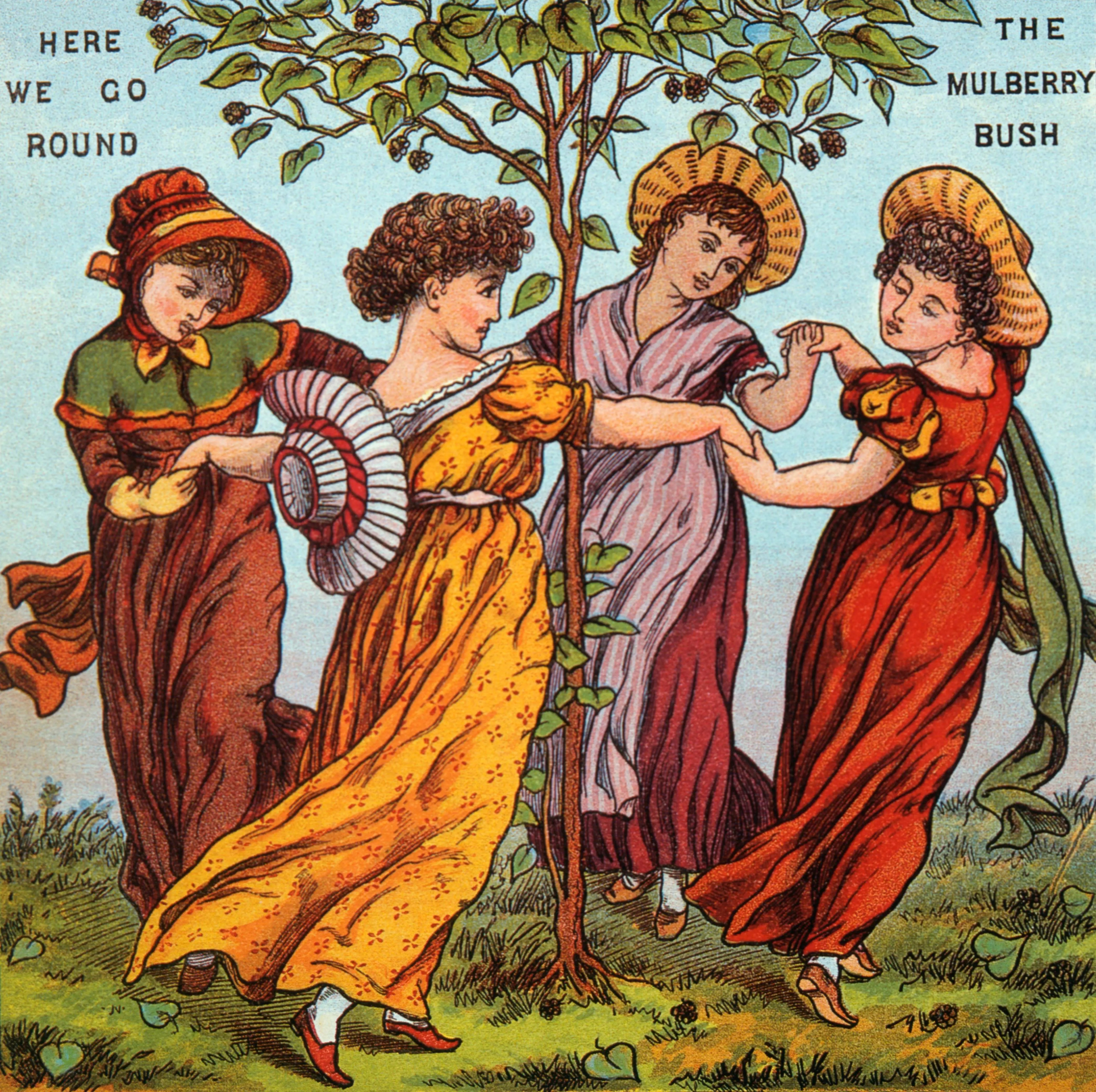
Another possible interpretation of the rhyme is that it references Britain’s struggle to produce silk. Silkworms eat mulberry leaves and during the eighteenth and nineteenth centuries, Britain tried to emulate the success of the Chinese silk production industry. Britain’s cold winters with frost proved to be to harsh for the mulberry trees to thrive and this hampered the development of a successful silk production industry.
The lyrics: “Here we go round the mulberry bush / On a cold and frosty morning” are thought to be a joke about the difficulties experienced by the industry.
About Robbie Cheadle

South African author, photographer, and artist, Robbie Cheadle, has written and illustrated seventeen children’s books, illustrated a further three children’s books, written and illustrated four poetry books and written and illustrated one celebration of cake and fondant art book with recipes. Her work has also appeared in poetry and short story anthologies.
Robbie also has two novels and a collection of short stories published under the name of Roberta Eaton Cheadle and has horror, paranormal, and fantasy short stories featured in several anthologies under this name.
You can find Robbie Cheadle’s artwork, fondant and cake artwork, and all her books on her website here: https://www.robbiecheadle.co.za/
Social Media Links
Bluesky: https://bsky.app/profile/robbiecheadle.bsky.social
YouTube: https://www.youtube.com/channel/UCVyFo_OJLPqFa9ZhHnCfHUA
Goodreads: https://www.goodreads.com/author/show/15584446.Robbie_Cheadle
TSL Publications: https://tslbooks.uk/product-tag/robbie-cheadle/
Amazon: https://www.amazon.com/stores/Robbie-Cheadle/author/B01N9J62GQ
Unsplash profile: https://unsplash.com/@r_cheadle


 LatinosUSA

Deja un comentario