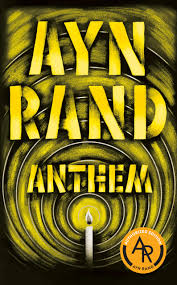
What Amazon says
Ayn Rand’s classic tale of a dystopian future of the great “We”—a world that deprives individuals of a name or independence—that anticipates her later masterpieces, The Fountainhead and Atlas Shrugged.
They existed only to serve the state. They were conceived in controlled Palaces of Mating. They died in the Home of the Useless. From cradle to grave, the crowd was one—the great WE.
In all that was left of humanity there was only one man who dared to think, seek, and love. He lived in the dark ages of the future. In a loveless world, he dared to love the woman of his choice. In an age that had lost all trace of science and civilization, he had the courage to seek and find knowledge. But these were not the crimes for which he would be hunted. He was marked for death because he had committed the unpardonable sin: He had stood forth from the mindless human herd. He was a man alone. He had rediscovered the lost and holy word—I.
“I worship individuals for their highest possibilities as individuals, and I loathe humanity, for its failure to live up to these possibilities.”—Ayn Rand
My review
This book does not have the best plot I have ever read, and neither is it the best written book I have ever read, but it is controversial and makes the reader think. Prior to writing this review I read several of the reviews that had been posted about it. They range from 1-star reviews from people who totally disagree with Ayn Rand’s philosophical viewpoint, to 5-stars from people who have embraced it. For me, a book that results in so much thinking and diverse opinion must be a 5-star read as that is what a book of this nature is all about. It is intended to make the reader think about an extreme social situation.
From a personal perspective, I appreciated the author’s thoughts about a society where everything is for the collective. In many ways it is a lovely thought to have everyone committed to the group as opposed to behaving as individuals, but I firmly believe everyone is different and has different talents, desires, and abilities. Some people are a lot more driven to achieve goals, some of which are for their own financial gain, but there are many people who are driven to achieve personal goals and achieve in areas such as science and maths. Without the academics and thinkers of this world, we would not progress. Progress requires individuality and creativity as well as single minded dedication and determination. Such people are usually obsessive about their areas of learning. If knowledge and learning were to be discouraged and those with a different way of thinking, spurned, our progressive society would soon faulter and we would start reversing as a society in the manner depicted in this book. H.G. Well’s shared similar thinking in his book, The Time Machine, where the future generation has everything it needs to live a happy life resulting in the people having a diminished intellect from lack of stimulation and behaving like young children.
In this book, the main character is a young man called Equality 7-2521 who is forward thinking and academically inclined. He understands concepts much more quickly than his counterparts and suffers for it in the hands of an intolerant schooling system where being more agile minded than others is discouraged. The MC knows he is different from his peers, but he has never known a society different from the one he lives in where there are no marriages, people do not chose partners but are coupled at the discretion of the leadership, children are raised in communes by people other than their parents and everyone is assigned a job regardless of ability. The book hints at the fact that the MC is assigned to be a street sweeper by the leadership in a deliberate move to suppress him and ensure he could not develop his intellectual abilities. It does not work, and the MC discovers a tunnel under the ground which has the remains of an electric railway line and a sophisticated lightening system.
The MC goes against his upbringing and finds a way to hide in the tunnel and study his findings. This results in him rediscovering electricity. This is a story of a return to a dark age where people are held back in the name of the collective good. It is an extreme view, as mentioned previously, but it is necessary to take that stance to demonstrate the author’s point so effectively.
The plot also includes a romance which is forbidden, and which puts a positive spin on the story and provides the possibility of a future generation of people who are free from the shackles of their narrow-minded society and progress can again take place.
Quote from Anthem by Ayn Rand
“The word «We» is as lime poured over men, which sets and hardens to stone, and crushes all beneath it, and that which is white and that which is black are lost equally in the grey of it. It is the word by which the depraved steal the virtue of the good, by which the weak steal the might of the strong, by which the fools steal the wisdom of the sages.
What is my joy if all hands, even the unclean, can reach into it? What is my wisdom, if even the fools can dictate to me? What is my freedom, if all creatures, even the botched and impotent, are my masters? What is my life, if I am but to bow, to agree and to obey?
But I am done with this creed of corruption.
I am done with the monster of «We,» the word of serfdom, of plunder, of misery, falsehood and shame.
And now I see the face of god, and I raise this god over the earth, this god whom men have sought since men came into being, this god who will grant them joy and peace and pride.
This god, this one word:
«I.”
Purchase Anthem by Ayn Rand


 LatinosUSA
Replica a John W. Howell Cancelar la respuesta