
An overview of the book
Hotel on the Corner of Bitter and Sweet is a historical novel written by Jamie Ford. The plot makes use of a dual timeline: one featuring Henry as a 12-year-old Chinese boy growing up during World War II and the other depicting Henry 44 years later as a widow with an adult son.
The storyline revolves around the friendship between Henry, the only son of immigrant Chinese parents living in Seattle, Washington, and Keiko, the daughter of a second-generation Japanese family. Henry and Keiko become friends as the only two Asian children at their elementary school. They are both bullied by their white peers, and they are both expected/forced to work as free labour in the school cafeteria dishing up meals and cleaning up in terms of their scholarships.
When Japan bombs Pearl Harbour and the USA enters the war, the anti-Japanese sentiment in America increases. Henry’s father, who only speaks Cantonese and who despises the Japanese because of the Japanese invasion of the Chinese province of Manchuria in 1931 and the impact it had on Henry’s father’s life, is concerned about his son’s safety. He forces Henry to wear an “I am Chinese” badge so that he isn’t mistaken for Japanese. Henry’s father is ardently anti-Japanese and Henry hides his friendship with Keiko and her family from him.
As the war progresses, the anti-Japanese sentiment in America increases and all people of Japanese ancestry are viewed as potential spies and war criminals. This culminates in the US government ordering all the people in Japan Town where Kaiko lives (adjacent to China Town where Henry lives) to relocate to internment camps.
Keiko’s family is transferred temporarily to Camp Harmony, a temporary internment facility on the Western Washington Fairgrounds in Puyallup, Washington. Henry is able to visit her through a collaboration with the lady who runs the cafeteria at his elementary school. He assists her in serving meals to the internees on a Saturday.
Eventually, Keiko’s family is transferred to the Minidoka internment camp in Idaho. Henry visits her there once with an older musician friend and they become betrothed. They agree to wait for each other and to write to each other.
Sadly, due to Henry’s father’s fanatical anti-Japanese attitude, this never turns out as planned and Henry loses touch with Keiko.
The second timeline features Henry as an older man with a grown son, Marty, who is studying at the local college. Henry wife, Ethel, has passed away from cancer and he is living alone. One day, Henry learns that the possessions of several Japanese American families who were forced to leave Japan Town have been discovered in the basement of the Panama Hotel. Henry goes to the hotel to investigate as he believes that some of Keiko’s families stored possessions might still be there. Henry has never forgotten Keiko even as he cared for his critically ill wife, but he kept his thoughts to himself. He eventually finds the courage to confide in Marty and his fiance about Keiko.
In summary, this book is about how warfare effects the lives of everyday people and civilians living away from the front lines. Keiko and Henry’s lives are both turned upside down due to the culture of fear, anger, and animosity that dominates during times of war.
Although the temporary and permanent internment camps where Keiko and her family live are both featured in this book, the camps are not a main character as is the case in some books about similar topics.
Dark origins
Hotel on the Corner of Bitter and Sweet revolves around the forced internment of Japanese American citizens during WW2.
During WW2, the US government forcibly relocated and incarcerated approximately 125,000 people of Japanese descent in 75 different internment facilities. Of those interned, approximately 67% were American citizens. The internments were undertaken as a result of Executive Order 9066 signed into effect by President Franklin D. Roosevelt. This order allowed regional military commanders to designate ‘military areas’ from which ‘any or all persons may be excluded’. People of Japanese ancestry were forced to leave Alaska, California and parts of Oregon, Washington and Arizona on the strength of this order.
Japanese Americans were initially prevented from participating in the military, but in 1943 this was changed and 20,000 Japanese Americans fought in the war on behalf of America. According to Hotel on the Corner of Bitter and Sweet, the internees volunteered for military services to prove their loyalty to their new country.
I was interested to learn that by 1992, the US government disbursed $1.6 billion in reparations to 82,219 Japanese Americans who had been incarcerated.
These are a few pictures that correlate with the content of this book taken from https://www.history.com/topics/world-war-ii/japanese-american-relocation
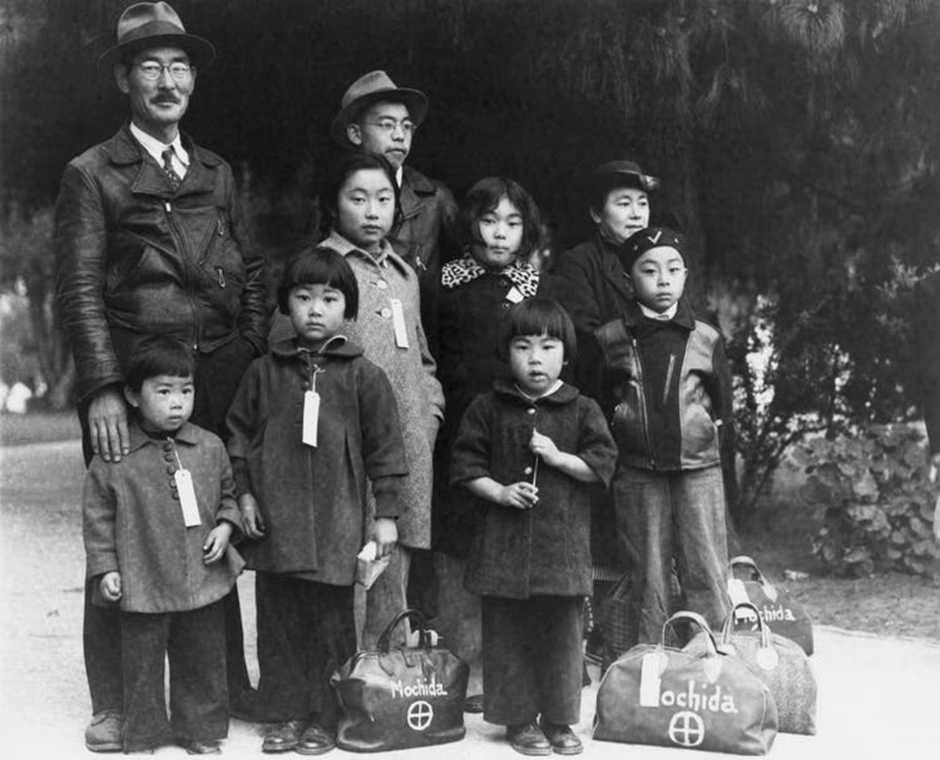
The Mochida family featured in this picture were among the thousands of Japanese-Americans forced into internment camps during WWII https://www.history.com/topics/world-war-ii/japanese-american-relocation
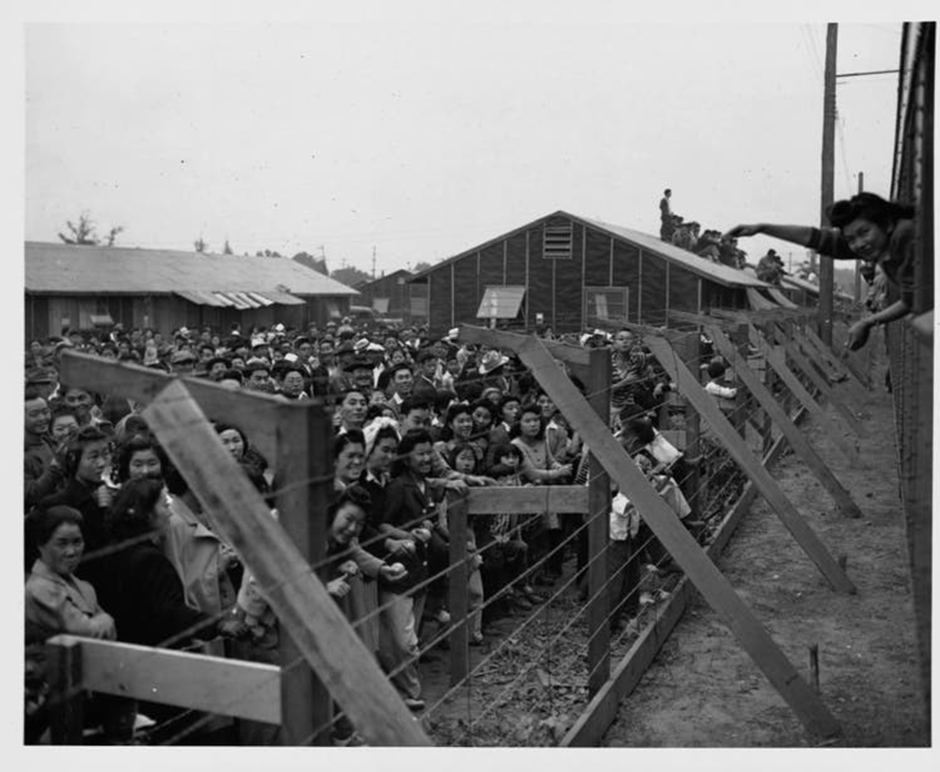
Japanese Americans incarcerated in crowded conditions in Santa Anita. https://www.history.com/topics/world-war-ii/japanese-american-relocation
A few powerful quotes from Hotel on the Corner of Bitter and Sweet
“The hardest choices in life aren’t between what’s right and what’s wrong but between what’s right and what’s best.”
“Henry, this isn’t about us. I mean it is, but they don’t define you by the button you wear. They define you by what you do, by what your actions say about you. And coming here, despite your parents, says a lot to them- and me. And they’re Americans first. They don’t see you as the enemy. They see you as a person.”
“The more Henry though about the shabby old knickknacks, the forgotten treasures, the more he wondered if his own broken heart might be found in there, hidden among the unclaimed possessions of another time. Boarded up in the basement of a condemned hotel. Lost, but never forgotten.”
“Henry looked up and down the empty avenue—no cars or trucks anywhere. No bicycles. No paperboys. No fruit sellers or fish buyers. No flower carts or noodle stands. The streets were vacant, empty—the way he felt inside. There was no one left.”


 LatinosUSA
Replica a T. W. Dittmer Cancelar la respuesta