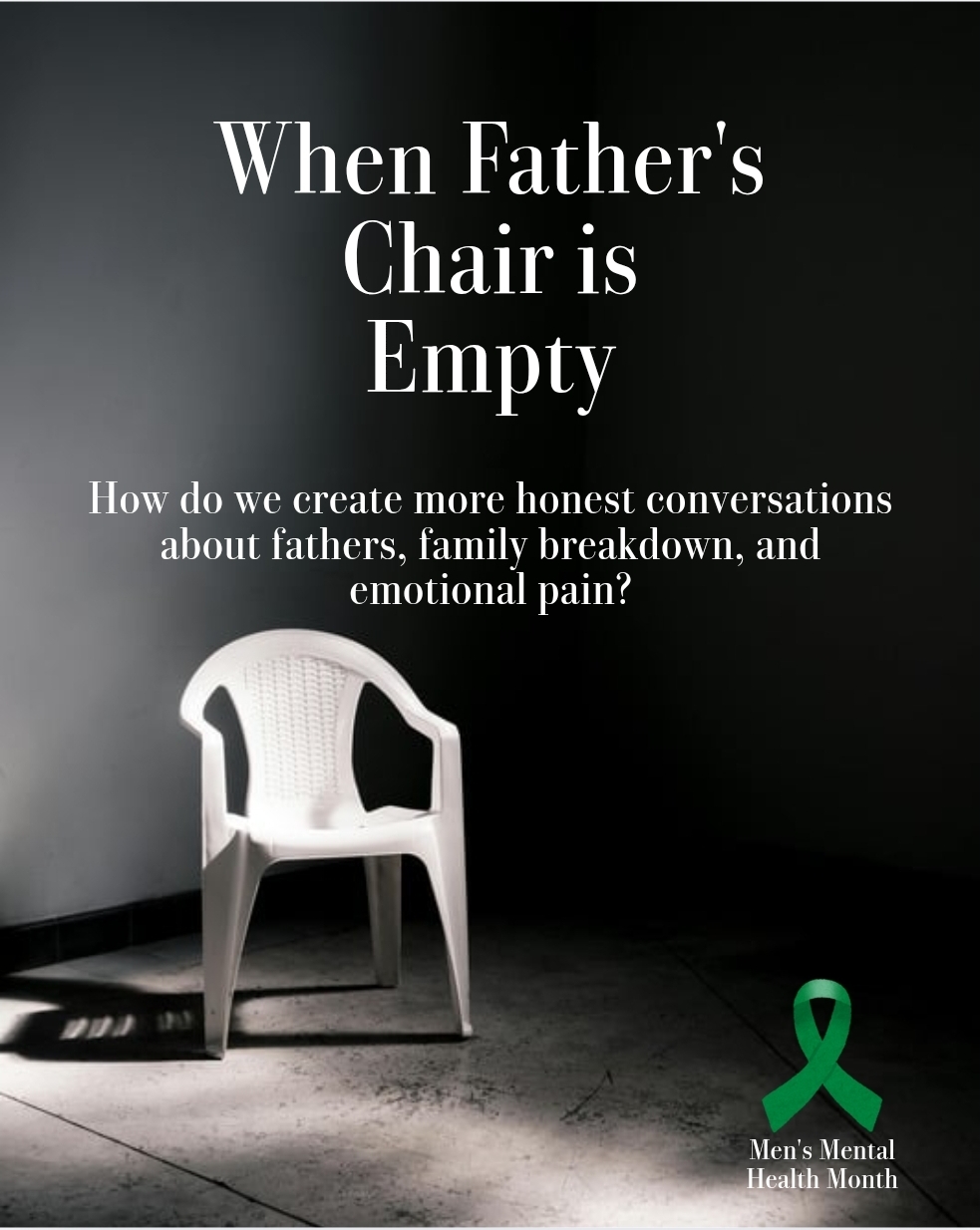
«When Father’s Chair is Empty» By Nigel Byng
About this time last year, I watched two families dear to me begin to unravel under the weight of broken marriages. My first thought was for the children: their confusion, anxiety, and quiet self-blame when a father leaves the home. But I also began to see another grief, quieter and often less spoken: the grief of a father who still loves his children deeply, yet can no longer tuck them in at night, hear their questions from the next room, or wake up under the same roof as the lives he helped bring into the world. Telling them “Jesus cares” is true, but the truth can feel far away when a family’s whole world has been disrupted.
As devastating as the fallout was within the home and eventually the church, I wondered how the church family could and should respond to the brothers involved. Neither had been accused of infidelity or violence, and both wanted to remain present in their children’s lives. They were not asking the church to bless brokenness. They were asking whether there was still room for a father whose chair at the dinner table was now empty, whose children’s laughter would come in fragments, and whose love had to travel through phone calls, scheduled visits, and prayers whispered from a distance.
That raised a difficult question: Can the church uphold the sanctity of marriage while also ministering wisely and compassionately to families whose homes have already broken? As Bible-believing Christians, we cannot treat marriage casually. Scripture presents marriage as a covenant: “the two shall become one flesh” (Genesis 2:24), and Jesus reminds us that what God joins together should not be treated carelessly (Matthew 19:6).
Yet homes can break. Love can become buried under resentment, silence, exhaustion, fear, and hurtful accusations. Divorce is not merely paperwork; it is a wound. It disrupts family rhythms, reshapes childhood memories, and brings grief to everyone involved. For a father who has tried to be present, the loss can feel like a daily bereavement: missing ordinary moments, hearing about milestones after they have happened, and carrying the ache of being near in love but far in daily life.
The facts are sobering, though divorce statistics must be handled carefully because studies measure different things. Still, available research points in the same pastoral direction: divorce is present among Christians, too. These numbers should not be used to shame believers; they should awaken the church to the wounded families already sitting in its pews.
A father may leave the house to preserve the peace and still ache to remain a father. He may drive away with a numbing pain and tears he does not know how to explain. He may sit in a quiet apartment where bedtime stories, school uniforms, spilled cereal, and Saturday morning noise used to be. But fatherhood is not measured only by residence. It is measured by faithful presence, love, protection, prayer, provision, repentance, where needed, and the refusal to let bitterness become a child’s inheritance.
I am not excusing sin, abuse, abandonment, or irresponsibility. Christian compassion must never cover harm. Where danger exists, protection must come first. Where there has been moral failure, repentance is necessary. But pastoral care must also make room for fathers who are grieving, still showing up, and still trying. Some fathers carry their loss quietly because they fear that naming their pain will sound like self-pity or an attempt to avoid responsibility. The church should be a place where pain can be confessed honestly, where women are protected and believed, children are not forced to carry the burden of adult conflict, and fathers pursuing peace are not treated as though their grief is invisible.
When divorce happens, Christian families need more than judgment. They need prayer, accountability, trauma care, counsel, co-parenting support, and a theology of peace. A grieving father does not need the church to minimize the pain his children feel; he needs help loving them faithfully through it. He needs brothers who will call him higher, sisters who will pray without feeding bitterness, and a church family that remembers reconciliation, where possible, begins with humility, truth, and peace. Paul writes, “God has called us to peace” (1 Corinthians 7:15). That peace does not mean pretending everything is all right; it means refusing to let brokenness have the final word.
A father may no longer live in the home, but he can still choose to be present in the heart. He can apologize, call, pray, bless, provide, remember birthdays, attend school events when permitted, speak well of the other parent, and pursue peace even while his own heart is breaking. His love may now have to cross distances, schedules, and painful boundaries, but distance does not have to become disappearance. And where any parent has been absent, inconsistent, wounded, or unable to give what a child needs, God is not absent. Scripture tells us He is “a father to the fatherless” (Psalm 68:5), that He “heals the brokenhearted and binds up their wounds” (Psalm 147:3), and that when father and mother forsake us, “the Lord will receive” us (Psalm 27:10).
Marriage is sacred. Divorce is painful. Children are precious. Fathers can grieve deeply. But brokenness does not get the final word. In the hands of a gracious God, even the wound of separation can become a place where repentance, tenderness, and healing begin.
© Nigel Byng, 2026. All Rights Reserved.
Writer, poet, storyteller, Byng’s words move from quiet domestic moments to global, socially conscious truths. His stories and poems explore love, memory, morality, and the human experience with lyrical precision and emotional punch. Contributor to top anthologies and creator of the Exploring Poetry series, his debut collection, The Drifter, The Prodigal, The Last Son, is one to watch.


Deja un comentario