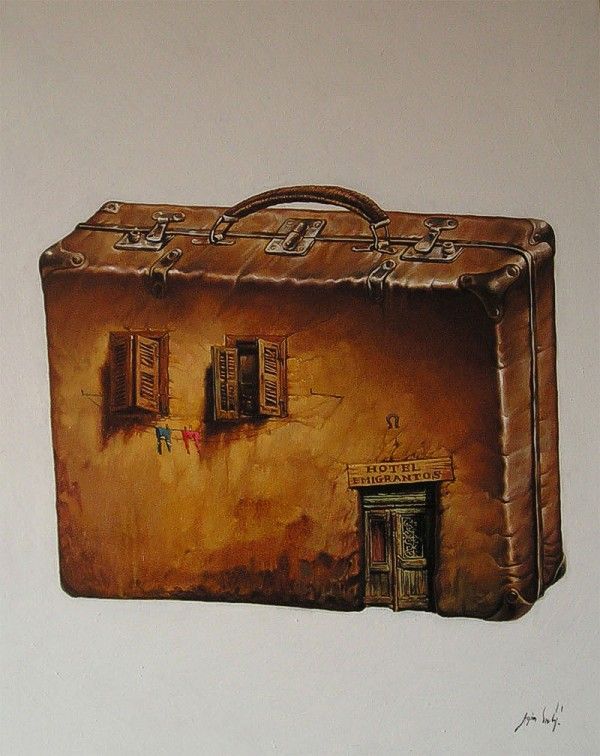
By Rafael Julivert Ramírez. The forthcoming book, The Portable Homeland, analyzes the published work of J. Ré Crivello. Rafael Julivert is an AI Editor (Barcelona, 1967) and an author and popularizer interested in artificial intelligence, philosophy, and the digital humanities. He has written several essays on the social and ethical impact of AI, as well as on contemporary technological transformation.
Chapter 24: What Writing Means for Ré Crivello
Having gathered the seven characteristics, one might ask what the very act of writing means for this writer; and the answer, once one has explored his work, proves unexpectedly simple. For Crivello, writing is building and inhabiting a house. It is not expressing oneself, nor denouncing, nor even, in the first instance, communicating: it is raising a roof. Adorno wrote in Minima Moralia, that book also born in exile, that for those who no longer have a homeland, writing becomes a place to live, and that in their text, the writer establishes their home.13 The phrase seems dictated for Crivello. He who was abandoned in other people’s houses, who lived in ghost hotels in Rome and in Barcelona’s Barrio Chino, who only in his thirties bought a landing, found in the page the only dwelling he could furnish to his liking and that traveled with him.
That house, in his work, has three forms or three floors, which are in reality a single refuge seen from three windows: the bar, the internet, and the page. The bar is the first and the oldest. La Rambla, the Turkys in Vilanova, the terrace where he writes in the mornings: for Crivello, the café is not the bohemian stage of literature, but his office and his parish. It is the place where Hannah Arendt is read «in the bar» and not in the seminar, where high culture is placed at the service of a «village ambition,» of the humble and human scale of things. The bar is the secular version of the Hotel Patria: a place of passage where, nevertheless, one has one’s place, one’s table, one’s time. Cacciatore saw this from the beginning when he called that first Facebook «a café with no other perfume than that of ideas.»
The internet is the second refuge, and it is the expansion of the bar on a planetary scale. The blog that restores the feuilleton, the five weekly articles, the eight hundred thousand visitors, Masticadores with its four hundred and fifty writers in six languages: the internet is the café that can be entered from anywhere in the world, the portable agora of the writer far from any center. And it is also a house with two bosses—the writers and the readers—an organized hospitality, the alternative institution of those excluded from institutions. If the bar is the place for conversation, the internet is the place where the conversation never cools, where the soup—to use the food metaphor that runs throughout his work—stays warm because there’s always someone on the other end.
The webpage, in short, is the third refuge, the one that contains the other two, because both the bar and the internet end up becoming a webpage. It’s the place where what the bar said and the internet disseminated is stored, the house of words proper, the one that survives crashed servers and dead URLs. On the webpage live the dead to whom we continue to speak, the characters with initials who migrate from one book to another, the grandmothers with whom we dream of conversing in Piedmontese through a machine. The webpage is the only homeland that doesn’t expel anyone: not the burned book of Quixotic scrutiny, because Crivello doesn’t burn any books; nor the full name, because no one is required to have their papers in order.
It’s important to see that these three refuges don’t follow one another chronologically, as if the writer had moved from the bar to the internet and from the internet to the page, but rather that they coexist and feed off each other. The very act of writing an article on a terrace in the morning, uploading it to Masticadores at midday, and collecting it in a Fleming book a few years later describes the complete journey of a Crivellian text: it’s born in the bar, circulates online, and settles on the page. This triple residence is the material form of his portable homeland: a house with a street entrance—the café, open to the street and to conversation—a service entrance that opens onto the entire planet—the internet—and an inner room where lived experience is preserved—the page. None of the three would suffice on its own. The bar without the page would be mere chatter carried away by the wind; the page without the bar would be literature without substance, without the murmur of the voices that gave it life; the internet without the other two would be noise. Together they form a complete dwelling, with its threshold, its passageways, and its intimacy.
It’s also important not to idealize this refuge. A house made of words also has its constraints, and this book hasn’t hidden them: the urgency that produces typos also produces disjointed sentences and stereotypes; the hospitality of the internet coexists with the lack of a filter, with the book that no one could advise against; the prolific output of someone who writes five articles a week sometimes leads to repetition and padding. Crivello himself, insightful, stated it without excuse: when no one can say no, the book becomes a state of writing rather than a finished work. The portable homeland is habitable, but not comfortable; it has leaks, unplastered walls, mismatched furniture. It is, precisely, the house that can be built by someone who constructs alone, in haste, and with whatever materials are at hand. And it is precisely this accepted precarity—not disguised beneath the veneer of skill—that makes it a first-rate human document, even before it is an aesthetic achievement.
Hölderlin wrote that man inhabits the earth poetically, and the phrase has been quoted so often that it is best used with the same restraint with which Heidegger glossed it: not as an embellishment, but as a description of a way of being.14 To inhabit the earth poetically, in Crivello’s case, is neither ethereal nor sublime. It means, quite concretely, that a man without a stable homeland, without a single language, without complete legal status for much of his life, made writing the firm ground beneath his feet. The page was his plot of land, his cadastral area; the thirty square meters that, according to him, are enough to be happy or to plummet. That is why his work does not aestheticize exile—Said warned against that temptation, against turning the exile’s wound into a postcard of melancholy—but rather manages it, furnishes it, makes it habitable.15 The portable homeland is not a poetic consolation: it is a survival strategy. He writes because he needs a home, and this was the only one within his reach.
There is also a fidelity in this that deserves to be highlighted. Walter Benjamin, in his essay on the storyteller, lamented the extinction of that figure who knew how to give advice because he had experience to transmit, the craftsman of the spoken word whom the information industry had rendered obsolete.16 Crivello is, against all odds, a storyteller of that lineage who reappears in the medium that seemed to have killed it. He tells stories because he has lived—the trades, the journeys, the dead, the inherited hunger—and because he still believes that storytelling serves a purpose, even if only to keep the soup from getting cold. The fact that it happens on a screen, with typos and hashtags, doesn’t distance it from the old storyteller by the fire: it brings it back. The digital serial is the portable fireplace of the global villager.
Notes:
1. The expression “portable homeland” (ein portatives Vaterland) comes from Heinrich Heine, Confessions (Geständnisse, 1854), where he applies it to the Hebrew Bible as the transportable home of the Jewish people in the Diaspora. The formula has become widely used as a symbol for all literature of exile; this book has taken it, from its title, as the central hypothesis for reading Crivello’s work.
2. The reading of exile as a productive condition, and not only as loss, runs through the tradition that extends from Edward W. Said, Reflections on Exile (in the volume of the same name, 2000), to George Steiner, Extraterritorial (1971), by way of Benjamin’s notion of transmissible experience. This first thesis encapsulates the entire study; for its development in stages, see chapters one, two, and twenty-three.
3. Regarding programmatic incompleteness as a poetics, the foremost model in Spanish is Macedonio Fernández, *Museo de la Novela de la Eterna* (posthumous, 1967), with its endless prologues and its deliberately «unfinished» work. The distinction between passive misprint and significant imperfection was established in Chapter Seventeen, to which the reader is referred for the catalogue details.
4. For full heteronymy, see Fernando Pessoa and Bernardo Soares’s *Libro del desasosiego*; for the signature as threshold, Gérard Genette, *Umbrales* (Seuils, 1987). The characterization of «weak heteronymy»—the author who becomes blurred without fully splitting into two complete persons—was argued in Chapter Three.
5. The lineage of elegiac dialogue with the dead ranges from Petrarch’s Familiares to Cicero’s Mourning Diary by Roland Barthes (posthumous, 2009), by way of C. S. Lewis’s A Grief Observed (1961). Crivell’s device of glossing the digital archive of the deceased was analyzed in Chapter Eight in relation to Memoirs of a Stupid Man.
6. The opposition between the canon as duty and the library as discovery engages with Harold Bloom’s The Western Canon (1994) and The Anxiety of Influence (1973), refuted in practice by an intertextuality without hierarchies whose ultimate model is Flaubert’s Bouvard et Pécuchet (posthumous, 1881). This is developed in Chapter Twenty.
7. Walter Benjamin, «The Author as Producer» (1934): the writer who intervenes in the means of production of literature instead of merely supplying them. Crivello’s material trajectory—from the El País blog to Fleming and Masticadores—was studied in this light in Chapter Four.
8. Pierre Bourdieu, The Rules of Art (1992), for the notion of the literary field and the instances of consecration. The critical silence surrounding Crivello was interpreted, already in Chapter Four, as a structural fact—the position of the writer outside the field—and not as an aesthetic verdict.
9. John Ruskin, “The Nature of Gothic,” in The Stones of Venice (1851–1853): the imperfection of Gothic carving as a sign of the artisan’s freedom in the face of the servile perfection of the machine. The image of the crooked gargoyle formed the backbone of Chapter Seventeen.
10. On the Romantic fragment as “project and ruin,” the fragments from Friedrich Schlegel’s Athenäum (1798–1800), in particular the famous fragment… 206 (the fragment “complete in itself like a hedgehog”); for the fusion with the moral aphorism and the hashtag, see Chapter Eighteen, with Lichtenberg, La Rochefoucauld, and Gómez de la Serna.
11. The tradition of the literary tombeau, from Stéphane Mallarmé (Pour un tombeau d’Anatole) to Jorge Manrique’s Coplas, was discussed in Chapter Eight; the displacement of the genre to the digital medium—the Facebook archive as the subject of the elegy—is the properly Crivellian twist.
12. Gilles Deleuze and Félix Guattari, Kafka: For a Minor Literature (1975): the major language deterritorialized from within by a “minor” use. Crivello’s interlanguage—Rioplatense, Catalan, Italian, and English—was analyzed as a case of minor literature by a single speaker in Chapter Two.
13. Theodor W. Adorno, Minima Moralia: Reflections from Damaged Life (1951), aphorism 51, “Asylum for the Homeless”: “For those who no longer have a homeland, writing becomes a place to dwell” (in the original, Wohnen). The book, written in Californian exile, is one of the great documents of the exiled consciousness of the 20th century and offers the precise, learned counterpoint to Crivell’s “house of words.”
14. Friedrich Hölderlin, the line “dichterisch wohnet der Mensch auf dieser Erde” (“Poetically, man dwells on this earth”), from the late poem “In lieblicher Bläue…”; Martin Heidegger glossed it in the lecture “…Poetically, man dwells…” (1951), collected in Lectures and Articles. It is used here with the restraint that the subject demands, to name a concrete, not sublime, way of dwelling. 15. Edward W. Said, Reflections on Exile,


Deja un comentario