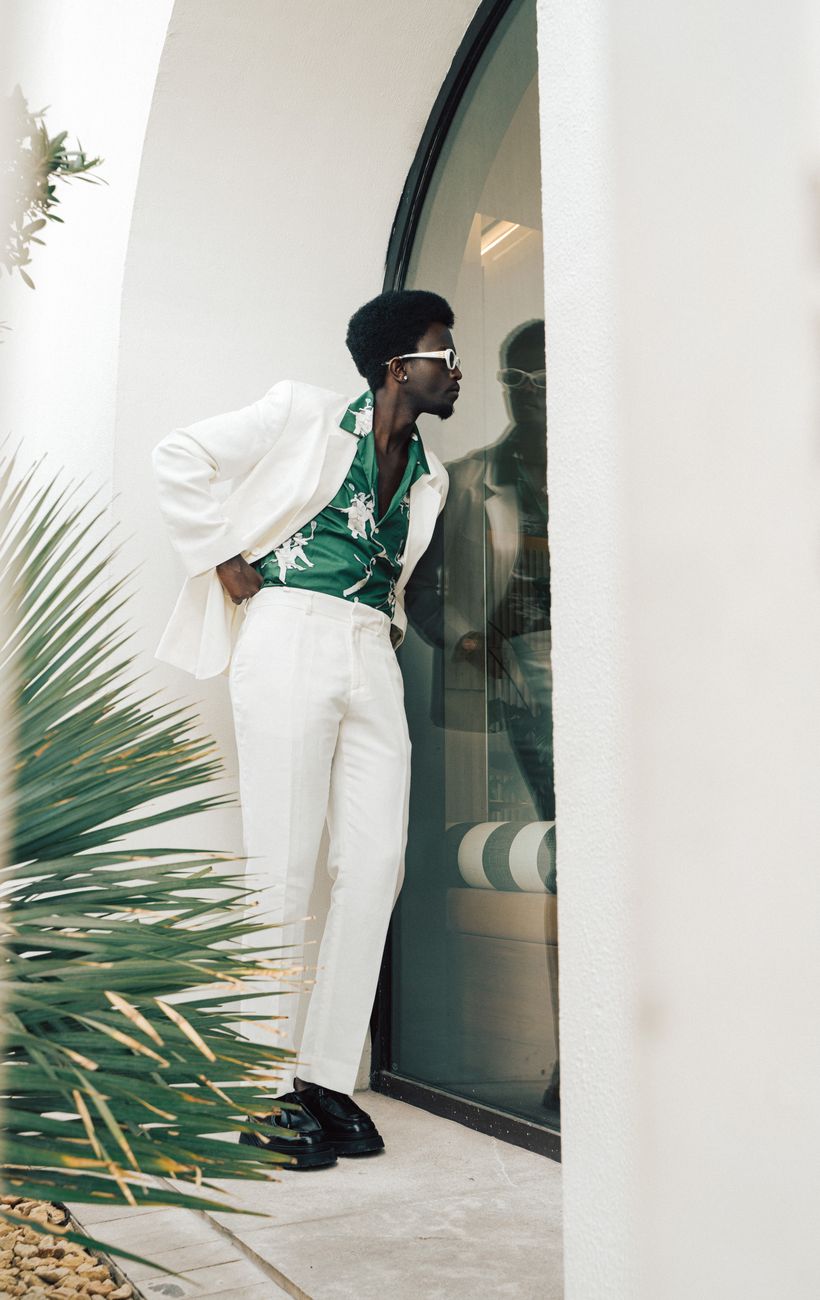
Wearing a business suit without a tie is trendy nowadays. Like most other sartorial practices that are trendy nowadays, it is strikingly unattractive. A man wearing a business suit without a tie looks like he has just been released from jail after having been hauled in with a snoot-full the night before, and divested of his tie in order that he not hang himself–unless he buttons his top button, in which case he resembles an Iranian politician. Not surprisingly, the tie-less look is often favored by the same men who don’t realize that gray stubble doesn’t make a man look sexy, sporty, and simpatico, but rather like a homeless inebriate.
With each of these two practices, the men in question are telling us something. Those of the gray-stubble cohort are unwittingly telling us that they are mistaken about what chicks dig. The suit-with-no-tie brigade is telling us that men want clothing that enables them to be somewhat dressed up but still comfortable, using pieces other than going tieless with a traditional sportcoat and slacks. They want to respect their surroundings and the occasion, in an increasingly casual society, without feeling physically restricted.
We have been here before.
The leisure suit, popular with fashion victims for about half a dozen years in the 1970s and with the severely afflicted until friction-pilled polyester became a fire risk, is one of the most maligned fashion phenomena of all time. It is the Edsel of the garment industry.
This writer remembers it with horror, particularly because the assistant principal of his middle school–a truly wonderful man–draped his paunchy but otherwise angular ex-basketball-player frame in an ensemble of electric-blue hue. Accessorized with a paddle the size of Odysseus’s oar, it was impressive in its way, but not a source of aesthetic pleasure or fond memory.
The leisure suit deserves better. It was a good idea, but, like the victims of Jack Ketch and condemned prisoners in Tennessee, it was badly executed.
Let us first establish what a leisure suit is not. John Travolta did not wear a leisure suit in Saturday Night Fever, no matter how many times ill-informed people say he did. His suit was a ‘70s-cut three-piece business-type suit in ‘70s-style polyester. The same is true of the pastels worn by the Lawrence Welk Champagne Music Makers in those days. Being overtly ‘70s doesn’t make a suit a leisure suit.
A leisure suit is an ensemble of matching trousers and lapel-less jacket with shirt-type collar points. The jacket hem is straight, lacking the frontal upsweep toward the buttons that one sees with single-breasted suits and sportcoats. The jacket is worn open over a tie-less dress shirt or perhaps a turtleneck. Shoes ideally are a bit more casual than outright dress shoes, but not too much, well-polished loafers are usually a sound choice.
Some perspective is in order. The leisure suit was ludicrous, but so was most of the clothing worn by ordinary Americans in the 1970s, particularly the voguish fare. Lurid colors and cheap synthetics were the order of the day. I see a photo of a man in a leisure suit, and I understand what he and the designer of the outfit were trying to do. I cannot get there with the belly-warmer neckties, sprawling lapels, dagger-like shirt collars, maxi and midi skirts, cascading sleeve ruffles. and platform shoes of that decade. Give the leisure suit a break.
Thomas Hine’s history of ‘70s styles and fads, The Great Funk, treats the leisure suit and its wearers with kindness:
Those who bought it acknowledged that times had changed and the old rules no longer applied. They didn’t necessarily want to turn back the clock, but they didn’t want anarchy either. Besides, there are real advantages to suits. They simplify the lines of the body and take attention away from potbellies and spare tires…Photographs of men in leisure suits are poignant because they show us men who are trying to move into a new kind of society even as they are anchored to the old.
In other words, the leisure suit was an honest attempt to adjust to new realities while maintaining standards. Heaven knows we don’t see enough of that in our day.
Giorgio Armani, may he rest in peace, took us some distance in the ‘80s toward elegant comfort, with his drapey suits, jackets, and trousers for men, though admittedly the shoulders grew a bit too wide and the trousers too billowy. Then it all dissolved into Miami Vice jokes and the mindless embrace of whatever people supposedly were doing in the Pacific Northwest or inner city in the ‘90s. The need is still there, and an attempt to address it, and like most makeshifts, the result isn’t very appealing.
Alternatives to the traditional suit never quite caught on. If you’ve seen Jack Lord’s ill-advised attempt at the Kariba suit in the latter seasons of Hawaii Five-O or a clip of Werner Klemperer in a Nehru tuxedo accepting an Emmy, you understand why. But the leisure suit deserves another chance.
There’s no reason why the leisure suit can’t be brought back with straight or slightly tapered legs, a tidy collar, and tasteful fabrics in black, navy, and various shades of gray, tan, and taupe. It would be comfortable without looking like the wearer has just emerged from the slammer or is trying to be cool and can’t bring it off.
Today’s American male presents himself as a childish slob, for the most part. He might, just might, do a tiny bit better if we gave him the opportunity to gussy up slightly but not completely, and if his woman insisted on it. Her judgment couldn’t possibly be worse than that of the various jocks, clowns, and demagogues he emulates. It shouldn’t be an insurmountable task to smarten men up without asking them to dress like their grandfathers. I’m on their grandfathers’ side, but when I’m out and about on Halloween, people ask me who I “are.”
Americans today look awful, and men in public life who eschew the tie with the business suit are not helping. My friends, there is a better way, and the journey begins with the admission that the Edsel was really a pretty good car, designed for a particular market niche, that deserved better from its creators.
Bring back the leisure suit, and do it right this time. I’ll take mine in a nice medium gray.
Previously published in Humor Times
Deja una respuesta