Two hundred years ago, 22-year-old John Keats (1795-1821) returned from a walking tour in the Lake Districts and Scotland with some friends, during which he had begun to show symptoms of the tuberculosis that would kill him within three years.
It was 1818: during that year Keats’s health began to fail and his financial difficulties deepened as his brother Tom also was battling tuberculosis and another brother’s poor investment had left him penniless. The one bright spot in his life was his fiancée, Fanny Brawne.
Keats, the eldest of five children born to a lower-middle-class family in London, had worked at a hospital in London as a junior apothecary and surgeon in charge of dressing wounds, but had abandoned medicine to devote himself to poetry.
Progressive tuberculosis, a family disease, led him to Italy hoping a warm climate would ease his condition. He died in Rome in an apartment overlooking the Spanish Steps, when he was only 25 years old.
According to some researchers, mercury was the cause of his death: he had poisoned himself with the disastrous medical treatments of the time
Keats had been a skilled physician, fully aware of the dangers of old-fashioned treatments such as letting blood, cupping and blistering, and – most lethal of all – mercury. But when he abandoned medicine to pursue his poetic career, he neglected the deadly effects of the cures with which he was treating himself: the use of mercury for an unspecified ailment, probably a venereal disease. Back in London in August 1818 his prolonged recourse to mercury had already poisoned him. It was in this vulnerable state that he spent considerable time nursing his dying brother and, as a result, he contracted the tuberculosis that sent him to an early grave.
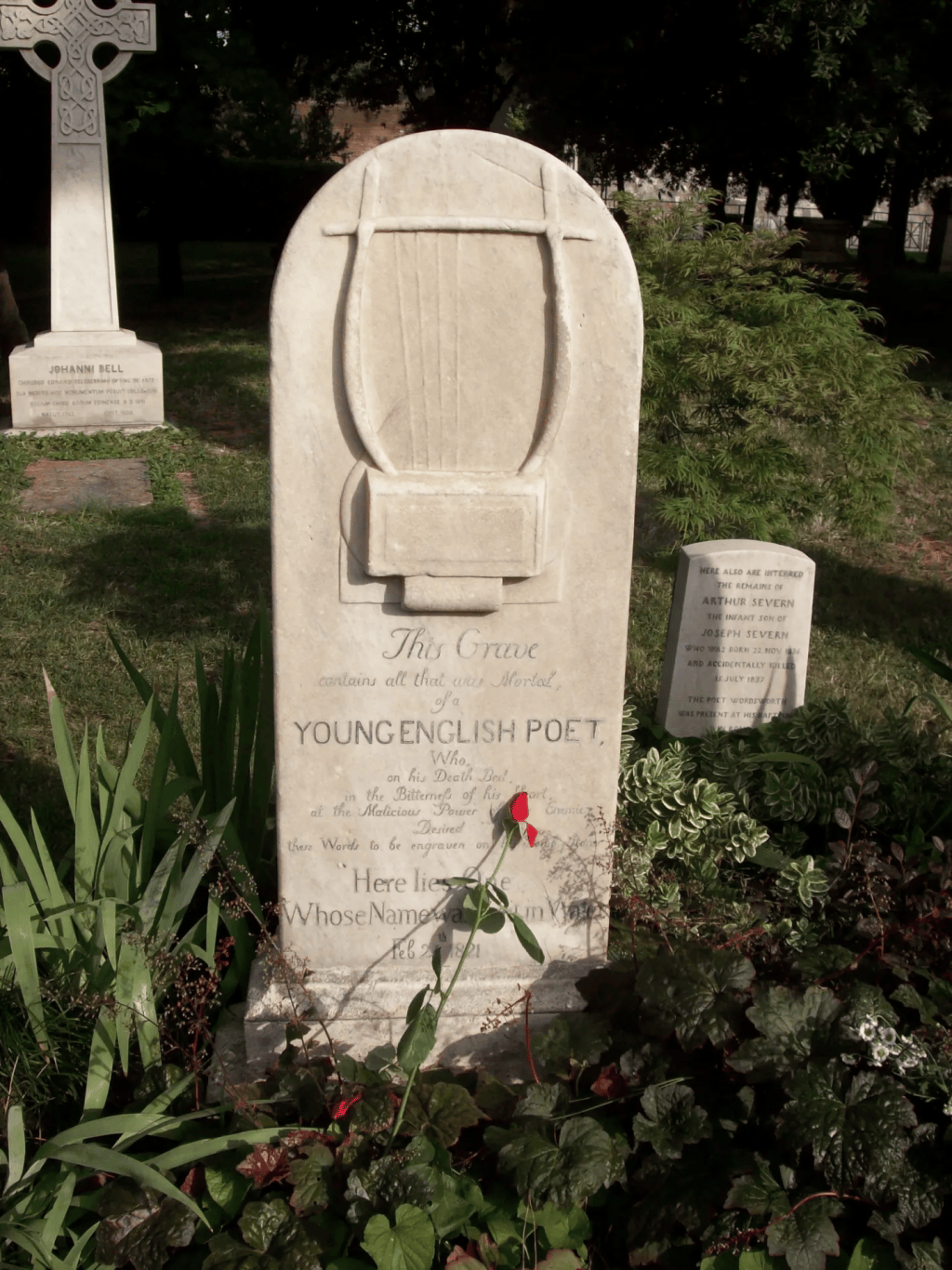
Keats expressed the wish that on his tombstone no name or date should be written, only the inscription ‘Here lies one whose name was writ in water’
The full inscription on his gravestone in the Non-Catholic Cemetery of Rome, reads:
This Grave
contains all that was Mortal,
of a
YOUNG ENGLISH POET,
Who
on his Death Bed,
in the Bitterness of his Heart,
at the Malicious Power of his Enemies
Desired
these Words to be engraven on his Tomb Stone:
“Here lies One
Whose Name was writ in Water.”
Feb 24 1821


Deja un comentario