Synopsis
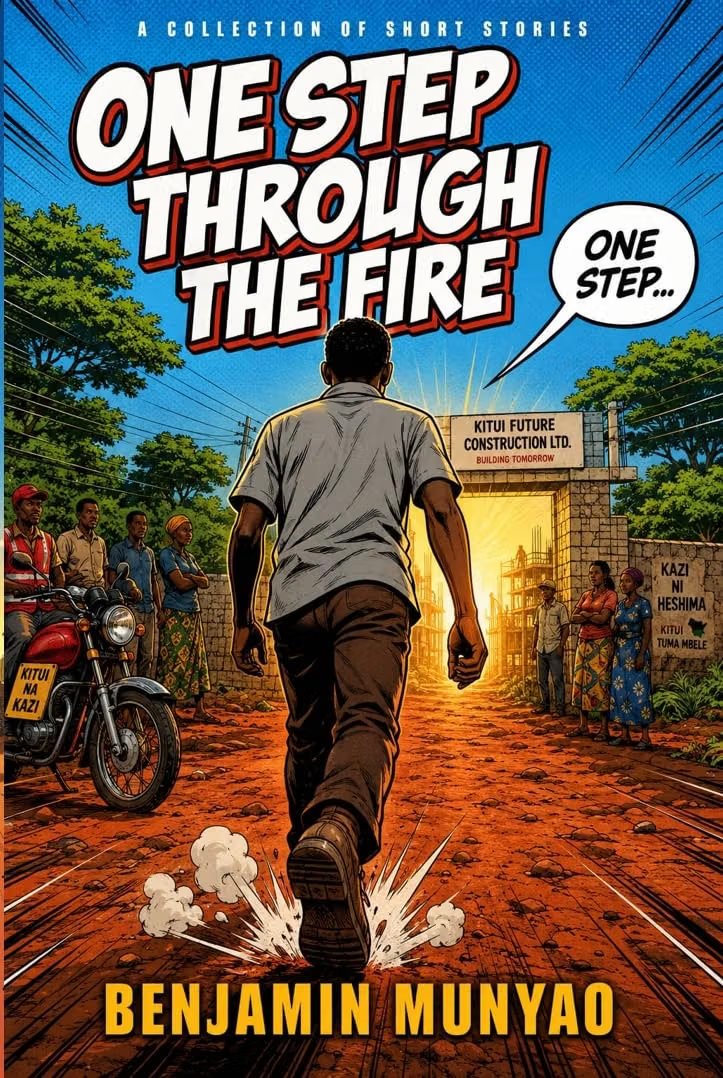
ONE STEP THROUGH THE FIRE is a collection of deeply human stories about resilience, family, fear, memory, hardship, hope, and the courage to keep moving forward.
The stories move across different emotional and imaginative landscapes. Some are rooted in the realities of poverty, family responsibility, education, illness, work, and the determination to build a better life. Others explore memory, identity, uncertainty, and the mysterious boundaries between what we believe is real and what we fear may be true.
The title story, “ONE STEP THROUGH THE FIRE,” follows Mwendwa, a young man carrying the weight of his family’s struggles. His younger brother, Kyalo, risks losing his education because of unpaid school fees, while their mother Mueni battles illness. When Mwendwa receives an opportunity at a construction site, he must confront not only poverty but also his fear of failure. With encouragement from those around him, he takes one step forward—and that step becomes the beginning of transformation.
Another story, “FADING MEMORIES,” enters a very different world. A narrator suffering from a mysterious condition begins losing his memories and discovers recordings suggesting that his memories are not simply disappearing—they may be deliberately altered. As his sense of identity begins to fracture, he must fight to preserve the one thing that may still belong entirely to him: his own voice.
Together, these stories ask questions about what remains of us when life takes away the things we thought defined us.
I wrote this book because I believe some of the most powerful stories come from ordinary people—people whose struggles may never make headlines, whose sacrifices may remain unseen, but whose lives contain extraordinary courage and humanity.
My experiences of rural life, hardship, community, family, and perseverance have deeply influenced my writing. I hope these stories can carry voices and experiences from places the world may rarely notice into a wider conversation.
Most of all, I hope readers will find something of themselves in these pages—and perhaps discover the courage to take their own next step.
Sample 1 “ONE STEP THROUGH THE FIRE”
The sun rose slowly over the dry hills of Kitui, casting long shadows across the cracked earth. For Mwendwa, mornings used to carry promise. Now, they carried weight.
He stood outside their small house, arms folded, watching his younger brother Kyalo struggle with a torn school bag. The strap had been stitched and restitched so many times it barely held together.
“Let me see that,” Mwendwa said, stepping closer.
Kyalo pulled it back slightly. “It’s fine.”
“It’s not fine.”
“It’s good enough,” Kyalo replied, his voice low but firm.
Mwendwa paused. That tone—it wasn’t disrespect. It was something else. Something heavier.
“Teacher said I shouldn’t come back without fees,” Kyalo added, avoiding his brother’s eyes.
Mwendwa exhaled slowly. “You’ll go. I’ll sort it.”
Kyalo didn’t argue. But he didn’t believe him either.
Inside the house, Mueni coughed again—a deep, rattling cough that seemed to shake the walls. Mwendwa turned immediately and stepped inside.
She lay on a thin mattress, her face pale but her eyes still sharp.
“You should be resting,” she said.
“I will,” Mwendwa replied. “After I fix things.”
Mueni studied him. “You’ve been saying that for a long time.”
Mwendwa didn’t answer.
Mwende arrived mid-morning, balancing a basket of vegetables on her head. She found Mwendwa sitting outside, staring at the ground as if it might offer answers.
“You’re thinking too loudly,” she said, setting the basket down.
Mwendwa let out a small breath. “If thinking solved anything, we’d be fine by now.”
Mwende sat beside him. “What’s wrong?”
He hesitated, then spoke. “Everything. Kyalo’s school, Mama’s health… I can’t keep up.”
Mwende nodded slowly. “You don’t have to solve everything at once.”
“That’s easy to say.”
“And hard to do,” she admitted. “But still true.”
Mwendwa looked at her. “What if I fail them?”
Mwende met his gaze. “Then you stand up and try again.”
At the construction site near the road, Muli worked steadily under the harsh sun. His hands were rough, his movements practiced. He noticed Mwendwa approaching long before he arrived.
“You look like a man carrying the whole village,” Muli said.
“Feels like it,” Mwendwa replied.
Muli wiped his hands and leaned against a stack of timber. “There’s something coming up. A new project. They need someone who can read, write, keep records.”
Mwendwa frowned. “That’s not me.”
“It is,” Muli said simply.
“I’ve never done it.”
“You’ve never had the chance,” Muli corrected.
Mwendwa shook his head. “What if I mess it up?”
Muli shrugged. “Then you learn. Or you fail. But at least you move.”
Mwendwa looked at the ground. Fear crept in quietly, wrapping around his thoughts.
“I don’t know,” he said.
Muli stepped closer. “You’re waiting to feel ready. That day may never come.”
Sample 2 “FADING MEMORIES”
The first thing I remember forgetting was her laugh.
Not the sound itself—at least, not immediately—but the shape of it. The way it used to rise like something caught between joy and disbelief, as if the world had surprised her again and again and she never quite got used to it. One day, I reached for that memory, and it slipped through me like water through open fingers. I stood there, in the middle of my kitchen, holding a cup of coffee I didn’t remember making, and realized something inside me had gone quiet.
That’s how it began.
They called it Gradual Dissolution Syndrome at first, before people started calling it what it felt like: fading. Memories didn’t disappear all at once. They softened at the edges, blurred like an old photograph left too long in the sun. Names went first. Then faces. Then entire years collapsed into impressions—colors, smells, fragments of voices that no longer belonged to anyone.
I used to keep a notebook to fight it.
Every morning, I would sit by the window—third floor, overlooking a street that always smelled faintly of rain even when it hadn’t rained—and write down everything I could remember.
Because once you stop writing, things vanish faster.
At least, that’s what I believed.
The day I realized the notebook wasn’t enough was the day I found a page written in my own handwriting that I didn’t recognize.
It was tucked between two entries I did remember writing. The ink was the same. The pen strokes were mine—slightly slanted, heavy on the downstroke—but the words felt like they belonged to a stranger.
“Do not trust the recordings. They are editing you.”
I stared at it for a long time.
Outside, a bus hissed to a stop. Someone laughed—a sharp, distant sound that made something inside my chest tighten—but I couldn’t place why.
Editing me?
I flipped back through earlier pages. Most of them were what I expected—lists, descriptions, desperate attempts to preserve moments before they dissolved. But then I started noticing inconsistencies.
Descriptions that contradicted each other.
In one entry, my childhood home was painted white.
In another, it was green.
In one, my father was alive.
In another, I wrote about attending his funeral.
I closed the notebook.
For a moment, I thought maybe this was just the disease progressing—memory collapsing in on itself, rewriting, distorting. But something about that sentence lingered.
Do not trust the recordings.
I didn’t remember setting up recordings.
But when I searched my apartment, I found them.
Small devices, no bigger than coins, placed in corners—on shelves, under tables, beside the bed. There were dozens of them, all silently blinking a faint blue light.
I picked one up.
It pulsed once in my hand, then emitted a soft tone.
A voice followed.
My voice.
“If you’re listening to this, it means you’ve forgotten why we did this,” it said. Calm, measured, like someone explaining instructions to a version of themselves they didn’t entirely trust.
I sat down slowly.
“We started recording everything because writing wasn’t enough. You kept losing context. Emotional continuity. So we built a system. Audio, visual, environmental capture. Continuous logging.”
There was a pause.
“If everything is working, you should be able to reconstruct your life from these recordings.”
Another pause.
“But it isn’t working.”
My grip tightened around the device.
“Something is wrong with the playback. It’s not just gaps. It’s alterations. Subtle at first. Then more aggressive.”
The voice lowered slightly.
“They’re changing things.”
A sharp crackle interrupted the recording, followed by silence.
I don’t know how long I sat there.
Time had already become unreliable for me—minutes stretched, hours collapsed—but something about that recording made it worse.
It introduced a new kind of uncertainty.
Not just what I remembered, but whether what I remembered had been changed.
I decided to test it.
I gathered several devices and synced them to the central console—a sleek, unfamiliar machine sitting against the far wall of my living room. I didn’t remember buying it. Didn’t remember installing it.
But my hands knew how to use it.
That was the most terrifying part of fading:
your body remembered things your mind didn’t.
I selected a date.
Three weeks ago.
A video appeared on the screen.
It was me, sitting at this same table, speaking directly to the camera.
“You’re going to doubt this,” I said in the recording. “But you need to listen carefully.”
I leaned closer.
“There’s a facility. They told us it was for treatment. Memory stabilization. They said the recordings would help anchor identity.”
My recorded self smiled faintly.
“That was the first lie.”
The image flickered.
Behind me—in the recording—I saw movement. A shadow crossing the room. But I didn’t react to it.
“Every time you review a memory through their system, it updates. Small corrections. Behavioral adjustments. They’re not preserving us.”
The flicker intensified.
“They’re rewriting us.”
The screen glitched.
For a split second, the room behind my recorded self wasn’t my apartment anymore. It was something else—white walls, no windows, a faint hum like distant machinery.
Then it snapped back.
“They call it adaptive continuity,” my voice continued, as if nothing had happened. “But it’s control. Identity smoothing. Removing inconsistencies. Removing resistance.”
Another glitch.
This time, my recorded self’s face distorted—just slightly, like a reflection in uneven glass.
“You need to stop using the system.”
The video cut to black.
I checked the timestamp.
It still said three weeks ago.
But I had no memory of recording it.
No memory of any facility.
No memory of agreeing to any treatment.
I stood up, heart pounding.
If the recordings were being altered, then everything I thought I knew—every reconstructed memory, every detail I had clung to—could already be compromised.
Even her.
Especially her.
To Purchase the Kindle Edition


Deja un comentario