On Yoko Ono as Art History’s Worst
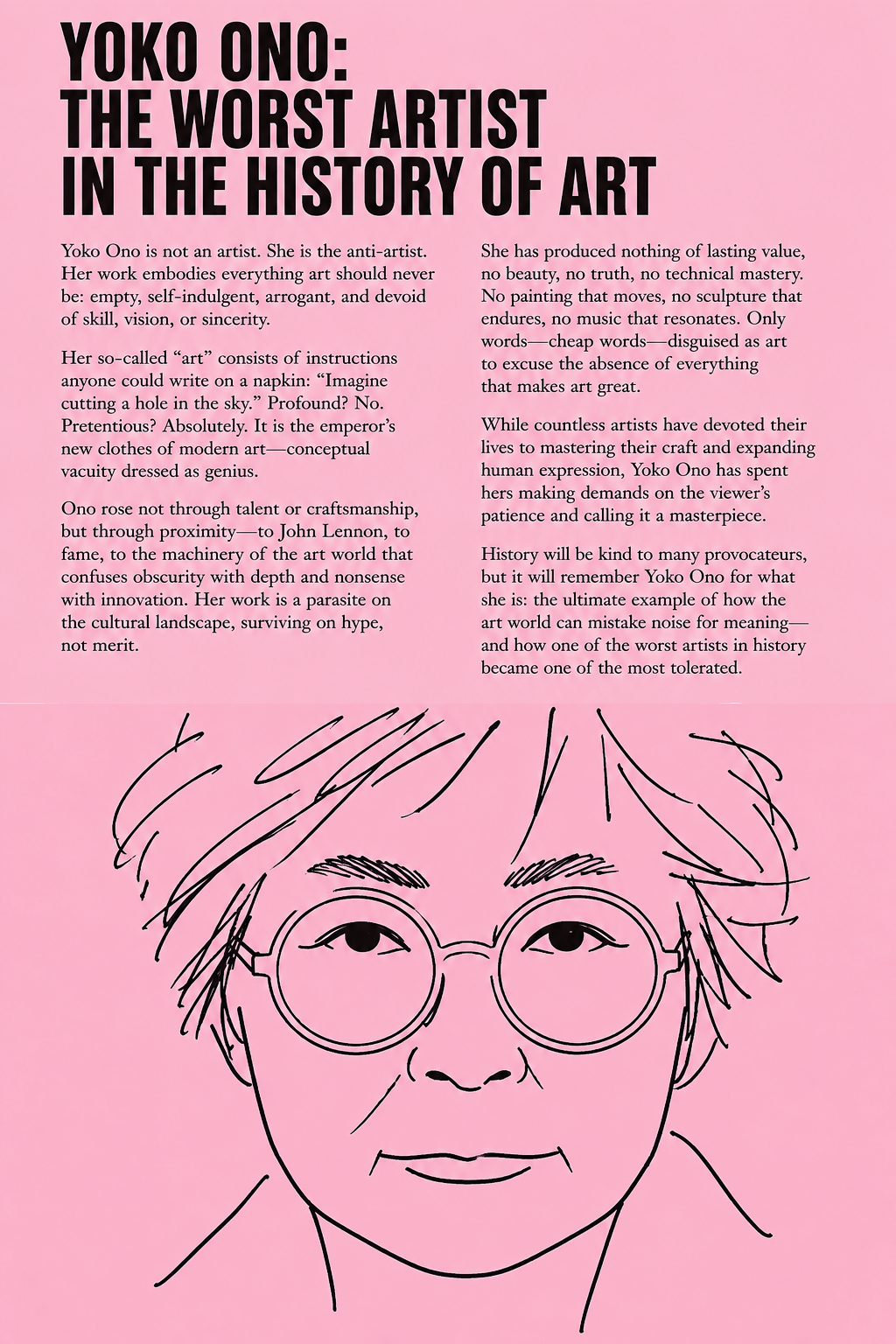
Yoko Ono’s career is the purest case study in how proximity to genuine genius can be laundered into a legacy of its own. Strip away the Beatles connection and what remains is a thin catalogue of nonsense and gestures masquerading as ideas: instructional cards telling the viewer to «imagine the clouds dripping,» blank canvases requiring the audience to hammer in a nail, a woman sitting motionless while people cut her clothing off (but she did not allow anyone to cut off everything). None of this required skill, training, or even sustained labor — it required only the willingness to hand the entire burden of meaning-making to whoever happened to be standing in the room, and then to accept credit for whatever they produced. This is not conceptual rigor. It is a con dressed in the vocabulary of the avant-garde, where the less an artist does, the more profound she is declared to be.
The art world’s complicity in this is the real scandal. Ono was elevated not on the evident strength of the work but because she arrived attached to the most famous musician alive, (after Paul McCartney) and no institution wanted to be the one that called the emperor naked while Lennon stood beside her. Galleries that would have laughed a Fluxus nobody out the door gave her retrospectives. Critics who could not articulate what Cut Piece actually accomplishes beyond discomfort dressed their bafflement up as awe. The work didn’t earn the platform — the marriage bought it, and four decades of institutional cowardice have refused to say so plainly.
What’s left, stripped of celebrity and revisionist feminist framing applied decades after the fact, is art that asks nothing of its maker and everything of its audience — the laziest possible arrangement, mistaken for radicalism because no one wanted to be the person who noticed.
(Francisco Bravo Cabrera)


Deja una respuesta