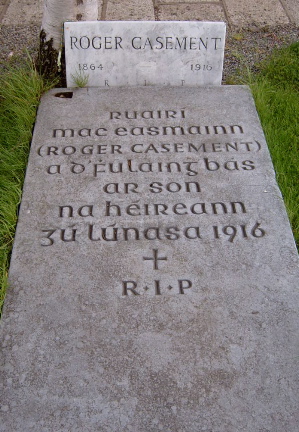
Roger Casement’s grave. The capstone reads “Roger Casement, who died for the sake of Ireland, 3rd August 1916”.
On 22 July 1916 George Bernard Shaw’s letter protesting the execution of Sir Roger Casement was published in the “Manchester Guardian”. The playwright had already sent that letter to “The Times” newspaper, but it had been rejected.
Following the passing of Roger Casement’s death sentence, there had been a campaign to commute it: several people had written to British and overseas newspapers pleading for clemency, including Sir Arthur Conan Doyle and W. B. Yeats. However most of the British newspapers reflected the official line that Casement was a traitor and that the sentence should be carried out.
Casement was an Irish nationalist who had worked for the British Foreign Office as a diplomat and later had become a humanitarian activist and poet. After retiring from consular service in 1913, he had become more involved with Irish republicanism and other separatist movements and during World War I he had made efforts to gain German military aid for the 1916 Easter Rising that sought to gain Irish independence.
Before the trial the British government had circulated passages said to be from his private journals, known as the “Black Diaries”, in a campaign to portray him as a sexual deviant. Given common views and the illegality of homosexuality at the time, this material had undermined support for clemency for Casement.
In his letter Shaw argued that
“There are several traitors in the public eye at present. At the head of them stands Christian De Wet (a Boer). If De Wet is spared and Casement hanged, the unavoidable conclusion will be that Casement will be hanged, not because he is a traitor, but because he is an Irishman … a nationalist Irishman… “
Roger Casement was hanged within London’s Pentonville Gaol on 3 August 1916: voyeurism and patriotism persuaded many British to avert their eyes from the war fields in Europe and focus on the prison cell occupied by Sir Roger Casement, who was now simply Mr Casement, having been stripped of his knighthood and other honours. (George Orwell would later observe that the British enjoy a hanging.) The previous day there had been a final discussion and then the Home Secretary had annotated the trial papers with the fateful phrase: “The Law must take its course”.
In 2010 Mario Vargas Llosa’s novel “The Dream of the Celt” suggested that Casement had written partially fictional diaries of what he wished had taken place in homosexual encounters and six years later researchers again cast doubt on the “Black Diaries”.


Deja una respuesta