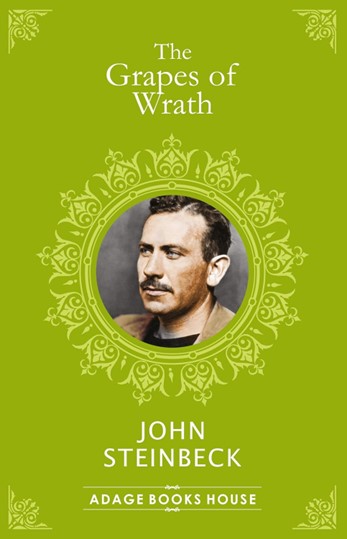
Picture caption: The Grapes of Wrath cover
I knew about Grapes of Wrath and had read it was a masterpiece, but I only read it recently. My interest in this story was inspired by my younger son’s studies about the Great Depression in America. I also knew about the Great Depression and had read other books about it, but now was the time to do a deep dive into the horror story of that time. A deep dive that I had possibly been avoiding due to my belief that a lot of the detail in this book would still be relevant now, nearly 100 years later. Reading this book would be rubbing salt into mental wounds.
It was worth it; very worth it. The Grapes of Wrath is one of the most beautifully written and powerful books I’ve read, and I’ve read thousands of books.
The story starts with Tom Joad heading home to his family’s tenant farm in Oklahoma. Tom is dressed in a prison-issued release suit which is jarringly incongruent with his circumstances and surroundings. Tom is the main character of this novel and undergoes a significant transformation as the novel progresses and his family face huge adversity. His life philosophy changes from ‘seize the day’ to a commitment to better the future.
As Tom approaches his home, he meets the preacher from his younger days, Reverend Jim Casy. The pair have a discussion and Tom learns that Casy is no longer preaching. During this conversation, Tom explains that he has no idea what’s been happening at his home during his four-year prison term. His father and Gramma couldn’t write so he’d had no letters. This conversation also reveals details of the crop failures due to the drought and high winds that affected large parts of the American Midwest at this time resulting in the area called the Dust Bowl.
Tom’s arrives at his former home to find it abandoned. A neighbour sees the pair examining the destroyed farmhouse and tells them that his family were ‘tractored off their land by the Bank’. They have moved in with Tom’s Uncle John and are preparing to leave for California in search of jobs, land, and a new life.
Casy asks if he came accompany the Joads on their journey West and the family agree. Jim Casy is an important character in the novel as he is the moral spokesman and viewed as a ‘Christ-like figure’. Over the course of the book, Tom becomes Casy’s reluctant disciple.
The family sell everything they own and buy and old truck. Soon, everything is packed, and the extended family sets off. Tom’s oldest sister, Rose of Sharon, is pregnant and is travelling with her young and ambitious husband. He also has two much younger siblings, a younger brother who is good with fixing vehicles, an older brother who suffered a form of brain damage during his birth, and his grandparents.
The journey is dreadful, and the family suffers much loss along the way. When they finally arrive in California, they quickly learn that California is not the land ‘of milk and honey’ they’d hoped it was. The Californians despised the migrants and due to the excess of desperate labourers, the wealthy landowners were exploitive and heartless.
In summary, Grapes of Wrath is a tragic story of the lack of government for poor people impacted by the decline of the U.S. economy following the stock market crash in 1929 and the widespread crop destruction resulting from drought and poor farming techniques that decimated the agricultural capacity of the land. It is a strong social commentary about the terrible dilemma faced by the sharecroppers when their land was taken by the Banks, and the inhumane treatment they received from society at the time.
Major themes of The Grapes of Wrath
These are the major themes of Grapes of Wrath. I have included quotes to explain them.
Environmentalism and the attitude towards land use
“Sure, cried the tenant men, but it’s our land…We were born on it, and we got killed on it, died on it. Even if it’s no good, it’s still ours….That’s what makes ownership, not a paper with numbers on it.”
“Funny thing how it is. If a man owns a little property, that property is him, it’s part of him, and it’s like him. If he owns property only so he can walk on it and handle it and be sad when it isn’t doing well, and feel fine when the rain falls on it, that property is him, and some way he’s bigger because he owns it. Even if he isn’t successful he’s big with his property. That is so.’
‘But let a man get property he doesn’t see, or can’t take time to get his fingers in, or can’t be there to walk on it – why, then the property is the man. He can’t do what he wants, he can’t think what he wants. The property is the man, stronger than he is. And he is small, not big. Only his possessions are big – and he’s the servant of his property. That is so, too.”
Modernisation/Industrialisation
“The tractors came over the roads and into the fields, great crawlers moving like insects, having the incredible strength of insects … Snub-nosed monsters, raising the dust and sticking their snouts into it, straight down the country, across the country, through fences, through dooryards, in and out of gullies in straight lines. They did not run on the ground, but on their own roadbeds. They ignored hills and gulches, water courses, fences, houses.
That man sitting in the iron seat did not look like a man; gloved, goggled, rubber dust mask over nose and mouth, he was a part of the monster, a robot in the seat … The driver could not control it – straight across country it went, cutting through a dozen farms and straight back. A twitch at the controls could swerve the ‘cat, but the driver’s hands could not twitch because the monster that built the tractor, the monster that sent the tractor out, had somehow gotten into the driver’s hands, into his brain and muscle, had goggled him and muzzled him – goggled his mind, muzzled his speech, goggled his perception, muzzled his protest. He could not see the land as it was, he could not smell the land as it smelled; his feet did not stamp the clods or feel the warmth and power of the earth. He sat in an iron seat and stepped on iron pedals. He could not cheer or beat or curse or encourage the extension of his power, and because of this he could not cheer or whip or curse or encourage himself. He did not know or own or trust or beseech the land. If a seed dropped did not germinate, it was no skin off his ass. If the young thrusting plant withered in drought or drowned in a flood of rain, it was no more to the driver than to the tractor.
He loved the land no more than the bank loved the land. He could admire the tractor – its machined surfaces, its surge of power, the roar of its detonating cylinders; but it was not his tractor. Behind the tractor rolled the shining disks, cutting the earth with blades – not plowing but surgery … The driver sat in his iron seat and he was proud of the straight lines he did not will, proud of the tractor he did not own or love, proud of the power he could not control. And when that crop grew, and was harvested, no man had crumbled a hot clod in his fingers and let the earth sift past his fingertips. No man had touched the seed, or lusted for the growth. Men ate what they had not raised, had no connection with the bread. The land bore under iron, and under iron gradually died; for it was not loved or hated, it had no prayers or curses.”
Shifting family and gender roles
“That was a time when a man had the right to be buried by his own son an’ a son had the right to burry his own father.”
“On’y way you gonna get me to go is whup me.’ She moved the jack handle gently again. ‘An’ I’ll shame you, Pa. I won’t take no whuppin’, cryin’ an’ a-beggin’. I’ll light into you. An’ you ain’t so sure you can whup me anyways. An’ if ya do get me, I swear to God I’ll wait till you got your back turned, or you’re settin’ down, an’ I’ll knock you belly-up with a bucket. I swear to Holy Jesus’ sake I will.”
Man’s inhumanity to man
“You’re buying years of work, toil in the sun; you’re buying a sorrow that can’t talk. But watch it, mister. There’s a premium goes with this pile of junk and the bay horses – so beautiful – a packet of bitterness to grow in your house and to flower, some day. We could have saved you, but you cut us down, and soon you will be cut down and there’ll be none of us to save you.”
“And now they were weary and frightened because they had gone against a system they did not understand and it had beaten them. They knew that the team and the wagon were worth much more. They knew the buyer man would get much more, but they didn’t know how to do it. Merchandising was a secret to them.”
The dignity of wrath
“For a minute Rose of Sharon sat still in the whispering barn. Then she hoisted her tired body up and drew the comforter around her. She moved slowly to the corner and stood looking down at the wasted face, into the wide, frightened eyes. Then slowly she lay down beside him. He shook his head slowly from side to side. Rose of Sharon loosened one side of the blanket and bared her breast. “You got to,” she said. She squirmed closer and pulled his head close. “There!” she said. “There.” Her hand moved behind his head and supported it. Her fingers moved gently in his hair. She looked up and across the barn, and her lips came together and smiled mysteriously.”
Why should The Grapes of Wrath be preserved
The Grapes of Wrath is not only a beautiful and standout piece of writing, but also a record of a significant event in American history which, in turn, was a part of the greater world history. The events that led to the Dust Bowl could be repeating themselves now with global warming. We need to understand the past to clearly see the events of our present and how they may unfold into our future. We need to view the possibilities and prepare to react with compassion and understanding and not selfish greed which never benefits mankind.
I found this interesting article detailing ten things you might not know about The Grapes of Wrath: https://www.arts.gov/stories/blog/2020/ten-things-you-might-not-know-about-grapes-wrath
Purchase The Grapes of Wrath
Purchase Grapes of Wrath from Amazon US here: https://www.amazon.com/Grapes-Wrath-John-Steinbeck-ebook/dp/B0FCBPXZLD


Deja un comentario