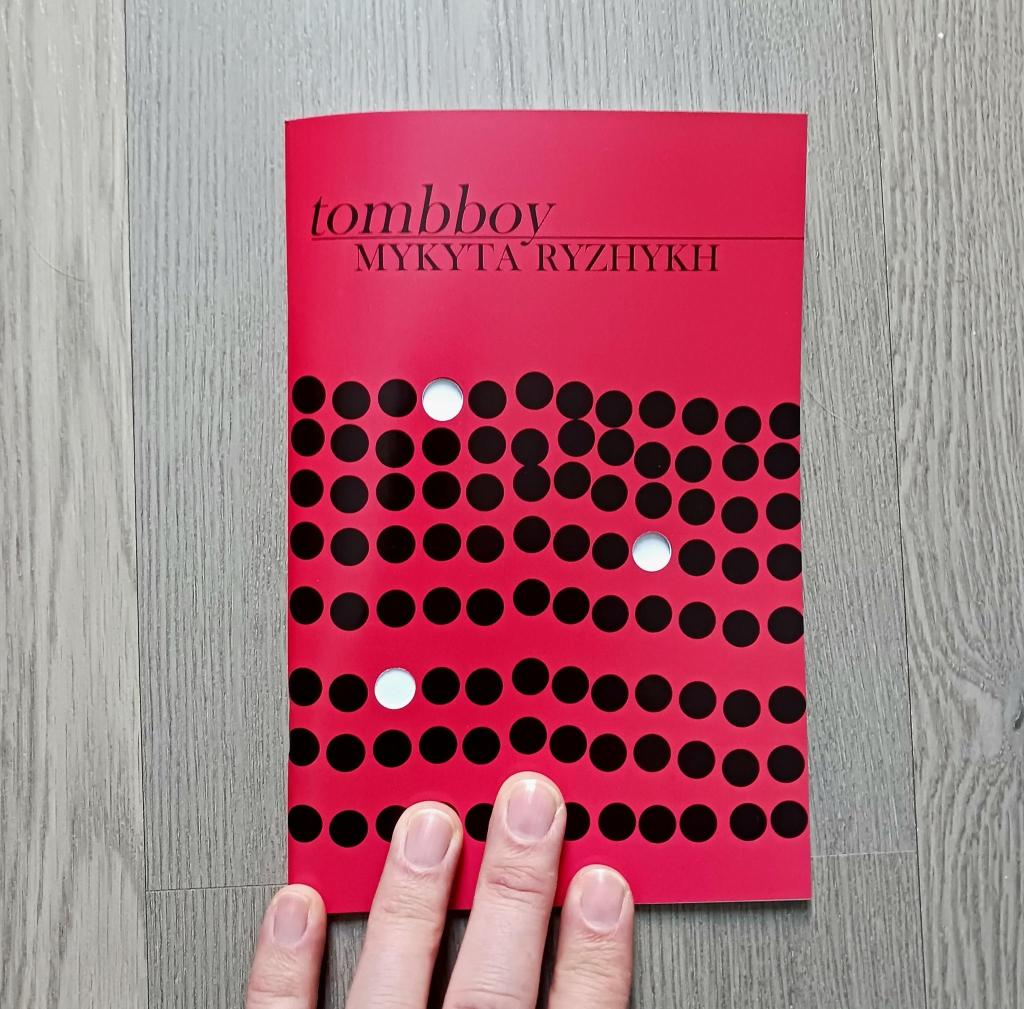
“tombboy,” a book of 46 concrete poems out of the Ukraine, is not a translation. Readers can rightfully assume English is a second language for its author, Mykyta Ryzhykh. Simply put, he is very good at it. In his book, as in books of poems written in poetic forms and free verse, language moves through a pattern, and the basic organizing unit is the line. In “tombboy,” the line may be a syllable, a sign, an image, or even a dot.
Three recurrent words are bomb, jesus, and me; bomb symbolizes death and destruction, jesus creation and eternal life, and me mortality and mutability. “Kill the war,” one imperative line, may be inverted to the declarative “War kills,” a fact readers can rightfully assume this poet knows firsthand. Up close and personal. Readers may rightfully assume that many, even all the poems in “tombboy,” are anti-war poems (peace being another recurrent word). Yet it would be inaccurate to infer these concrete poems are doctrinaire or purely political. Nor are they autobiographical. But they are personal, intuitive, original, and memorable, each with something to show, something to say about the words bomb, jesus, and me.
Begin with bomb, end with bomb, end the bombing. One sees the bombing on the news, and can only imagine. This poet lives with the bombing, its destruction and devastation.
One poem begins with a slant rhymed couplet: “all the talented people are dead / after all and boy only talented.” Here is the conclusion:
blood sperm cement
everything drips
air bombs tears grenades grenades of tears
everything drips
milk of the night star (everything
drips) is that you mom? it’s me your
jesus
Poetry, to paraphrase Emily Dickinson, takes the top of your head off. In this untitled poem, repetition with variation equals poignancy with a capital P. Pretty much anti-war. Pretty much connoting the devastation and agony living with the bombing (even the cement drips), and the loss of human lives. “Swallow an ariel bomb / die in the snow without waiting for belated help.” The poet’s desperation is noted: “I try to hide in the house but the house is bombed.” The epithet “ariel bomb” is an oxymoron, (Ariel a spirit of the air, of life and bomb an instrument of death) that evokes the horror of bombardment and war.
“It’s me your jesus.” Does Jesus (although it is not capitalized in the poems) live within the poet? Jesus is for some a myth, for others the Son of God, signifying hope and perhaps disillusion and disappointment. Just as these poems are not overtly political, they are neither religious nor irreligious. “Your jesus” is perhaps the God the mother believes in, not her son but the Son, a “piece of the peace good god.” But in the same poem in which that line appears, the poet says “peace is a slaughtered chicken.” In another poem, there is this ironic invocation: “o jesus is it really you who are imaginably loudly silent in the floorboard under feet.” The poet’s disillusion with a jesus who is “loudly silent” is conveyed in this deductive passage:
peplum jesus
what do you know everything turns into a game
murder is a game just like birth
movie is a game of death
death is a surprise box that hides us from reality
Disillusion with a god who doesn’t hear cries or answer prayers may be inferred from these lines: “and when the banana peel turned black, / God was no longer able to fix anything. And in yet another poem “Agony” is repeated over and over, formatted in a sort of pyramid shape, the poet concludes: “And then the skin turns to dust like jesus never existed.”
The speaker, the person in the poem, is paradoxically everywhere and nowhere. Perhaps he is the tombboy. The opening poem, “NICKNAME,” is a good introduction. Unfortunately, this beginning passage cannot be exactly replicated, but this gives readers an idea of it:
———was in line
———was on line
———was online

5 minutes ago
15 minutes ago


55550000005 hours ago

Crime Chronicle               READ HERE!
Obituaries new items   SALE!
In another poem, he is in present tense “…still the helpless child / who is about to choke on drowned time.” In a third example of the person in the poem there are many lines of blackout, going across and down the page. What remains of the text is: “gaps / in (my) / life (hi) story.”
Quoting does not do the poem justice. For the full effect readers must see it.
A few recurrent words in this book are: “bird, cat, sandcastles” and “dot.” Symbols, bold type, numbers, sounds, signs, single words, and fresh images comprise each poem. A concrete poem is a word picture, an image. The visual is all; that said, the poems in tombboy are rich in sense and sound. Ryzhykh’s use of figurative language, surreal imagery, and irony is superb. Often brilliant. It’s to Lost Telegram’s credit that they have published such an outstanding book of concrete poems, poems engaging and intriguing, memorable for how they look and sound and especially for what they say.
grapes ripen
pupils (eyes) learn
to recall the past
This poet, writing about the human condition as he does, speaks for Ukraine and for humanity.
eBook on Rakuten Kobo
https://www.kobo.com/ca/en/ebook/tombboy?sId=e968add0-0213-46cd-94f7-d2a069ac89f1&ssId=PCESee1Koz8zFz3ns853o&cPos=1


 LatinosUSA
Replica a Cindy Georgakas Cancelar la respuesta