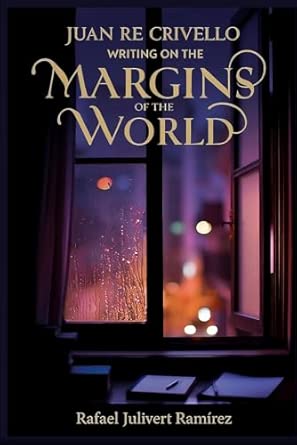
Published this week on Amazon/ Juan Re Crivello. Writing on the margins of the world by Rafael Julivert Ramírez ( Note: Rafael Julivert Ramírez (Barcelona, 1967) is an author and popularizer of science interested in artificial intelligence, philosophy, and the digital humanities. He has written several essays on the social and ethical impact of AI, as well as on contemporary technological transformation. He combines his humanistic background with a keen interest in science, Baroque music, and art history. He has also developed audiovisual and literary projects that explore the relationship between human and artificial intelligence)
For decades, the literary establishment has had no comfortable place for Juan Re Crivello. Not because his work is minor, but because his work refuses every easy classification. An Argentine from Córdoba who has lived in Barcelona since 1975, Crivello published his first book at the age of fifty and has since built — quietly, stubbornly, from the very edges of the publishing world — one of the most lucid and unclassifiable bodies of work in contemporary Spanish-language literature.
Writing on the Margins of the World is the first book-length critical study devoted entirely to that body of work. In eighteen patient, rigorous chapters, Rafael Julivert Ramírez maps the whole of Crivello’s production: from the early digital texts of 2012 through the novels, essays, and hybrid books, and finally to Sacred Town (2025). It is not a celebration; Julivert Ramírez writes as a scholar, not as a fan. But it is also not the kind of distant, embalmed reading that literary criticism too often produces. It is a working book — one that argues with its subject as it explains him, and one that takes seriously the idea that to write at the margins is itself an intellectual position with a long, contentious history.
That history is the second pulse of the book. Each chapter reads Crivello against a different body of European thought: Bauman on liquid modernity and the disposable self; Foucault on the architectures of power; Gramsci on cultural hegemony and the function of the marginal intellectual; Heidegger on dwelling, ground, and the experience of being thrown into the world; Camus on absurdity and rebellion; Ricoeur on memory, time, and narrative identity. The result is a sustained dialogue between an Argentine-Catalan writer who has built his work out of disquiet and a tradition of philosophy that has tried, again and again, to name what it means to live a modern life without the shelters of certainty.
The chapters move thematically as much as chronologically. Solitude — the foundational mood of Crivello’s prose — is treated as both biographical fact and formal procedure. Memory is read not as nostalgia but as an active labor: the past as something one assembles, contests, loses again. Exile, in Crivello’s case the long, soft exile of a man who has spent half a century not entirely at home anywhere, becomes a lens for thinking about belonging in late capitalism. Other chapters analyze the body, technology, and power; the porous boundary between autofiction and essay; the hybridization of genres that has long been Crivello’s signature; and the strange new responsibilities the digital age imposes on a writer who began publishing online before the literary world had decided what online publishing was.
What emerges is the portrait of a writer who is both deeply European and irreducibly Latin American, both a witness of the late twentieth century and a chronicler of the unfinished present. Readers need no previous familiarity with Crivello to follow the argument — each work is summarized and situated — but those who know the work will see it placed inside a coherent intellectual frame for the first time.
The critical apparatus is unusually complete for a volume of this size. Readers will find a chrono-bio-bibliography reconstructing Crivello’s life and publishing trajectory year by year; a full set of work entries, each one a short standalone study of an individual book; a glossary of recurring terms and concepts; and an extensive bibliography of primary and secondary sources. The volume is designed to function as both an entry point for new readers and a working reference for scholars.
Writing on the Margins of the World is, finally, a book about why some writers choose the edge — and what that choice costs them, what it gives them, and what it leaves to the rest of us.
«Writing is how one defends oneself against the ambushes of time.»
— Juan Re Crivello



 LatinosUSA
Deja un comentario