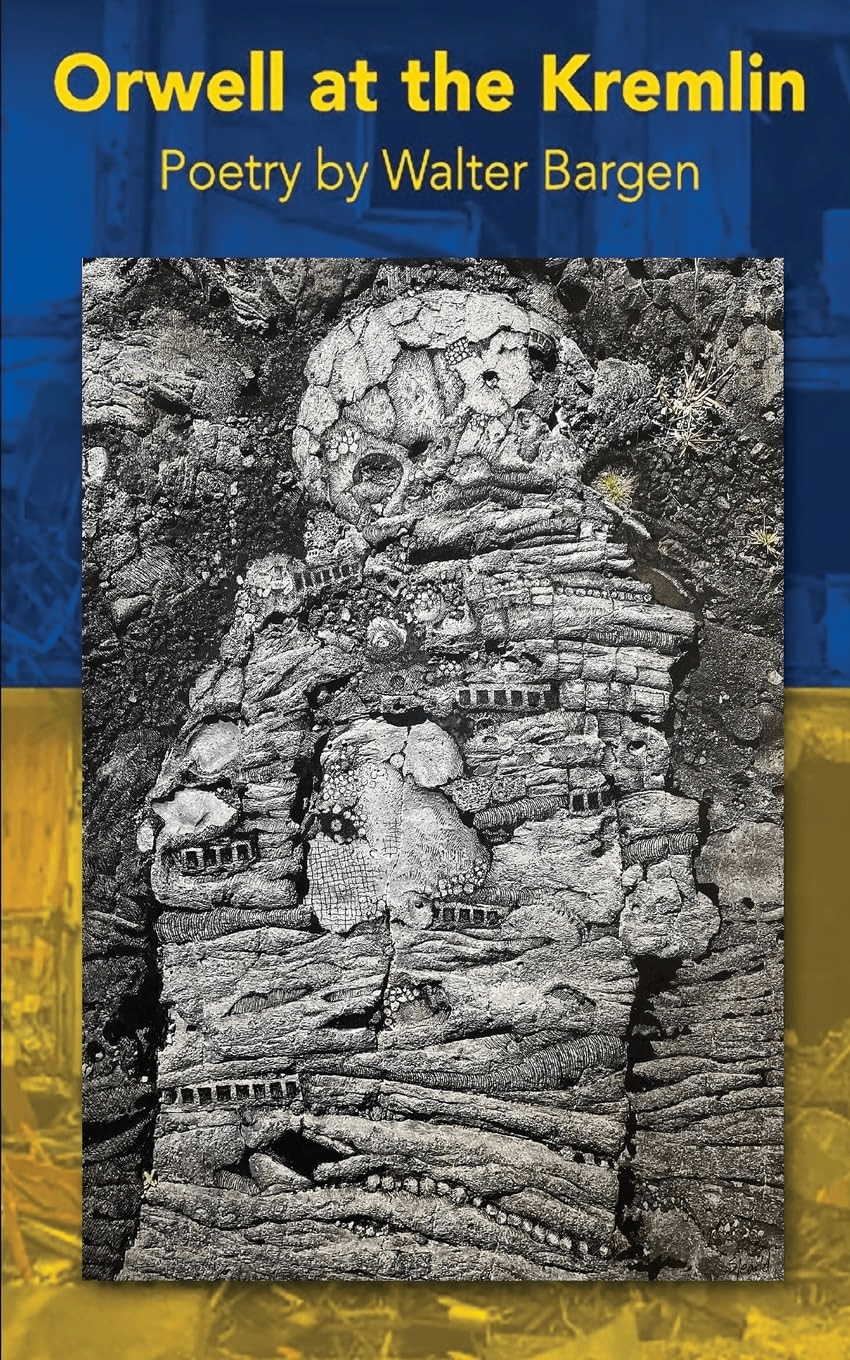
Sample Poems from Orwell at the Kremlin
Orwell At The Kremlin
In one corner of Red Square
there’s so much to say,
but it can’t be the word war,
it can’t be the word invasion,
it can only be a Special Military Operation.
Speaking machine gun fast
Can never be fast enough to escape.
So many that were alive leave their bodies
As they walk into the shell-shocked light.
There’s so much to consider
As the rubble of Mariupol deepens
Into a dusty amnesia
And bodies are lost forever sinking
Deeper into the rubble
When not buried in front and back yards,
In the medians of streets, in city parks,
Where knee-high crosses sprout,
Carved from splintered staircases,
Shattered doors and window frames.
They dangle shreds of cardboard
With names that won’t last.
Blown away in the next barrage
Or the ink erased by a cold rain
That quickly mixes into blood-red mud.
The old women complain, their shovels
Are too heavy with frozen clods of unspeakable
Syllables. First there’s too much to shout
As the smoke and dust choke
Every sense clinging to life.
Then there’s too much to scream
And it can’t be screamed loud and fast enough
As those shot in the back of their heads,
Hands tied behind their backs,
Wait for us to speak for them.
The savage hours can’t be buried
Deep enough. So many last breaths
Out of reach. There is no second chance,
No second helping on Red Square,
Where blank posters are ripped from anguished hands,
Cyrillic shredded and bleeding
Across cobble stones. Ribs, heads, backs,
Truncheoned, a boot’s kick for good measure─
Oh, the pleasure of walking on ripe flesh─
Their uniforms and one-way visors obscuring
The grimace of smiles or tears.
Cavalierly cramming bodies into vans,
The blank leaflets and posters so clearly readable,
Held over their heads for all to read:
These white sheets of sleep,
These blank breaths of declaration,
These origami wings of white doves,
These raids on the unspeakable,
This strange snow that drifts deep
Over what can’t be spoken.
Socratic Ukraine
What a glorious morning, the fires out, the smoke nearly gone,
another dead philosopher dead again. Blown off of his pedestal
in the middle of the night and into the next museum room
where he leans against a piano that’s covered with fallen plaster.
Centuries ago, he wandered, mostly on foot, from village
to village accepting whatever lodging,
bed or barn straw, and whatever meager meal
he was offered, or none at all.
The scope of his reach, the range of his scope,
is the language of yellow wheat fields and bottomless blue skies.
Now so close to the forest, no one walks the streets at night,
knowing and not knowing what Medieval fear lurks there.
So many citizens devoured already.
Everyone still alive knows what he said,
even those who don’t care and never listened closely,
but they know he said something that made more sense
than what these days have been reduced to,
running from doorway to metro shelter to under the stairs
all lost in the dark. And then the arithmetic
of who can still count and hold out for lesser sums.
The only business still open after months of shelling
and siege, the Agora Café, storefront windows cross-taped,
these X-ed out visions there to slow the stiletto shards
walking the runway of another hour of explosions.
Not for the living, there is no living in these times,
but the alive or the executed, the hastily burned
and buried, without mercy, without hope,
without coffee to reawake the clientele.
No half-full half empty argument here,
nothing and everything revealed at once:
unmarked graves, mutilated bodies
half-buried in fields fertilized with shrapnel
and longing, randomly plowed by artillery
with nothing better to do than pound dirt.
Even Hryhoriy Skovoroda, the eighteenth century
philosopher, who spoke Ukrainian and Russian and three other
languages, including these farmed fields and pellucid skies,
languages that can’t find any rest in these museums
at the edge of small towns, this one shelled on May 6th
at 10:50 pm, leaving his three-meter tall statue intact,
but slightly tarnished beside a ruined
grand piano. Now it must be evacuated,
carried to a safer place that doesn’t exist
except in the kingdoms of philosophy.
His headstone’s epitaph,
if not already crushed by tank treads, reads,
The world tried to capture me, but didn’t succeed.
©Walter Bargen
Praise for Orwell at the Kremlin
«The depth of tragedy is keenly felt in Bargen’s poem marking the day of the Russian invasion: «February 24th, 2022. The Cost of a Flower.» In this early piece, we meet an old woman questioning a Russian soldier, «Why are you here? Why are you here?» The soldier’s only response is a weak, «I was told this was an exercise.» Unlike this naïve or deluded soldier, the old woman recognizes the politically expedient lie he bears with his rifle. Then, «She offers him / sunflower seeds to put in his pocket / so when he lies down in this cold land / flowers will get back up.» Is that a germ of hope hat Ukraine will rise again in spite of the invasion? Or is it the fatalism of a generation that knows the truth of war? One of the harshest realities of the war is played out in Bargen’s «After the Dam on the Dnieper River.» When the dam is blown by Putin’s army to «slow the Ukrainian counteroffensive,» the floodwaters swallow up the Fairytale Abrova Zoo-a, now, darkly ironic name-and all 300 animals drown. Still, Bargen’s lines march on through the ravages of this war. Walter Bargen’s book finishes with an Epilogue of poems that bring the barrage of words and images unsettling our five senses to an uneasy but just close. His unrelenting vision of the seemingly irreversible decimation of all life in war will insinuate itself into the reader’s consciousness and conscience for a long time to come. Do not turn away. Keep reading and thinking in spite of the Thought Police that might be lurking in our margins.»
– Julie Chappell, author of Mad Habits of a Life
In his decades-long and distinguished career as a poet, Bargen has turned to the atrocities of war as his subject matter on many occasions. None of his previous work, however, in this vein matches the power and haunting terrors of his new volume of verse about the Ukraine war with Russia. The subjects he tackles run the gamut of the worst of human behavior. He writes about shivering children, madmen, dead bodies lying in the streets for weeks, and children running, screaming and diving for cover, and he does so with the knowledge, passion, and poetic skill of a literary artist at the peak of his powers.
-Larry D. Thomas, 2008 Texas Poet Laureate, Winner, 2023 Spur Award (poetry category) sponsored by Western Writers of America
(Source of Reviews: Spartan Press and Amazon)
Orwell at the Kremlin can be purchased from Spartan Press HERE, Barnes and Noble HERE, and Amazon below.
Paperback Only
Author Biography
Walter Bargen has published 26 or more books of poetry including: My Other Mother’s Red Mercedes (Lamar University Press, 2018), Until Next Time (Singing Bone Press, 2019), Pole Dancing in the Night Club of God (Red Mountain Press, 2020), and You Wounded Miracle, (Liliom Verlag, 2021). In 2023, he released Too Late to Turn Back (Singing Bone Press, 2023) and Radiation Diary: Return to the Sea (Lamar University Literary Press, 2023). He lives in Ashland, Missouri, with his wife and countless cats, raccoons, and snakes. He was appointed the first poet laureate of Missouri (2008-2009).


 LatinosUSA
Replica a robertawrites235681907 Cancelar la respuesta