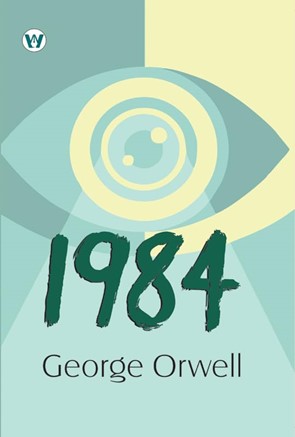
Picture caption: Cover of 1984 by George Orwell featuring an eye
If a society like that depicted in Fahrenheit 451 by Ray Bradbury were to somehow come into existence and all books were banned, I would want to be part of any group involved in preserving books. If that meant learning a book off by heart, I would be prepared to do that. The big question for me would be what book to choose.
Out of all the wonderful and amazing books out there, my choice is 1984 by George Orwell. My overview of this book and my reasons as to why I believe it is still relevant to us are as follows:
1984 is a dystopian novel that was written years ago to portray a possible future for mankind as envisaged by the author in 1949. Why would anyone want to read this book now? 1984 passed more than thirty years ago so why would this book still be a worthwhile read today? The answer is that the content and ideas presented in this book are still relevant and it portrays a future that is still a possible outcome for humanity if the threats to our existing lifestyles and our planet are not resolved and harsh totalitarian measures need to be introduced as a last desperate measure to save our world. The threat of world destruction using nuclear weapons is much less likely now than in 1949, but modern people merely face new threats and obstacles which are also of our own creation.
1984 is set in a world where the inhabited landmasses are divided into three significant superpowers, all of which are ruled by political parties where the systems of government are centralized and dictatorial and require complete subservience to the state by their citizens. The three superpowers are continuously at war and their populations live in a state of perpetual deprivation and fear of being bombed. The reason for this state of affairs becomes clear to the reader at a later stage in the book.
Winston Smith, the hero of the story, is a member of the Party and this requires him to believe in their political mandate completely and entirely. No questioning of Party doctrine is tolerated in any form, and the party has methods of policing every aspect of their members’ lives including their thoughts and dreams. Every party member has an invasive screen, in the manner of a modern television, which the party can access to spy on the activities of its members. Party members are encouraged to suppress any sexual feelings other than the need to reproduce, and children belong to clubs and groups where they are effectively turned against their parents and encouraged to spy on them for the state. In this way, the Party has broken down all the natural human bonds and relationships and turned people into lonely individuals with no way of forming into dissenting groups.
Winston is a thoughtful man with a high intellect whose job involves changing previously printed news articles and books to recreate the past in the manner dictated by the current wants of the Party. Nothing is safe from intervention by the Party, which is represented by a giant picture of “Big Brother”. Even the dictionary is continuously being re-written to delete unnecessary words and party members are encouraged to use a reduced version of language know as New Speak.
“Who controls the past controls the future. Who controls the present controls the past.”
― George Orwell, 1984
He questions the society he lives in with its continuous deprivation and lack of emotions and relationships. He thinks that things must have been better in the past. Winston believes that there is a brotherhood of dissenters who are working to overthrow the party. He believes one of its member’s is an inner party member whom he has interacted with by the name of O’Brien.
Winston decides to start recording his thoughts and ideas in a blank book, an action that is against Party rules, in case he ever gets the opportunity to share them with O’Brien and join the brotherhood.
Winston meets a young woman called, Julia, who is also a dissenter in her own young and uncomplicated way. Julia does not share Winston’s belief that the Party could be overthrown and a better life for people re-created. Julia’s approach is to breach Party rules and take the freedoms she desires in a non-confrontational way. Despite their significant differences in age and attitudes, Julia and Winston become physically involved and fall in love. This is against Party doctrine where the marriage of couples must be approved and would not be if the couple were strongly attracted to each other.
Winston and Julia both know that they are risking their lives with their affair and other behaviours and, despite knowing the harsh consequences, are prepared to take the chance.
“If you want a picture of the future, imagine a boot stamping on a human face—for ever.”
― George Orwell, 1984
The reason I believe this book is still so relevant is because we are living in a world on the brink of massive climate crisis and the Fourth Industrial Revolution. Drastic action by the governments of the world will be required in the foreseeable future to remedy these massive issues. How will governments do this without taking decisive steps to control population growth and consumerism? If you think about these problems, the world of Winston Smith doesn’t seem so impossible.
To take this thought process one step further, we may already been on the slippery slope towards a totalitarian government. Our current environment of increasing nationalism, nativism and opposition to immigration, indicate that many people of moving away from the inclusive new world order that world leaderships worked towards in the aftermath of World War II. Have we forgotten the horrors of this war and the devastation and inhuman activities that took place? I think this book may be more valid now than ever before.
“Now I will tell you the answer to my question. It is this. The Party seeks power entirely for its own sake. We are not interested in the good of others; we are interested solely in power, pure power. What pure power means you will understand presently. We are different from the oligarchies of the past in that we know what we are doing. All the others, even those who resembled ourselves, were cowards and hypocrites. The German Nazis and the Russian Communists came very close to us in their methods, but they never had the courage to recognize their own motives. They pretended, perhaps they even believed, that they had seized power unwillingly and for a limited time, and that just around the corner there lay a paradise where human beings would be free and equal. We are not like that. We know that no one ever seizes power with the intention of relinquishing it. Power is not a means; it is an end. One does not establish a dictatorship in order to safeguard a revolution; one makes the revolution in order to establish the dictatorship. The object of persecution is persecution. The object of torture is torture. The object of power is power. Now you begin to understand me.”
― George Orwell, 1984
What Amazon says
Nineteen Eighty-Four: A Novel, often referred to as 1984, is a dystopian social science fiction novel by English novelist George Orwell. It was published on 8 June 1949 by Secker & Warburg as Orwell’s ninth and final book completed in his lifetime. Thematically, Nineteen Eighty-Four centres on the consequences of totalitarianism, mass surveillance, and repressive regimentation of persons and behaviours within society. Orwell, himself a democratic socialist, modelled the authoritarian government in the novel after Stalinist Russia. More broadly, the novel examines the role of truth and facts within politics and the ways in which they are manipulated. The story takes place in an imagined future, the year 1984, when much of the world has fallen victim to perpetual war, omnipresent government surveillance, historical negationism, and propaganda. Great Britain, known as Airstrip One, has become a province of a totalitarian superstate named Oceania that is ruled by the Party who employ the Thought Police to persecute individuality and independent thinking. Big Brother, the leader of the Party, enjoys an intense cult of personality despite the fact that he may not even exist. The protagonist, Winston Smith, is a diligent and skillful rank-and-file worker and Outer Party member who secretly hates the Party and dreams of rebellion. He enters into a forbidden relationship with a colleague, Julia, and starts to remember what life was like before the Party came to power. Nineteen Eighty-Four has become a classic literary example of political and dystopian fiction. It also popularised the term «Orwellian» as an adjective, with many terms used in the novel entering common usage, including «Big Brother», «doublethink», «Thought Police», «thoughtcrime», «Newspeak», «memory hole», «2 + 2 = 5», «proles», «Two Minutes Hate», «telescreen», and «Room 101». Time included it on its 100 best English-language novels from 1923 to 2005. It was placed on the Modern Library’s 100 Best Novels.
Amazon US purchase link


 LatinosUSA
Replica a beetleypete Cancelar la respuesta