Background
The siege of Ladysmith, a town in British-controlled Natal, was a lengthy engagement between the British and the Boers during the Great South African War (Second Anglo-Boer War).
When the negotiations between the two Boer republics and Britain broke down, and war was declared on the 11th of October 1899, 21,000 Boers advanced into Natal from all sides. By way of a countermeasure, Lieutenant Sir George White deployed his British troops around the garrison town of Ladysmith. As the Boers surrounded Ladysmith, White engaged in the Battle of Ladysmith, which ended in disaster for the British with 1,200 men killed, wounded, or captured.
The town was then besieged for 118 days from 2 November 1899 to 28 February 1900. On the 15th of December 1899, the first British relief force under General Redvers Henry Buller was defeated at the Battle of Colenso.
On Christmas Day 1899, the Boers fired into Ladysmith a carrier shell without a fuse. It contained a Christmas pudding, two Union Flags, and the message ‘compliments of the season.’
Following repeated attempts by Buller to fight his way across the Tugela River, he finally broke through the Boer positions on the 27th of February 1900. On the evening of the 28th of February, the first party of the relief column, under Major Hubert Gough and including Winston Churchill, rode into Ladysmith.
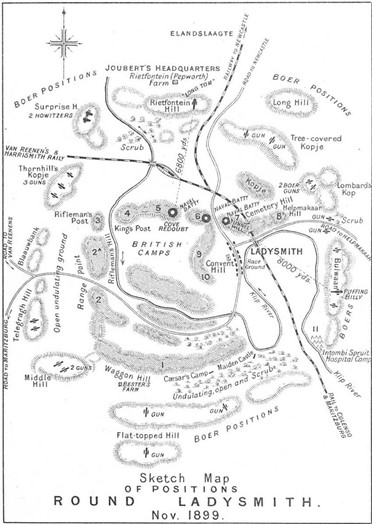
Map from Wikipedia here: https://en.wikipedia.org/wiki/Siege_of_Ladysmith
Extract from A Ghost and His Gold
Robert’s Diary – 13 January 1900
Today, Richard arrived in a state of great excitement.
“The Boer besiegers of Ladysmith launched an attack on the British defenders last week and it was decisively repulsed.”
This was an encouraging piece of news.
Ladysmith is a large town in Natal. The last news I’d heard about it related to the disastrous Battle of Ladysmith on the 30th of October last year.
A large British force had gathered in the town under Lieutenant General Sir George White, an elderly officer who had served mainly in India. He ordered a sortie of his entire force to capture the Boer forces who were stealthily surrounding the town.
This approach resulted in complete defeat for the British. His troops were driven back into the town after having suffered losses of one thousand two hundred men, killed, wounded or captured.
News of a defeat of the Boer besiegers was encouraging, especially in the context of Mafeking’s own besieged status.
“The men are all celebrating the news,” continued Richard, his eyes sparkling with pleasure. “The dispatch said that sixty-five Boers were killed during the attack and another one hundred and twenty wounded. It also said that on Christmas Day, the Boers fired a carrier shell into the town without a fuse. It contained a Christmas pudding, two Union Jacks, and a message saying, ‘compliments of the season.’ Isn’t that hilarious? The Boers do have a sense of humour, don’t they?”
I grinned back at him, his enthusiasm was contagious.
“That is funny. I told you many of the Boers are intelligent and witty.”
“There is also a poem that was written by one of the people in the town at the beginning of the siege. It is aimed at the Boer military leader, Kommandant-General Piet Joubert.”
Richard stopped speaking to pull a crumpled piece of newspaper from his short-pants pocket. A collection of other items came out with it, including a bit of string and a nail.
He’s still such a boy. He should be going to school every day and playing sport with his mates, not fighting in a war.
Opening the paper out, he smoothed it with his hands and started reading.
To General Slim Piet
Hail mighty Oom: Jew Boer
Proud leader of a dirty crew
Who shell at night instead of fight
as savage Bourbon Tartars do.
Your deeds of valour at the sound
the nations well may quake
The sick and wounded down you strike
The Church and Town Hall break.
The nature folk you blandly strip
of cattle clothes and money
and thus you prove you’re closely bred
To sow and wolf or monkey.
Oh slippery one at last you’ve hit
The biggest marks in town
Days twenty four you’ve done your best
To shell the Red Cross down.
But still it waves and up its back
Stands honour, brave and true
Our warrior lads but wait the word
to meet and share and square with you.
“What does slim mean?” he asked when he’d finished.
“In South African English it means someone who has outwitted you. It is not an insult.”
His forehead wrinkled with effort as he attempted to understand the poem’s satire.
“The use of the word slim in this context is satire. The poet is ridiculing the general by saying his is clever and then clearly informing him that the shells he is firing into Ladysmith are only hitting soft targets like the churches, hospitals and civilians instead of the military. The poet is essentially criticising him for his stupidity while praising him for being clever.”
“I understand now. Thanks for explaining.”
The corners of his mouth turned up in a broad smile as he silently re-read the poem with greater understanding.
Seeing this boy learn and develop is rewarding and I’ll miss him when the siege eventually ends, and I move on from Mafeking. Assuming it ever does end; it is relentless and endless right now.
The poem is from “The War Report, The Anglo-Boer War Through the Eyes of the Burghers” by J.E.H. Grobler
About “A Ghost And His Gold”
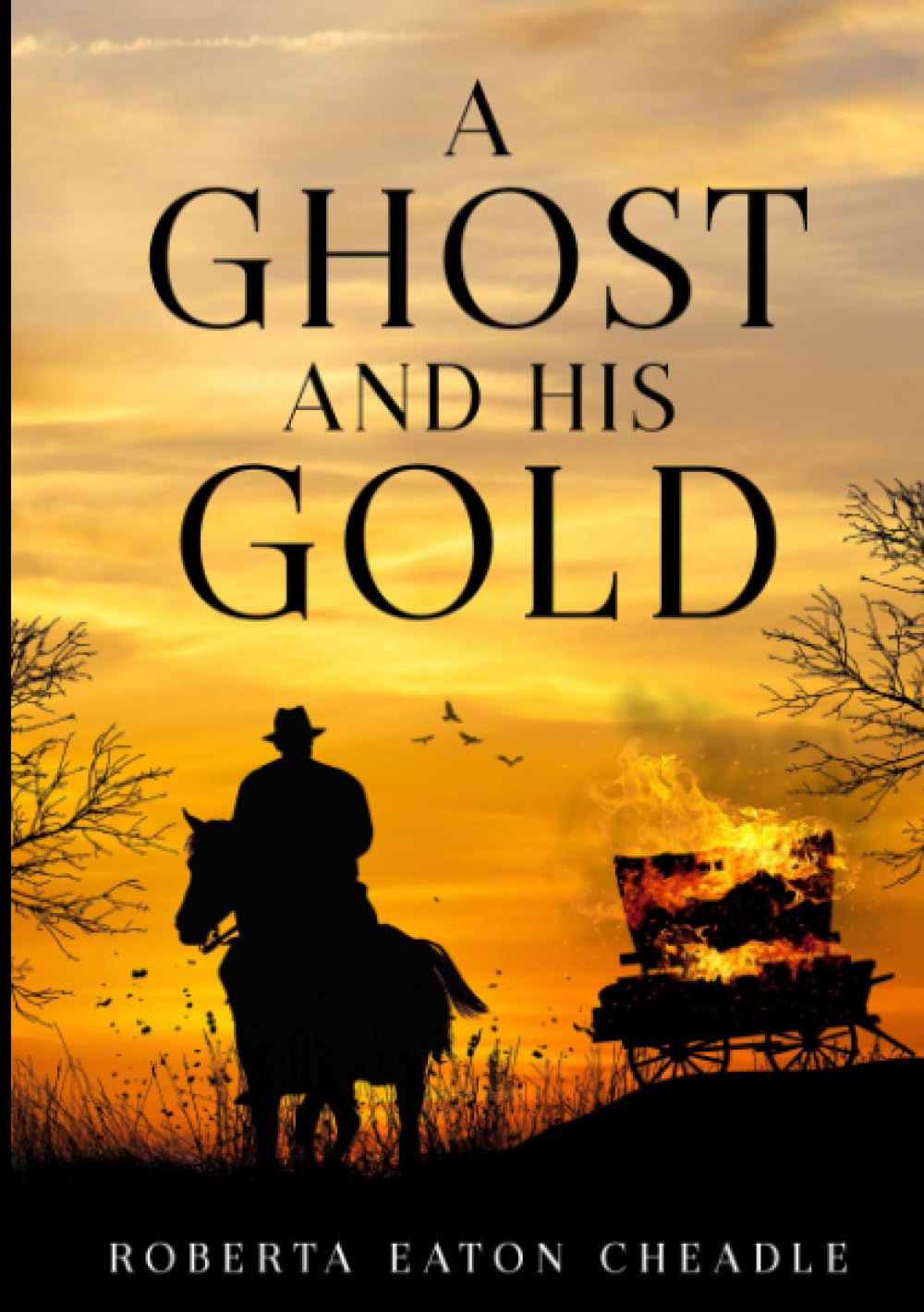
After Tom and Michelle Cleveland move into their recently built, modern townhouse, their housewarming party is disrupted when a drunken game with an Ouija board goes wrong and summons a sinister poltergeist, Estelle, who died in 1904.
Estelle makes her presence known in a series of terrifying events, culminating in her attacking Tom in his sleep with a knife. But Estelle isn’t alone. Who are the shadows lurking in the background – one in an old-fashioned slouch hat and the other, a soldier, carrying a rifle?
After discovering their house has been built on the site of one of the original farms in Irene, Michelle becomes convinced that the answer to her horrifying visions lie in the past. She must unravel the stories of the three phantoms’ lives, and the circumstances surrounding their untimely deaths during the Second Anglo Boer War, in order to understand how they are tied together and why they are trapped in the world of ghosts between life and death. As the reasons behind Estelle’s malevolent behaviour towards Tom unfold, Michelle’s marriage comes under severe pressure and both their lives are threatened.
Purchase Links
Paperback:
eBook:


 LatinosUSA
Replica a robbiesinspiration Cancelar la respuesta