
Hi everyone, it’s Robbie Cheadle bringing you Nicole Sara’s thoughtful and interesting analysis of Leda and the Swan by Giovanni Antonio Bazzi.
Leda and the Swan
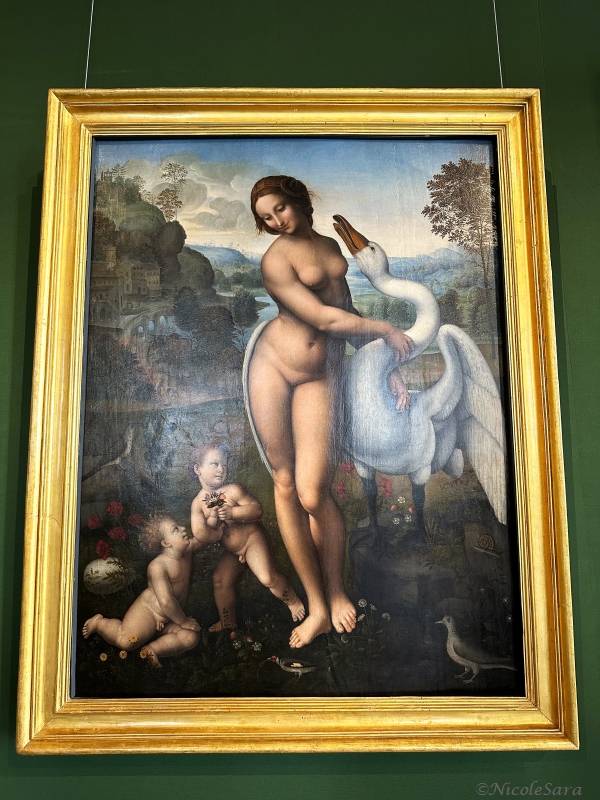
Leda and the Swan, displayed at Galleria Borghese in Rome, is a copy after Leonardo da Vinci attributed to the Italian Renaissance painter Giovanni Antonio Bazzi (Il Sodoma), c. 1510–1515. The painting, in tempera on wood, is in fact one of the most significant copies of the lost Leda, cited in sources in France in 1625, and the nine currently known copies of the work are a reflection of the popularity of the theme.
Leonardo is one of the best-known artists from the period known as the Italian Renaissance – a term used to describe the culture, art and politics of Italy during the 15th and 16th centuries. He is widely regarded as the ultimate ‘Renaissance Man’; that is to say, he had skills that ranged across multiple subjects including art, science, engineering and music.
Greatly admired in its time, Leda and the Swan revisits the ancient myth of Jupiter (Zeus) who transformed himself into a swan out of love for Leda. The painting was a reflection by Leonardo on the theme of the forces of Nature, the intertwining bodies reflecting Renaissance ideas about nature, fertility, and transformation. The symbolic centre of the Borghese composition is the egg, almost hidden by the grass, with the figure of Leda, still enclosed in the embrace of her lover, acting as a counterpoint.
Nowadays, this might not be a subject we can easily identify, however, during the Renaisssance, this story was well known. Jupiter, King of the Gods and therefore immortal, often disguised himself in order to seduce anyone he took a fancy to. Here, disguised as a swan, he seduces Leda, who was human, not divine.
In the painting, a completely naked woman is caught in an embrace with a swan; she caresses the swan’s long curved neck as it appears to be nestling into her hair or ear with its beak. Curiously, the woman’s pose is very like that of the swan. By blending the forms of Leda with the surrounding botanical studies, Leonardo combines his fascination with nature and classical myth and in particular a story linked to fertility and the cyclical power of nature.
The babies hatching from the eggs to which Leda gestures are her children. Most accepted versions of the story describe Pollux and Helen hatching from one egg, and Castor and Clytemnestra from the other. The storyline suggests that Jupiter was the father of two of the babies and that Leda’s husband, Tyndareus, was the father of the other two. Castor and Pollux are better known as Gemini (meaning twins, although technically they were not). Clytemnestra and Helen were Spartan princesses who married kings and were both implicated in one way or another in the Trojan War.
In poetry, «Leda and the Swan» is a sonnet by William Butler Yeats composed in 1923, combining psychological realism with a mystic vision, also alluding to the Trojan War, which will be provoked by the abduction of Helen (who will be begotten by Zeus on Leda, along with Castor and Pollux, in some versions of the myth). Clytaemnestra, who killed her husband, Agamemnon, leader of the Greeks at Troy, was also supposed to have hatched from one of Leda’s eggs. The poem is regularly praised as one of Yeats’s masterpieces.
There is also the beautiful poem by Nicaraguan poet Rubén Darío’s, «Leda» written in 1892, which contains an oblique description of Leda and the swan, watched over by the god Pan. Here are the first two stazas of this beautiful poem,
El cisne en la sombra parece de nieve;
su pico es de ámbar, del alba al trasluz;
el suave crepúsculo que pasa tan breve
las cándidas alas sonrosa de luz.
Y luego en las ondas del lago azulado,
después que la aurora perdió su arrebol,
las alas tendidas y el cuello enarcado,
el cisne es de plata bañado de sol.
English translation:
The swan composed of snow floats in shadow,
amber beak translucent in the last light.
The white and innocent wings in the glow
of the short-lived dusk are rose-tipped and bright.
And then, on ripples of the clear blue lake,
when the crimson dawn is over and done,
the swan spreads his wings and lets his neck make
an arch, silver and burnished by the sun.
It has been also proposed that Leonardo’s Chatsworth sketch for Leda and the Swan may have been inspired by the Laocoön Group, the ancient sculpture discovered in 1506 which has been called «the prototypical icon of human agony». There is a similar twist to the subject’s body, the curve of the swan’s neck recalls the snake’s lithe body in Laocoön’s hand and Leda’s twisted body resembles the forceful attack of the serpents.
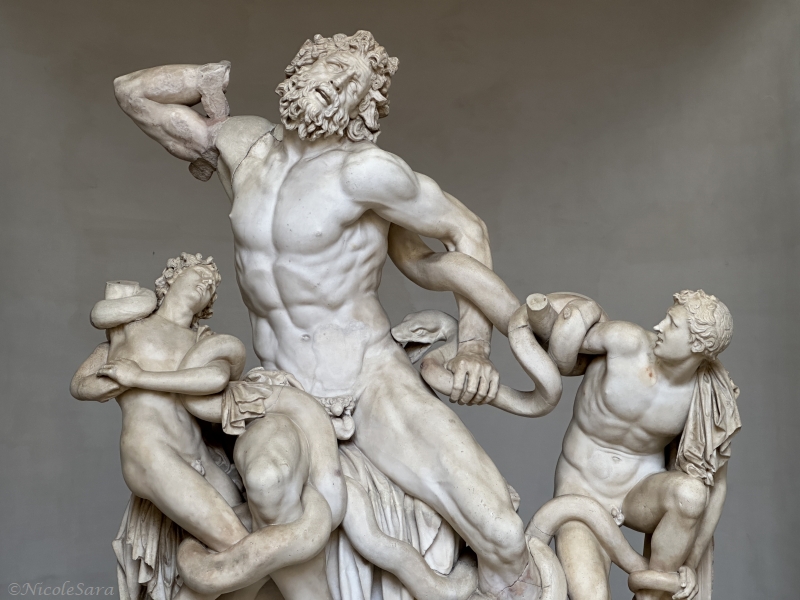
It was impressive to be able to admire and take photos of this painting in the Borghese Gallery in Rome, having read about and studied the myth before, both in art and poetry. What has always felt baffling to me is Leda’s calm, almost serene pose contrasting with the myth’s underlying tension, which seems to suggest the complex interplay between vulnerability and authority, and the blurring lines between force and seduction.
Lastly, it may be that at a deeper level, the work ultimately explores how divine forces subtly and mysteriously intrude upon the human world, reshaping entire destinies through intimate, sometimes unsettling encounters. Swans too, have often been seen as a symbol of wisdom and of the awakening of the power of self, also of balance and purity, inner beauty and outer grace, and even spiritual understanding and evolution. What do you think?
Sources:
https://www.collezionegalleriaborghese.it/en/opere/leda-3
https://en.wikipedia.org/wiki/Leda_and_the_Swan_(Leonardo)
About Nicole Sara

Nicole Sara is an inspirational poet, writer and blogger with a Master’s Degree in Philology and American Studies from the “Al.I.Cuza” University in Iași. She loves languages and performing magic with words and ideas in both playful and dreamy, insightful ways.
For Nicole, writing, and especially writing in verse, is a delight! She writes in order to fly away without too many restrictions and to rejoice in every beautiful thing around. When writing, she feels she leaves the “much too real” routine behind, and she soars freely with each and every line and piece of imagery, dreaming away and fluttering restlessly among words, thoughts and rhymes.. and of course, lovely nature photos.
Aside from writing, photography is Nicole’s other great love. When she is not writing, she can be found clicking away, taking lots of flower and sunset photos, exploring the outdoors with her Nikon cameras and her phone, capturing pictures which she enjoys sharing on her blogs.
A little drop of orange and pink, her two favorite colors, and a couple of strawberries can also be added to the mix, a little more love of travelling, and a huge deal of sea, sky, sun and sand… there, the picture is almost done! The rest is to be discovered and enjoyed between the lines and photos dreamily dancing along the pages.
«Rhyming Dreams», Nicole’s debut collection, is for anyone who dreams a lot, loves deeply, going through both good and less good moments… like steps on a pathway, continuously winding but tirelessly searching for happiness and hope in the enjoyment of small but sweet things all around.
Find Nicole Sara
Blog: https://starrysteps.wordpress.com/
Bilingual blog: https://doarnicol.wordpress.com/
Fine Art America: https://fineartamerica.com/profiles/nicole-sara
Pixels: https://nicole-sara.pixels.com/
Etsy Shop: http://www.etsy.com/shop/starrystepsshop
Instagram: https://www.instagram.com/nicoles.steps/
Facebook Page: https://www.facebook.com/NicoleSaraArt/
About Robbie Cheadle
South African author, photographer, and artist, Robbie Cheadle, has written and illustrated seventeen children’s books, illustrated a further three children’s books, written and illustrated four poetry books and written and illustrated one celebration of cake and fondant art book with recipes. Her work has also appeared in poetry and short story anthologies.
Robbie also has two novels and a collection of short stories published under the name of Roberta Eaton Cheadle and has horror, paranormal, and fantasy short stories featured in several anthologies under this name.
You can find Robbie Cheadle’s artwork, fondant and cake artwork, and all her books on her website here: https://www.robbiecheadle.co.za/
Social Media Links
Bluesky: https://bsky.app/profile/robbiecheadle.bsky.social
YouTube: https://www.youtube.com/channel/UCVyFo_OJLPqFa9ZhHnCfHUA
Goodreads: https://www.goodreads.com/author/show/15584446.Robbie_Cheadle
TSL Publications: https://tslbooks.uk/product-tag/robbie-cheadle/
Amazon: https://www.amazon.com/stores/Robbie-Cheadle/author/B01N9J62GQ
Unsplash profile: https://unsplash.com/@r_cheadle


 LatinosUSA
Replica a Esther Chilton Cancelar la respuesta