The Chimes, a Dickens novella which was first published in 1844, one year after the well-known A Christmas Carol.
The story involves the disillusionment of Toby “Trotty” Veck, a poor working-class man who works as a casual messenger or ‘ticket-porter’. Dickens goes to great lengths at the beginning of the story to detail Trotty’s poverty as per the following description:
“Making, with his leaky shoes, a crooked line of slushy footprints in the mire; and blowing on his chilly hands and rubbing them against each other, poorly defended from the searching cold by threadbare mufflers of grey worsted, with a private apartment only for the thumb, and a common room or tap for the rest of the fingers; Toby, with his knees bent and his cane beneath his arm, still trotted.“
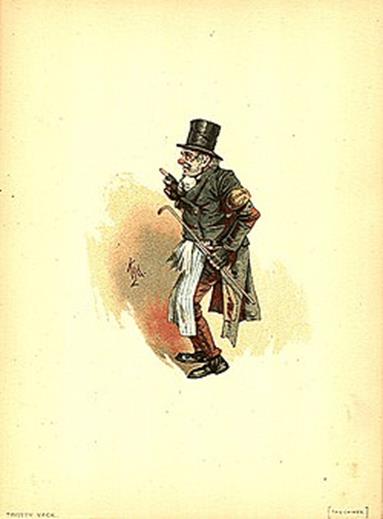
Picture credit: Public domain picture: Trotty Veck 1889 Dickens The Chimes character by Kyd (Joseph Clayton Clarke)
The story commences on the afternoon before New Year’s Day. Trotty is waiting for work outside the church. Work has been slow for a few weeks despite his willingness to work hard. He is depicted as being a cheerful man despite his lot in life, but on that cold winter’s afternoon he reads a newspaper which includes a number of scathing reports about the poor. He embarks on a train of thought that the working classes are unworthy and their poverty is a result of this unworthiness. Trotty wonders whether the poor are born corrupt and are incapable of redemption.
His lovely daughter, Meg, arrives, bringing him a meal of tripe she has cooked. Meg tells her father that she is going to marry her childhood sweetheart, Richard, despite the fact they are both poor. She makes it clear that she accepts their poverty and does not expect their situation to ever change. These are her words:
“‘He says then, father,’ Meg continued, lifting up her eyes at last, and speaking in a tremble, but quite plainly; ‘another year is nearly gone, and where is the use of waiting on from year to year, when it is so unlikely we shall ever be better off than we are now? He says we are poor now, father, and we shall be poor then, but we are young now, and years will make us old before we know it. He says that if we wait: people in our condition: until we see our way quite clearly, the way will be a narrow one indeed—the common way—the Grave, father.’”
Dickens intention with this depiction is to highlight the terrible plight of the poor who are trapped in a capitalist system where the wealthy always abuse the poorer. He is also demonstrating Meg’s and Richard’s passive acceptance of their situation. Dickens believed this passive acceptance of the status quo by the working classes to be wrong.
Trotty has misgivings about the marriage but hides it and they are happy until they encounter the proud and wealthy Alderman Cute and two other gentlemen. The gentlemen succeed in making Trotty, his daughter, and her fiancé feel as if they have no right to exist, never mind marrying and have children who with perpetuate the cycle of poverty. Alderman Cute degrades and humiliates Trotty and the working classes in general.
” ‘You see, my friend,’ pursued the Alderman, ‘there’s a great deal of nonsense talked about Want—“hard up,” you know; that’s the phrase, isn’t it? ha! ha! ha!—and I intend to Put it Down. There’s a certain amount of cant in vogue about Starvation, and I mean to Put it Down. That’s all! Lord bless you,’ said the Alderman, turning to his friends again, ‘you may Put Down anything among this sort of people, if you only know the way to set about it.’“
Cute gives Trotty a note to carry to Sir Joseph Bowley MP, who gives charity to the poor but is another arrogant and hypocritical man. Trotty’s encounter with Bowley leave him feeling even more humiliated and disillusioned.
“‘What man can do, I do,’ pursued Sir Joseph. ‘I do my duty as the Poor Man’s Friend and Father; and I endeavour to educate his mind, by inculcating on all occasions the one great moral lesson which that class requires. That is, entire Dependence on myself. They have no business whatever with—with themselves. If wicked and designing persons tell them otherwise, and they become impatient and discontented, and are guilty of insubordinate conduct and black-hearted ingratitude; which is undoubtedly the case; I am their Friend and Father still. It is so Ordained. It is in the nature of things.’“
Later that evening, Toby reads some sad and depressing news in the evening paper. He believes he hears the church bells chiming his name and he sets out to climb the church tower and hear what they have to say to him. This is the beginning of the supernatural part of the story that leads to Trotty realising that the poor are not born bad but that many of them end up in bad situations due to their terrible circumstances.
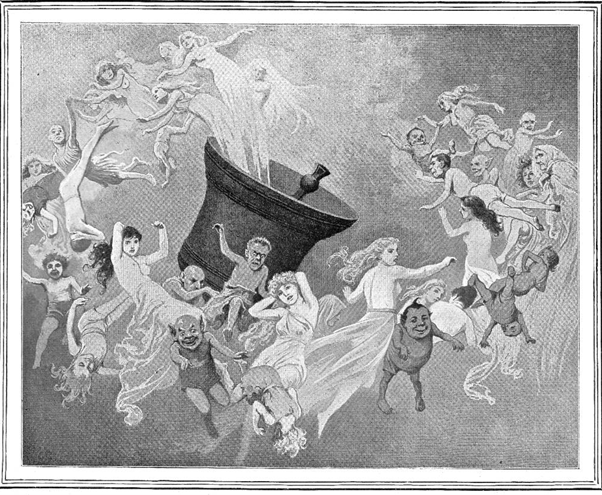
Picture credit: The Goblins of the Bells by Charles Green (p. 84). 1912. 7.5 x 9.9 cm. Dickens’s The Chimes, Pears Centenary Edition
Passage illustration:
“He saw the tower, whither his charmed footsteps had brought him, swarming with dwarf phantoms, spirits, elfin creatures of the Bells. He saw them leaping, flying, dropping, pouring from the Bells without a pause. He saw them, round him on the ground; above him, in the air; clambering from him, by the ropes below; looking down upon him, from the massive iron-girded beams; peeping in upon him, through the chinks and loopholes in the walls; spreading away and away from him in enlarging circles, as the water ripples give way to a huge stone that suddenly comes plashing in among them. He saw them, of all aspects and all shapes. He saw them ugly, handsome, crippled, exquisitely formed. He saw them young, he saw them old, he saw them kind, he saw them cruel, he saw them merry, he saw them grim; he saw them dance, and heard them sing; he saw them tear their hair, and heard them howl. He saw the air thick with them. He saw them come and go, incessantly. He saw them riding downward, soaring upward, sailing off afar, perching near at hand, all restless and all violently active. Stone, and brick, and slate, and tile, became transparent to him as to them. He saw them in the houses, busy at the sleepers’ beds. He saw them soothing people in their dreams; he saw them beating them with knotted whips; he saw them yelling in their ears; he saw them playing softest music on their pillows; he saw them cheering some with the songs of birds and the perfume of flowers; he saw them flashing awful faces on the troubled rest of others, from enchanted mirrors which they carried in their hands. [“Third Quarter,” pp. 83-85, 1912 edition]“
Dickens uses the goblins in the bells as his instruments for social criticism and to make his points about the unjust treatment of the poor who are often wrongly accused an imprisoned for any reason due to the government’s attitude of ‘to jail with them’. The goblins also expose the social inequality innate in Victorian society and the hypocrisy of the politicians and aristocrats of the time.
Conclusion
Of the four so called Christmas novellas written by Charles Dickens I have read A Christmas Carol, The Chimes, The Battle of Life and The Cricket on the Hearth, a Fairy Tale of Home, this is the one that brought the snobbery, hypocrisy, and arrogance of the Victorian gentry home to me the hardest.
The impact of the social inequality on the psyche of the working classes represented by Trotty and his daughter, Meg, and the injustices of the legal system presented by the treatment of Will Fenn, are truly heartbreaking as is the misguided attitude of the philanthropist represented by Sir Bowley.
How easy it is to judge others from a position of wealth and privilege.
You can read The Chimes for free here: https://www.gutenberg.org/files/653/653-h/653-h.htm
Have you read The Chimes? What did you think of its message?


 LatinosUSA


Replica a Liz Gauffreau Cancelar la respuesta