Classic Books and Poems – Myths, Legends, Poem, and Books: Dark Origins: Hansel and Gretel

Published by

on

Most people are familiar with the story of Hansel and Gretel, a German fairy tale collected by the Brothers Grimm and published in their Grimm’s Fairy Tales in 1812.

In summary, the story goes as follows:

Hansel and Gretel are a brother and sister whose starving parents decide to abandon them in the forest. Hansel overhears his parents plotting and drops pebbles on the path so that he and Gretel can find their way home later. The family’s plight does not improve and a short while later the mother [or stepmother depending on the version] persuades the father to take the children into the forest again and leave them there. This time, Hansel drops a trail of breadcrumbs but the birds eat them and the two children become lost in the forest.

The starving children come across a gingerbread house and they begin to break off bits and eat it. The house, however, is a trap set by a wicked witch who captures the children, enslaves Gretel and locks Hansel in a cage. She sets about fattening Hansel up so that she can eat him.

Gretel saves Hansel by shoving the witch into the oven which she has heated up in order to cook Hansel. The pair escape and manage to find their way home with the witch’s treasure. In the meantime, their mother [or stepmother] has died and their father is a broken man having abandoned his beloved children. The family live happily ever after.
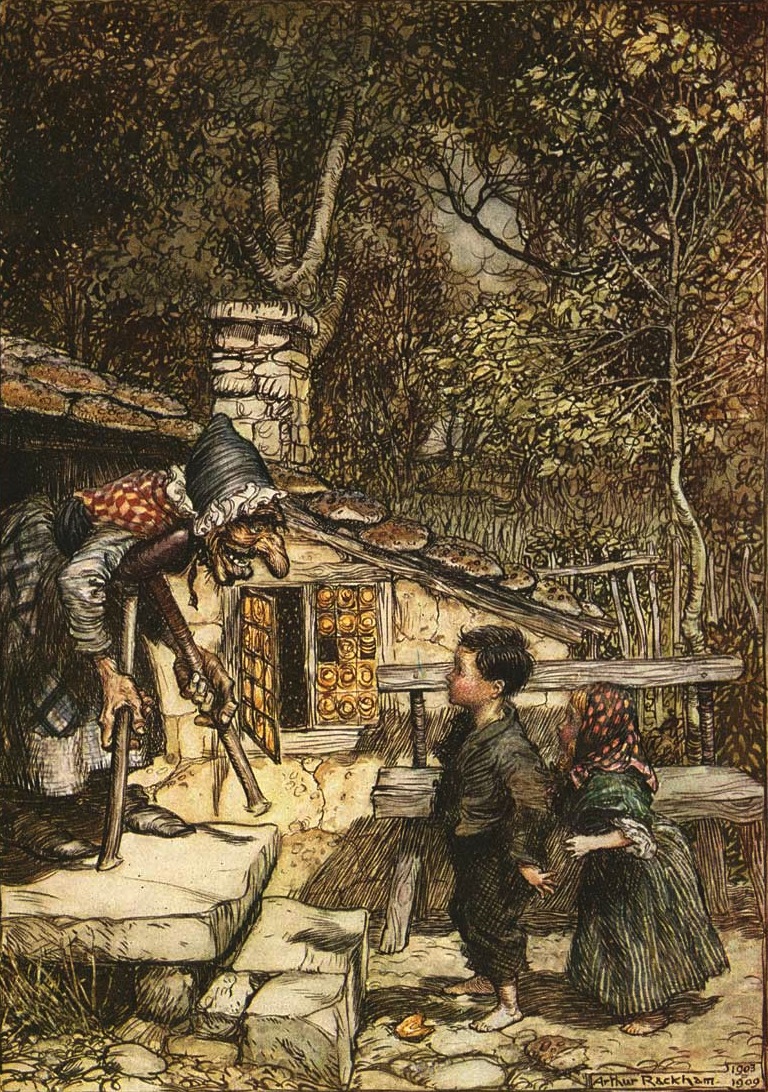
Hansel and Gretel - Wikipedia
Picture from Wikipedia: https://en.wikipedia.org/wiki/Hansel_and_Gretel

The real history behind this already rather grim story, is even more grim.

The true story of Hansel and Gretel may have its roots in the great flood and great famine of 1314. 1314 was a year of continuous rain and this continued throughout 1315 and 1316. The wet conditions resulted in crops rotting in the ground, harvests failing and livestock drowning or starving. Food prices increased dramatically as a result of severe food shortages.

The great famine is estimated to have effected 400,000 square miles of Europe, 30 million people and to have resulted in the deaths of up to 25 percent of the population in certain areas.

The famine was so bad that during the winter of 1315/1316, the peasants resorted to eating the seed grain they had stored for planting in the spring. People resorted to begging, stealing and even murder in their quest for food. Parents abandoned their children to fend for themselves and their were rumours of cannibalism. An Irish chronicler wrote that people “were so destroyed by hunger that they extracted bodies of the dead from cemeteries and dug out the flesh from the skulls and ate it, and women ate their children out of hunger.”

In the story of Hansel and Gretel, the pair are taken into the forest by their father and abandoned. They are taken in by an old woman living in a cottage. When the old woman starts to heat the oven, the children realise she is planning to roast and eat them. Gretel tricks the woman into opening the oven and pushes her inside.

It is interesting to note that this time of famine coincided with the end of the medieval warm weather period and the beginning of the little ice age. The changing climate with its cooler and wetter summers and earlier autumn storms damaged the harvests. Given the strange wet and cool summer South African is experiencing, coupled with severe cold in the northern hemisphere, this really is food for thought.

Another grim early tale along the lines of Hansel and Gretel is a Romanian story called The Little Boy and the Wicked Stepmother. You can read this story here: http://www.planetofbirds.com/the-story-of-the-little-boy-and-the-wicked-step-mother

The story of Hansel and Gretel was the inspiration for my recent twisted fairy tale Covid-19 cake which featured a gingerbread house and a witch who is trying to keep children out after they are declared to be vectors for the virus.

About Robbie Cheadle
Picture caption: Robbie Cheadle author photograph

South African author, photographer, and artist, Robbie Cheadle, has written and illustrated seventeen children’s books, illustrated a further three children’s books, written and illustrated four poetry books and written and illustrated one celebration of cake and fondant art book with recipes. Her work has also appeared in poetry and short story anthologies.

Robbie also has two novels and a collection of short stories published under the name of Roberta Eaton Cheadle and has horror, paranormal, and fantasy short stories featured in several anthologies under this name.

You can find Robbie Cheadle’s artwork, fondant and cake artwork, and all her books on her website here: https://www.robbiecheadle.co.za/

Social Media Links

Bluesky: https://bsky.app/profile/robbiecheadle.bsky.social
YouTube: https://www.youtube.com/channel/UCVyFo_OJLPqFa9ZhHnCfHUA
Goodreads: https://www.goodreads.com/author/show/15584446.Robbie_Cheadle
TSL Publications: https://tslbooks.uk/product-tag/robbie-cheadle/
Amazon: https://www.amazon.com/stores/Robbie-Cheadle/author/B01N9J62GQ
Unsplash profile: https://unsplash.com/@r_cheadle

48 respuestas a “Classic Books and Poems – Myths, Legends, Poem, and Books: Dark Origins: Hansel and Gretel”

  1. Avatar de richardbist

    I always find it interesting to learn the background and history of stories. Thanks for sharing this, Robbie. It was a great read.

    Me gusta

    1. Avatar de robertawrites235681907

      Hi Richard, I am pleased you also find these origins interesting.

      Le gusta a 1 persona

  2. […] Classic Books and Poems – Myths, Legends, Poem, and Books: Dark Origins: Hansel and Gretel […]

    Me gusta

  3. Avatar de Violet Lentz

    I love the historical boost you gave the storyline. Wonderful synopsis.

    Me gusta

    1. Avatar de robertawrites235681907

      Thank you, Violet. The origin is truly gruesome

      Le gusta a 1 persona

  4. Avatar de Dave Astor

    Thank you, Robbie, for the fascinating/harrowing real-life history behind «Hansel and Gretel»!

    Le gusta a 1 persona

    1. Avatar de robertawrites235681907

      My pleasure, Dave. I find these origins very interesting.

      Le gusta a 1 persona

  5. Avatar de D. Wallace Peach

    The history of famine in Europe as the origin of the tale is indeed dark, Robbie. Bleak times and desperate people. I think I like the Grimm Brothers’ version a little better, though even that one is dark!

    Le gusta a 1 persona

    1. Avatar de robertawrites235681907

      Hi Diana, I grew up with the original stories of Grimm Brothers, Hans Christian Anderson and Aesop’s fables. They molded my literature interests.

      Le gusta a 1 persona

  6. Avatar de Darlene

    It is always interesting to learn about the origins of these stories. They are usually quite grim.

    Le gusta a 1 persona

    1. Avatar de robertawrites235681907

      Hi Darlene, you are right they are grim but also fascinating.

      Le gusta a 1 persona

  7. Avatar de Rosie Amber

    The origins of theses types of stories are really interesting.

    Me gusta

    1. Avatar de robertawrites235681907

      Hi Rosie, I think so too. I have the book you recommended on my TBR for this month

      Le gusta a 1 persona

  8. Avatar de Nicole Sara

    Very interesting, to find out more about the origins of familiar fairy tales. Recently I have watched quite a few youtube video about the dark variants of such stories, as we have grown too used to the Disney versions, for instance.

    I used to read many fairy tale books as kid, also myths and legends, and later on, during faculty years I grew interested in deciphering the symbolism in some Romanian folk tales… absolutely fascinating. There is a book that inspired me to do that, The Golden Bough by Sir J.G. Frazer, and the writings of Mircea Eliade and Vasile Lovinescu (a Romanian esoteric philosopher).

    Although the motifs are quite familiar to me, I don’t think I read The Story of the Little Boy and the Wicked Stepmother, or… maybe I did and forgot. As kids, we read these innocently somehow, unaware of the grim side of things and the world’s. It is a very sad story, as most legends are.

    Le gusta a 1 persona

    1. Avatar de robertawrites235681907

      Hi Nicole, thank you for adding your thoughts about this topic. I also read a lot of fairy tales as a child and I read them to my children. They are often dark but children generally only understand to the extent they have experience so they don’t identify with the dark elements. This is why I always let my sons read what they wanted to. I did not let them watch what they wanted to because providing a graphic images changes the level of understanding a great deal. It’s hard to imagine what you don’t know.

      Le gusta a 1 persona

  9. Avatar de Rebecca Budd

    Thank you for this powerful reminder of where the story of Hansel and Gretel may have begun, Robbie. It is sobering to think of the hunger, rain and despair that shaped those early tales. Your research brings into focus how people once lived through unimaginable hardship and how stories became a way to carry those experiences forward.

    What stays with me is how creativity continues even in desperate times. These tales were born in fear and uncertainty, yet they survived because someone shaped them into narrative form, giving later generations a way to remember what happened. We may read them now as macabre or unsettling, but they hold the memory of real lives and real suffering.

    Your connection to today feels especially timely. We are still living in a world where climate change, illness and instability shape our stories. In that sense, we are not so far removed from those medieval families. And yet, like them, we keep creating. We keep finding meaning, even in bleak moments.

    Le gusta a 1 persona

    1. Avatar de robertawrites235681907

      Hi Rebecca, this is a very insightful comment. I agree that story telling is an important part of preserving human history and the emotion and drama of points in time and human development. New generations face different issues but they are no less challenging.

      Le gusta a 1 persona

  10. Avatar de Colleen Chesebro

    This is so interesting, Robbie. I’m glad you added some of this story to your new your newest book: Something Fancy A Winter Wonderland Celebration Book One (Something Fancy Celebrating with Confectionary 1). I like the connection to gingerbread in this story.

    Me gusta

    1. Avatar de robertawrites235681907

      Yes, I did add a bit of this interesting history to the gingerbread section. Thanks, Colleen.

      Le gusta a 1 persona

      1. Avatar de Colleen Chesebro

        I’m glad you did. It was fascinating.

        Me gusta

      2. Avatar de robertawrites235681907

        💓

        Me gusta

  11. Avatar de Tofino Photography

    I hope the children roasted the old woman just right and didn’t overcook her!

    ….on a side note they always portray the old woman as being ugly. What if she was very beautiful?

    Me gusta

    1. Avatar de robertawrites235681907

      Hi Wayne, you are right that most witches are described as being ugly. Roald Dahl described them as wearing masked to make them look ordinary. Underneath the masks they were hideous. I guess that is how it should be – bad actions should show on your face and body like in The Portrait of Dorian Grey. I’m sure roast witch would be very tough 😂

      Me gusta

  12. Avatar de Author Jan Sikes

    A grim history indeed! What a terrible for humans. Thanks for sharing, Robbie.

    Me gusta

    1. Avatar de robertawrites235681907

      It was a terrible time. Hard to imagine this situation in Europe.

      Me gusta

  13. Avatar de Teri Polen

    I never knew the history behind this story, but what a horrifying time it must have been. I can’t even imagine what life was like then. Thanks for sharing, Robbie.

    Me gusta

    1. Avatar de robertawrites235681907

      Hi Teri, it is easier to imagine this sort of situation in Southern Africa because we are surrounded by poverty here. It’s hard to imagine this in a European setting.

      Me gusta

  14. Avatar de Liz Gauffreau

    It sounds as though the great famine was as back as the Black Plague.

    Me gusta

    1. Avatar de robertawrites235681907

      Yes, Europe has had a difficult history. Just like everywhere else

      Le gusta a 1 persona

  15. Avatar de thomasstigwikman

    Yes that is a dark tale. I’ve heard the story behind Hansel and Gretel before, about the great famine. It reminds me of some recent great famines, such as Somalia 2011 (260,000 dead) and Sudan 2017. The great leap forward famine around 1960 killed between 15 million to 50 million people.

    Me gusta

    1. Avatar de robertawrites235681907

      Famine is still a huge threat to human survival. Thanks for sharing your thoughts on this topic, Thomas.

      Le gusta a 1 persona

  16. Avatar de beetleypete

    Thanks for the interesting history behind the folk tale, Robbie. Shared on Twitter.

    Best wishes, Pete.

    Me gusta

    1. Avatar de robertawrites235681907

      I’m glad you enjoyed this post, Pete. Thanks for the share.

      Le gusta a 1 persona

  17. Avatar de Annette Rochelle Aben

    Dark and grim, indeed. Well-presented and most appreciated.

    Me gusta

    1. Avatar de robertawrites235681907

      I’m pleased you enjoyed this history, Annette

      Le gusta a 1 persona

  18. Avatar de Edward Ortiz

    Great historical background, Robbie. I have never followed the story closely, but I watched the movie “Hansel and Gretel: Witch Hunters”, and I thought it was interesting.

    Me gusta

    1. Avatar de robertawrites235681907

      Hi Edward, I have not seen the movie you mentioned. I rarely watch movies. This history is pretty interesting.

      Le gusta a 1 persona

      1. Avatar de Edward Ortiz

        It’s definitely interesting. It’s good to revisit the history behind some of these classics.

        Me gusta

  19. Avatar de Jennie

    Thank you for the background, Robbie. I’m not surprised. The Brothers Grimm wrote scary tales. Cinderella is my favorite of their tales, and is very different (and creepy) from what we know today.

    Me gusta

    1. Avatar de robertawrites235681907

      Yes, the original Cinderella is a lot more horrific than the Disney version. I like the Disney version with the singing mice

      Le gusta a 1 persona

      1. Avatar de Jennie

        It is a lot more horrific; no fairy godmother, just the tree and the birds. The worst was the stepmother cutting off the heel of one of her daughters and the toes of the other daughter, so they could fit into the slipper. No, that’s not the worst! It’s the birds who pecked out the eyeballs of the stepdaughters.😳 Yup, the Disney version is for me, too!

        Me gusta

      2. Avatar de robertawrites235681907

        An eye for an eye was certainly the messaging in those stories 💞

        Le gusta a 1 persona

      3. Avatar de Jennie

        Yes, it was.

        Me gusta

  20. Avatar de Dawn Pisturino

    Thanks for this history!

    Me gusta

    1. Avatar de robertawrites235681907

      My pleasure, Dawn. It is interesting.

      Me gusta

  21. Avatar de SAYOR BASELENOUS

    Thank you for sharing this, Robbie. The historical background behind Hansel and Gretel is shocking yet fascinating. I also love how you creatively reimagine these tales in your artwork—it really brings them to life in a modern context.

    Me gusta

    1. Avatar de robertawrites235681907

      Thank you, I am pleased you appreciate my artwork and enjoyed this history.

      Le gusta a 1 persona

  22. Avatar de Lauren Scott, Author

    It’s interesting to learn the origins of these stories, Robbie, and they are quite dark, to say the least. They seem to be more for adults than for children. Thanks for sharing with us.

    Me gusta

Replica a robertawrites235681907 Cancelar la respuesta