
You can read The Cricket on the Hearth here: https://www.gutenberg.org/files/678/678-h/678-h.htm
According to New York University: “The Cricket on the Hearth was the most popular of Dickens’s Christmas Books, which he wrote both to support his large family and to generate readers’ sympathy and charitable giving, often through characters who are poor, suffering, and/or physically disabled.”
This story is set within a small family comprising of John Peerybingle, a carrier, his much younger wife, Mary but called Dot, and their baby. The baby’s nanny, Tilly Slowboy, lives with them. A cricket chirps on the hearth and acts as a guardian angel to the family.
The story starts with with a setting of domesticity where the reader meets Dot who is filling the kettle in anticipating of her husband’s arrival home after a long days work. There is a lengthily and entertaining description of the kettle, which Dot struggles to fill, carry over to the hearth, and set it upon the fire.
The purpose of the scene would appear to be to demonstrate the happy character of Dot who is quickly restored to good humour despite her struggle with the cantankerous kettle. The kettle submits and starts to behave, entering into a singing challenge with the cricket as indicated by this quote:
“And here, if you like, the Cricket DID chime in! with a Chirrup, Chirrup, Chirrup of such magnitude, by way of chorus; with a voice so astoundingly disproportionate to its size, as compared with the kettle; (size! you couldn’t see it!) that if it had then and there burst itself like an overcharged gun, if it had fallen a victim on the spot, and chirruped its little body into fifty pieces, it would have seemed a natural and inevitable consequence, for which it had expressly laboured.”
John soon arrives home to this scene of domestic bliss, bringing with him a selection of parcels that he is either to deliver or which will be collected from his home. Dot soon comes across a spectacular wedding cake and learns that the local miser, Mr Tackleton, is to be married to her young and beautiful school friend, May.
Dot is clearly upset by this news and not long afterwards, John remembers and elderly man who travelled on his cart with him, and rushes out to bring him inside. The elderly gentleman asks if he can lodge with the Perrybingles for a few days. It quickly becomes evident that the elderly man’s presence had disturbed Dot greatly and her behaviour is quite unusual that evening.
The Perrybingle’s are also great friends with Caleb Plummer, a poor toymaker who works for Mr Tackleton, and Caleb’s blind daughter, Bertha. It is disclosed that Mr Plummer also had a son, Edward, who’d travelled to South America some years before and never returned. May was the sweetheart of Edward and is being compelled to marry Mr Tacklton by her overbearing and anxious mother.
The night before the wedding, Mr Tackleton tells John that his wife is cheating on him and manages to show him a secret scene in which Dot embraces the mysterious stranger.
The rest of the story is devoted to untangling these threads and restoring all parties to harmony and love.
This story is quite removed from Dickens’ usual stories filled with social criticism, current events, and other topical themes, and is, in his own words, it is “quiet and domestic […] innocent and pretty.”
The most interesting social theme in the story is Dickens’ description of Bertha, the blind daughter of Caleb Plummer. Caleb has mislead Bertha from birth, describing the hovel in which they live as being charming, and his selfish and tyrannical employer, Mr Tackleton, as being kind at heart. Poor misled Bertha has fallen in love with her father’s depiction of Mr Tackleton and is heartbroken by his engagement to May.
It is important to note that Bertha’s portrayal and love for Mr Tackleton are dependent on the assumption at the time of writing of this story that blind women did not marry. This belief arose due to the Victorian anxiety that disabilities like deafness and blindness were hereditary. Writers of the day liked to place blind women in courtship plots with the express intention that these courtships would not culminate in marriage.
According to New York University’s commentary on The Cricket on the Hearth: “Dickens’s representation of Bertha Plummer as tragically removed from the world of courtship participates in stereotypes about blindness and femininity that linger into the twentieth century. His extension of Bertha’s blindness to a cognitive dullness is an example of the sociological phenomenon of “spread,” in which one disability is assumed, without evidence, to produce impairment to other physical and mental functions.”
I did not know about this stereotyping of blind women, so this was new information to me.
A family scene with John, Dot, the baby, and Tilly Slowboy. Picture credit: https://victorianweb.org/art/illustration/barnard/xmas/12.html
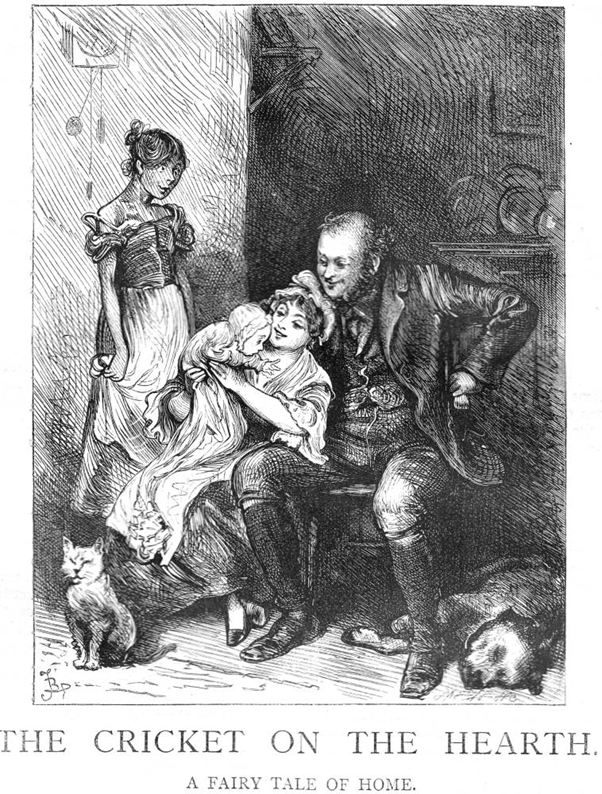
Relevant extract for this picture:
“It was pleasant to see Dot, with her little figure, and her baby in her arms: a very doll of a baby: glancing with a coquettish thoughtfulness at the fire, and inclining her delicate little head just enough on one side to let it rest in an odd, half-natural, half-affected, wholly nestling and agreeable manner, on the great rugged figure of the Carrier. It was pleasant to see him, with his tender awkwardness, endeavouring to adapt his rude support to her slight need, and make his burly middle-age a leaning-staff not inappropriate to her blooming youth. It was pleasant to observe how Tilly Slowboy, waiting inthe background for the baby, took special cognizance (though in her earliest teens) of this grouping; and stood with her mouth and eyes wide open, and her head thrust forward, taking it in as if it were air. Nor was it less agreeable to observe how John the Carrier, reference being made by Dot to the aforesaid baby, checked his hand when on the point of touching the infant, as if he thought he might crack it; and bending down, surveyed it from a safe distance, with a kind of puzzled pride, such as an amiable mastiff might be supposed to show, if he found himself, one day, the father of a young canary.”


 LatinosUSA
Replica a Miriam Hurdle Cancelar la respuesta