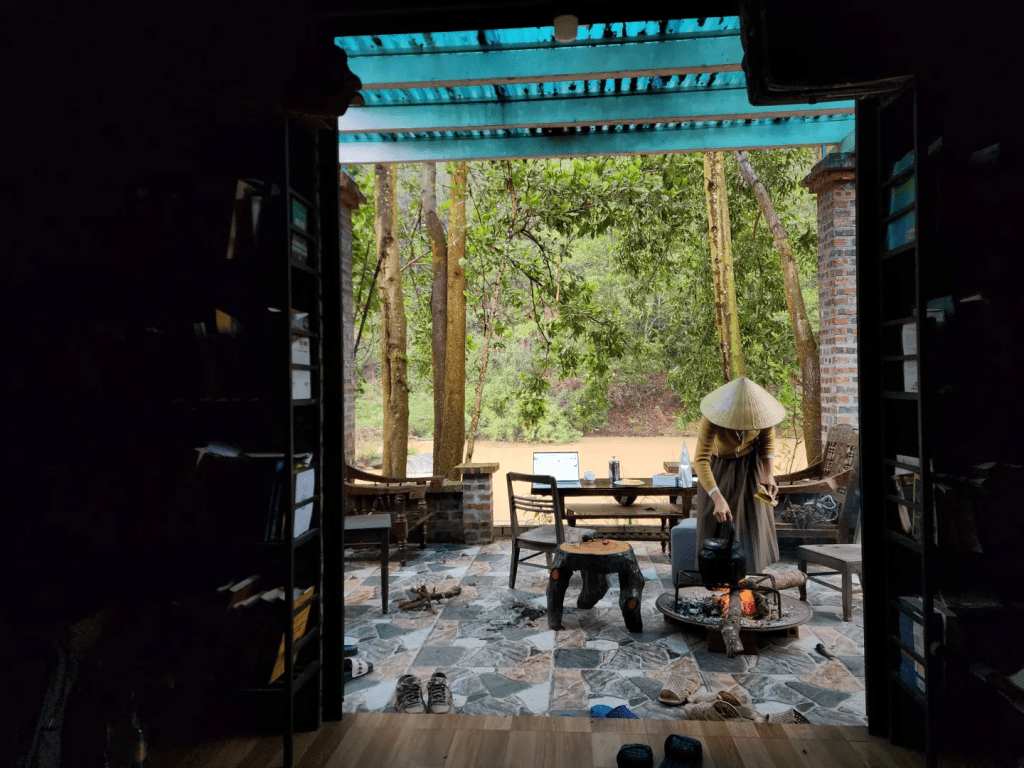
Thu. Photography Nguyễn Thị Phương Trâm
A short story in Vietnamese by Mai Thảo
Translator: Nguyễn Thị Phương Trâm [a body of work in progress – unedited]
It poured the day he saw the old professor. The dike ran along the right bank of Sông Đáy between Ba Thá and Vân Đình. A turbid and muddy trail. Human traffic going with and against each other. A struggle condensed into a fleeting moment of bashfulness, shame and brimming joy along with the image of a cold and unending long trek, pounding and drowning in the bleary white dusty rain the time they had bumped into each other. Remnants of dying villages in the distant.
Teacher and student holding onto each others hand, and the rain continued to pour – together ran for cover under a tree. The years rolling along past us by as we dived head first in to life, now fully grown, next to his teacher he is a head taller. The shrinkage of age makes his teacher appeared even smaller. But between them nothing has changed. As always the teacher is both more firm more confident compared to his student. The exemplary attitude and protection inside the classroom that he as a student received day after day.
“Sir, where are you staying now?”
“Ba Thá”
“You still teach”.
The professor smiled kindly:
“Yes, I still teach but yesterday afternoon the school was bombed. I’m heading for Ty now to make an official report. Ty is a district down from Vân Đình. I’ve lost everything, except for what is here.”
What is here: a sack, a couple of sets of brown clothes and a bamboo stick.
He looks at the small, meaningless career, the last remaining belongings of a moral life, and thought of two images: a humble and meagre ascetic of a certain era imparting beautiful thoughts to humanity in asceticism, and the image of a rain drenching windy path, the afternoon setting upon a large inter-region, the old teacher walking alone on that road, the simplicity of a noble profession is the heavy burden on his silvery hair in the dark stormy night.
The rain continued to pour. The student and teacher gravitated towards each other. Nodding, the old professor looks at his student:
“You gentlemen have changed a lot. All grown up. But it does not matter where I am you still recognise me, and I all of you. You still have exactly the same absent-minded look when you sat in my class looking out the classroom window during those summers in the middle of the day”.
His reply:
“Yes, I remember the way I used to be in class. That has not changed”.
The bass of professor’s warm voice discernable through the consistent clatter of the pouring rain:
“No, nothing has changed”.
The professor’s deep set eyes follows the long path through the rain to the end, further than the end of the road:
“War changes the path we take on the road. Every thing becomes bitter, harder than before. The earthly mounds. Pits and tunnels. Broken bridges. And the storms, there seem to be more of them”.
The professor sigh:
“We are the old ways learning how to walk on a new path”.
Before he turn to look at his student:
“And you, what are you doing now?”
“Buôn sir”
“Buôn?”
“I left school after Cách Mạng Tháng Tám. The stuff I want to smuggle is going up the river around Rót Rét. I will meet up with them at Bương Cấn and tonight once the rain ease I will head for Phú Thọ”.
The professor said two words quietly “I see” and that was that. His professor is by nature a quiet man. The rain poured over head. In front of them is the angry red and murky water of Sông Đáy. Unreachable is the other side of the bank. Taking a few steps back, standing behind his teacher, his eyes focused more intently on the strands of grey hair stirred by the wind on the familiar grave focused features of a face he had seen a past long gone standing against the black background of a chalk board. The smooth and luke warm memories and images of a time in a classroom came rushing back frame by frame on the small patch of the thoroughfare at the side of the road. Bunches of summer flowers in a brilliant red perched on the window sill, and as each cluster of flowers bloomed came the rushing was a peek of new dream, the light tempo of a time when the spirit was swept away to wild unexplored places far and beyond. Over new horizons were the fragile quiver of butterfly wings. Lucid panes of glass. Low timbre sound of our lessons pacing steadfast between the classroom’s chairs lined up in neat rows. Deep set hem topped with a white hat. Blocks of bricks worn out at the edges by the rain formed the steps up into each classroom. Bygone architecture of a school built on the ruble of an old citadel weaves through the rows of trees and scattered ponds. A city under the long howl of a ferry tailed by a trail of smoke that lingered in the sky. The first idea conjured, the air of an imaginary journey. Flickering images of a path lost in the sunlight of an impending summer.
He remembered the opening day the old teacher turned up after one transfer after the other. It also poured that particular morning. The sound of shoes approaching along the corridor. The professor stepped into the classroom and paused for a second, said: “Good morning gentlemen”, as he head straight for the raised lectern. The first hour was reserved for getting to know each other. The professor shared a private joy, he was happy about the transfer to a school in town after the ten years he had spent in the jungle.
He said: "The last school was right by the border of Vietnam and China, my students were half Kinh and half from a collective of small indigenous groups. Up there in the jungle, the nights are long and in the morning each time I opened the classroom door, the classroom would be filled with thick fog. The jungle surrounds it was thick with trees and more trees, the trees went on and on as though there were no end. On the school yard you can find paw prints of ferocious creatures and wild animals. And when it was cold it was extremely cold. The students' hands and feet were cold and their faces were pale and blue because it was so cold. The doors and windows must be shut tightly so our body heat could circulate before we could even do anything".
The images of a classroom at the border materialized via a warm and bass tone that was distinctively unique to the old professor. The way he tell his story, the way he phrase each sentence was also different. And immediately, amongst the forty five students listening, from a seat at the back of the classroom he looked up, found instantly the fondness and respect for his new teacher. A kind of fondness that was new to him. It was like a new discovery, a phenomenon, a change.
The life of a student, going up a class each year, there’s a new teacher, but amongst those teachers, often once after closing the door finally to that class, tucked away separately as life goes on, comes back immediately vividly in the memory of a student that particular teacher. Why? Perhaps its a certain feature of their face, voice, edged deeper in the past. Perhaps because its tided up to something, may it be abstract or pictorial, the emotional attachment surpasses the norm, denoting richer, more meaning.
He came first on his first essay in class. An odd occurance. He got his paper back three days later, when his name was called, the compliment and smile asked him to please read the best paragraph, standing up, his hand shaking holding onto the piece of paper and those minutes were the rosy highlight in the history of the years he spent in school where beyond that point into the past were mostly mediocre and dark.
He was lazy and
Mai Thảo [1927-1998] real name is Nguyen Dang Quy, another pen name: Nguyen Dang, he was born on June 8, 1927 in Con market, Quan Phuong Ha commune, Hai Hau district, Nam Dinh province (originally from Tho Khoi village, Gia Lam district, Bac Ninh province, the same hometown and related to the painter Le Thi Luu), his father was a merchant and wealthy landowner. Mai Thao absorbed his mother’s love of literature from Bac Ninh. As a child, he studied at a village school, went to Nam Dinh high school and then Hanoi (studied at Do Huu Vi school, later Chu Van An). In 1945, he followed the school to Hung Yen. When the war broke out in 1946, the family evacuated from Hanoi to Con market, in the “House of the Salt Water Region”, from then on Mai Thao left home to Thanh Hoa to join the resistance, wrote for newspapers, participated in art troupes traveling everywhere from Lien Khu Ba, Lien Khu Tu to the Viet Bac resistance zone. This period left a deep mark on his literature. In 1951, Mai Thao abandoned the resistance and went into the city to do business. In 1954, he migrated to the South. He wrote short stories for the newspapers Dan Chu, Lua Viet, and Nguoi Viet. He was the editor-in-chief of the newspapers Sang Tao (1956), Nghe Thuat (1965), and from 1974, he oversaw the Van newspaper. He participated in the literature and art programs of radio stations in Saigon from 1960 to 1975. On December 4, 1977, Mai Thao crossed the sea. After 7 days and nights at sea, the boat arrived at Pulau Besar, Malaysia. In early 1978, he was sponsored by his brother to go to the United States. Shortly after, he collaborated with Thanh Nam’s Dat Moi newspaper and several other overseas newspapers. In July 1982, he republished the Van magazine, and was editor-in-chief until 1996, when due to health problems, he handed it over to Nguyen Xuan Hoang; Two years later he died in Santa Ana, California on January 10, 1998.
Nguyễn Thị Phương Trâm, the blogger, poet, and translator, was born in 1971 in Phu Nhuan, Saigon, Vietnam. The pharmacist currently lives and works in Western Sydney, Australia.


 LatinosUSA
Replica a j re crivello Cancelar la respuesta