A fellow blogger introduced me to Vera Brittain, a feminist, writer, and poet, who lived through WW1 and lost her fiancé, brother, and two close friends. My own great aunt never married after losing her fiancé during WW1, so Vera’s feelings of loss and displacement after the war gave me a lot of insight into how many women must have felt whose lives were scarred by the Great War and who lived among youngsters who hadn’t experienced its devastation in such a personal way.
It was a stroke of good luck for me to discover Vera Brittain as she wrote the most comprehensive depiction of WW1 from a female perspective that is available. I wasted no time in grabbing a copy of Testament of Youth by Vera Brittain and here is my review:
My review
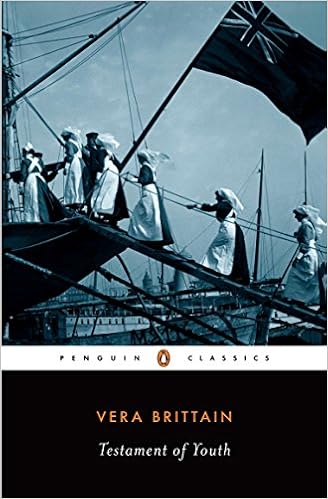
Testament of Youth is a compelling depiction of a young English woman’s life during the war years from 1914 to 1918. The book is a memoir of Vera’s personal experiences and includes snippets of letters to and from her fiancé, Roland Leighton, her brother, Edward Brittain, and her friends, Victor Richardson, and Geoffrey Thurlow, and extracts from her diary.
For me, one of the best aspects of this book is that it starts well before the war and describes in detail her childhood and girlhood growing up in a middleclass household in Buxton, Derbeyshire. The society in which Vera grew up was still that of the ultra conservative Victorian era and female children were raised to take their places as wives and husbands.
Vera includes her memories of the eventual successful ending by the British troops of the siege of Mafeking in South Africa during the Second Anglo Boer War and the celebrations throughout England when that conflict was resolved with victory for Britain in 1902. This was particularly interesting to me as a South African, and it helped me contextualise the attitudes of British society at the time and how the events that unfolded were perceived from a British context rather than a South African one.
Vera is sent away to boarding school in Surrey when she is 13. The school was run by her aunt and prepared girls for their future roles in English middle-class society. They are educated but were not prepared for a transition to University or any other tertiary educational institution. She is an excellent student with a passion for learning and literature. After she finishes school she is bored and discontent at home in Buxton and partitions her father to pay for her to attend Somerville College, a newly established college for women at Oxford University.
Vera’s struggles to get her family to recognise her talents and ambitions were as important a part of this story as the effect of the war on her life. She was a leader in the education of women in the UK and pushed against the social currents of the time to achieve her ambitions. Having finally achieved her objectives of going to Oxford along with her brother and his friends, the war entered all their lives and everything changed.
Vera became romantically involved with one of her brother’s school friends, Roland, who was also a great scholar with literary ambitions, but their romance was interrupted by the event of the war. Roland, Edward, and most of their friends enlisted and Roland was quickly sent to France.
Having completed her first year at Oxford, Vera decides to delay her degree and to take a job as a Voluntary Aid Detachment (“VADs”). Her motivation for this decision was wrapped up in the fact that all the men in her life were fighting in the war and she wanted to be part of it and do something useful for the war effort.
The detail of the experiences of her fiancé, brother, and friends in this war are depicted in some detail in the book and are sad and emotional. Her own life, working in a horrible position in a hospital as a VAD and being mistreated by some of her superiors who resented the intrusion of the VADs, and taking comfort in the letters she received from the front graphically illustrates the awful waiting the female and aging population of Britain experienced at the time. Notification of the deaths of loved ones often didn’t come for a few days afterwards. Vera’s planned leave to meet up with Roland for Christmas and his non-arrival because he was killed on the 23rd of December illustrated this very poignantly.
Her struggle to cope with the news of Roland’s death and find purpose for her life are very real and she resolves her internal conflict by volunteering to work abroad. Vera is sent to Malta and spends several months working in a hospital there. Once again, the narrow moral ideas of the time are highlighted when an unidentified VAD is seen in a compromising position with a young man, but manages to escape identity. The entire staff of VADs are interviewed and the disgrace the wayward VAD has brought upon them all is highlighted above all else despite the devastation and destruction that is taking place all around them.
Vera goes on to lose both her friends in different battles and works as a VAD near the Western Front in France for some time. The details of the shelling, gassed and disfigured patients, and on-going peril are vivid and compelling. The descriptions of the American soldiers and how they appeared to the war-weary VAD’s were also interesting. They are described as being big men and full of confidence. The German prisoners of war are also treated by Vera while she is in France and they are described as being gray and weary and the same as the British and French injured and dying.
Vera’s brother is killed in action near the end of the war and it is a devastating and disillusioning experience for her.
When the war finally ends, Vera must decide how to pick up the threads of her life. She decides to return to Oxford and study history. Her experiences with the younger generation of students who have not suffered the same loses as a result of the war, and her resulting bitterness, as well as her own PTSD symptoms are well described. My heart broke for her as she felt so unwanted and displaced. Fortunately, Vera was a strong character and she managed to rise above it all and become great friends with Winifred Holtby.
The last section of the book is devoted to Vera’s successful life after the war and how she learns to deal with the pain of her loss and move on to the extent possible. She has a successful career and also gets married and has two children.
For readers interested in WW1 and its impact on the civilian and female population, this book is a must read.
A few quotes from Testament of Youth
“How fortunate we were who still had hope I did not then realise; I could not know how soon the time would come when we should have no more hope, and yet be unable to die”
***
“To my amazement, taut and tearless as I was, I saw him hastily mop his eyes with his handkerchief, and in that moment, when it was too late to respond or to show that I understood, I realised how much more he cared for me than I had supposed or he had ever shown. I felt, too, so bitterly sorry for him because he had to fight against his tears while I had no wish to cry at all, and the intolerable longing to comfort him when there was no more time in which to do it made me furious with the frantic pain of impotent desire.
And then, all at once, the whistle sounded again and the train started. As the noisy group moved away from the door he sprang on to the footboard, clung to my hand and, drawing my face down to his, kissed my lips in a sudden vehemence of despair. And I kissed his, and just managed to whisper ‘Good-bye!’ The next moment he was walking rapidly down the platform, with his head bent and his face very pale. Although I had said that I would not, I stood by the door as the train left the station and watched him moving through the crowd. But he never turned again.”
***
“It is quite impossible to understand,’ I commented afterwards, ‘how we can be such strong individualists, so insistent on the rights and claims of every human soul, and yet at the same time countenance (and if we are English, even take quite calmly) this wholesale murder, which if it were applied to animals or birds or indeed anything except men would fill us with a sickness and repulsion greater than we could endure.”


 LatinosUSA
Replica a Rebecca Budd Cancelar la respuesta