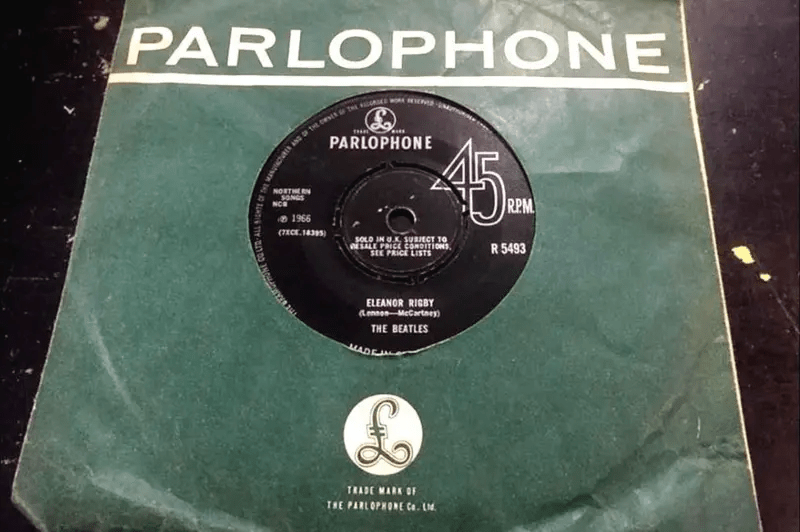
“Eleanor Rigby” (released in 1966) was written by Paul McCartney and credited to Lennon / McCartney
The song continued the Beatles’ evolution from a pop, live-performance band to a more experimental, studio-orientated band It was a very important move forward. both musically and lyrically, marking a break with the optimism of the band’s earlier work, and in its place presented an almost unbearably dark cynicism
Paul McCartney wrote most of this song. He got “Rigby” from the name of a store in Bristol, (Rigby & Evens Ltd, Wine & Spirit Shippers) and “Eleanor” from actress Eleanor Bron. who had starred with them in the film Help!. He liked the name “Eleanor Rigby” because it sounded natural. However, it has been pointed out that a graveyard in St. Peter’s Churchyard in Woolton, Liverpool, where John Lennon and Paul McCartney first met at a garden fete in 1957, contains the gravestone of a woman called Eleanor Rigby. McCartney may have been subconsciously influenced by that name.
The gravestone bearing that name shows that Eleanor Rigby died in 1939, at the age of 44. However Eleanor was not. She was born on 29 August 1895 and lived in Liverpool, where she married a man named Thomas Woods on Boxing Day 1930, so she was not like the lonely people in the song. She died on 10 October 1939 and was buried three days later.
In June 1990, McCartney donated to Sunbeams Music Trust a document dating from 1911 which had been signed by the 16-year-old Eleanor Rigby; it was then sold at auction in November 2008 for £115,000. This document is a salary register from Liverpool City Hospital, and “E. Rigby” is identified as a scullery maid.
Another of the gravestones in that churchyard has the word “McKenzie” written on it. Paul said that the name Father McCartney was the first that went to his mind. But then he thought that people would think he was referring to his father sitting knitting his socks, so he went through the telephone book and picked out the name “McKenzie”.
This is the only Beatles song where none of the Beatles play an instrument. They only sing while a string ensemble plays on. McCartney’s choice of a string backing may have been influenced by his interest in the classic composer Vivaldi..
“Eleanor Rigby” was not the first pop song to deal with death and loneliness, but it came as a shock to pop listeners in 1966. Its message of depression and desolation was very explicit, and the loneliness described didn’t mean just missing the loved one, which is a standard pop theme, but represented a spiritual dimension.
The song tells the story of two lonely people :a churchgoing woman named Eleanor Rigby, who is seen cleaning up rice after a wedding and a pastor whose sermons “no one will hear”, either because nobody goes to his church, or because they don’t get through to the congregation on a spiritual level. In the third verse, when Eleanor dies in the church, Father McKenzie buries her: they only meet at her funeral
Former US President Bill Clinton has stated that this is his favorite Beatles song
Eleanor Rigby —verses
[Verse 1]
Eleanor Rigby picks up the rice
In the church where a wedding has been
Lives in a dream
Waits at the window
Wearing the face that she keeps in a jar by the door
Who is it for?
The first lonely person is Eleanor Rigby, a woman who “lives in a dream”, an imaginary world , maybe created to overcome her loneliness. She goes into a church after wedding and grabs the rice, either to throw pretending she’s getting married, or to take part, somehow, in the ceremony.
When she goes home, she sits by the window and smiles hoping to grab someone’s attention
The “face kept in a jar” is makeup. She makes up her face in the hope she’ ll meet someone – despite her loneliness. Otherwise she feels mortified and lacks confidence so she puts on a smile when she meets people because she doesn’t want them to know she’s suffering. Her face in a jar may also suggest that, when she is alone, inside her house, she is faceless, she is nothing
There is also a play on the word ajar: when a door is ajar, it means it is open, so it could imply that her door is always open to people, but they never come into her house or her life.
[Verse 2]
Father McKenzie
Writing the words of a sermon that no one will hear
No one comes near
Look at him working
Darning his socks in the night when there’s nobody there
What does he care?
Father McKenzie is the other character, a lonely person forced to write church services that nobody will come to listen to , and this for a number of reasons: . they don’t pay attention to his words, they are unable to really understand or they don’t come at all.
Father McKenzie is “darning his socks”, a very humble task, because there is no one else who can do that for him. This represents his utter isolation and lack of companionship. The following question means that while he bothers himself with darning his socks, out of necessity, nobody will notice if they are darned or not,: so why does he care?
[Verse 3]
Eleanor Rigby died in the church
And was buried along with her name
Nobody came
Father McKenzie wiping the dirt
From his hands as he walks from the grave
No one was saved
This last verse is full of sad irony: these two lonely people could have been companions, but they only meet at Eleanor’s funeral. Even if they live in a church community, they have found no way to connect. Their destiny has been living their entire lives alone and apart until one of them has buried the other. This is a tragic ending full of despair: Eleanor dies in church, which should be a comfort, and ‘was buried along with her name.’. What’s more, “nobody came” to her funeral. Her death turns into the death of hope itself. No one can be saved
[Chorus]
All the lonely people
Where do they all come from?
The simple narrative conveys feelings of loss, isolation, alienation, but avoids sentimentality. The questions posed by the songs are not rhetorical and are unanswerable. Any response is inadequate .


 LatinosUSA
Replica a Priscilla Bettis Cancelar la respuesta