Hi, all:
I bring you a non-fiction book by one of my favourite authors (and people).
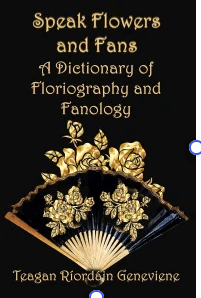
Speak Flowers and Fans: A Dictionary of Floriography and Fanology (Author Tool Chest) by Teagan Ríordáin Geneviene
How could flowers or hand-held fans be used as a means of covert communications? It sounds odd, maybe extreme, or possibly comical. However, once that was the case. Throughout history, sometimes women in particular were discouraged (to say the least) from speaking in public places. Actually, that was most of the time.
.
Those circumstances resulted in cryptological languages, or secret codes. Speak Flowers and Fans: A Dictionary of Floriography and Fanology explores two such codes, 1) Floriography, or the language of flowers, and 2) Fanology, the language of fans. The book is organized into a variety of interesting categories. It also defines the “secret codes” and gives examples. All this is illustrated by beautiful paintings from the eras when these languages were most used.
.
This volume is part of Teagan Ríordáin Geneviene’s “Author Tool Chest” collection of resource and reference books. While writers are an intended audience for these nonfiction works, they are useful and entertaining for nonauthors as well. Readers have used them to make up their own games and for dinner party conversations. Although this is not a scholarly work, students and scholars find interesting topics and jumping-off points for additional research.
About the author
Teagan Ríordáin Geneviene is certain that the pen is in your hand. After a life shaped by the tragedy of losing a sibling to Münchhausen Syndrome by Proxy, along with the abuse she herself survived, Teagan took that metaphorical pen into her hand. She wrote her way to a new chapter of life with a successful career authoring and editing technical documentation. With another revision that pen took her to the next chapter, working alongside highly placed Federal executives to compose their communications. However, Teagan wasn’t finished. The pen was still in her hand. In her latest chapter she is an acclaimed multi-genre author, living in a high desert town in the Southwest of the USA. Rescue cats, the Scoobies — Velma and Daphne, offer unsolicited advice on all stories, as well as the book covers Teagan designs.
This author’s stories range from paranormal to high fantasy and urban fantasy, to various steampunk (and other types of punk), to mysteries with historic settings. In addition to fiction, she has created the Author Tool Chest series of non-fiction works as resources for writers and anyone who loves language. In free time she enjoys conversations with friends, singing karaoke, and playing her piano.
See her book trailer videos at YouTube.
My review:
I discovered Ríordáin Geneviene’s blog many years ago, and I have followed her writing career ever since. I have enjoyed the stories she writes in her blog (most in collaboration with her followers), her novels, novellas, serials, short stories, and more recently also her non-fiction, in particular her series Author Tool Chest, where she shares some of the knowledge she has acquired through her detailed research of all kinds of subjects with other authors and interested readers. These books cover topics such as language in the Victorian, Edwardian, and Steam Era or real steampunk devices, and the author seems intent on adding to the collection, to the joy of all who follow her.
This little volume tackles two topics, one more common and popular than the other. We have all heard the adage ‘Say it with flowers,’ and most of us have made comments on seeing a bouquet or a flower arrangement, trying to show our knowledge of the language of flowers, however limited it might be. But I suspect not many of us have researched it in depth. I definitely haven’t, and that was one of the reasons that attracted me to this book.
This short volume is divided into two parts: one talks about flowers and their meanings (floriography), and the other, shorter, about fans (fanology).
Although the subtitle of the book defines it as a ‘dictionary’, it is much more than that. Some sections are organised as a dictionary, and readers can search for the meanings of a particular flower (in many cases varying according to their colour), but there are also sections on the history of both topics; how they are reflected in art and literature; how they vary in different countries, and also chapters that explore specific themes in more detail (celebrations, gratitude, house-warming flowers, flowers used as names…). And there are also beautiful illustrations at the beginning of each chapter, most of them classic paintings related to the content in question, which make this book beautiful as well as useful.
As is the case with all the books in this series, authors can use them to inform their stories, adding details about flowers and fans relevant to the plot that might add depth and intrigue to the proceedings. There is plenty here to inspire writers who want to add details to the setting of their stories, particularly those looking at historical fiction set in the Victorian and Edwardian eras, when social norms were paramount and communicating with others was not as straightforward as it is now. The use of codes and secret languages was all the rage because that was the only option available to many people, especially high-society women.
Other readers interested in historical subjects, particularly social history —not only authors— will also enjoy this book, as it provides plenty of information organised in an easy-to-search way. It can be read from cover to cover, or one can dip in and out and read about a particular theme or find out some specific information (like the meaning of a flower of a certain colour, or a gesture made with a fan). The book also contains a list of selected resources at the back, ideal for those who want to research and read more about floriography and fanology.
I enjoyed the way the book is organised, and the large amount of information it contains in very few pages. I was surprised by how little I really knew about both subjects. Some of the facts were totally new to me, for example, the information about the language of Filipino fans (Abaniko), and the fact that men used Japanese fans for war or signalling, and I also discovered the meaning of flowers I had never given much thought to. I know I will revisit it in the future, when I want to send flowers to somebody (or when I receive them), and I won’t look at my hand fan the same way ever again.
A great little book to add to anybody’s library, beautiful as well as informative. Totally recommended.
Thanks to the author for this wonderful book, to all of you for visiting, sharing, liking, commenting, and for always being there. Take care and remember to keep smiling!


Deja una respuesta