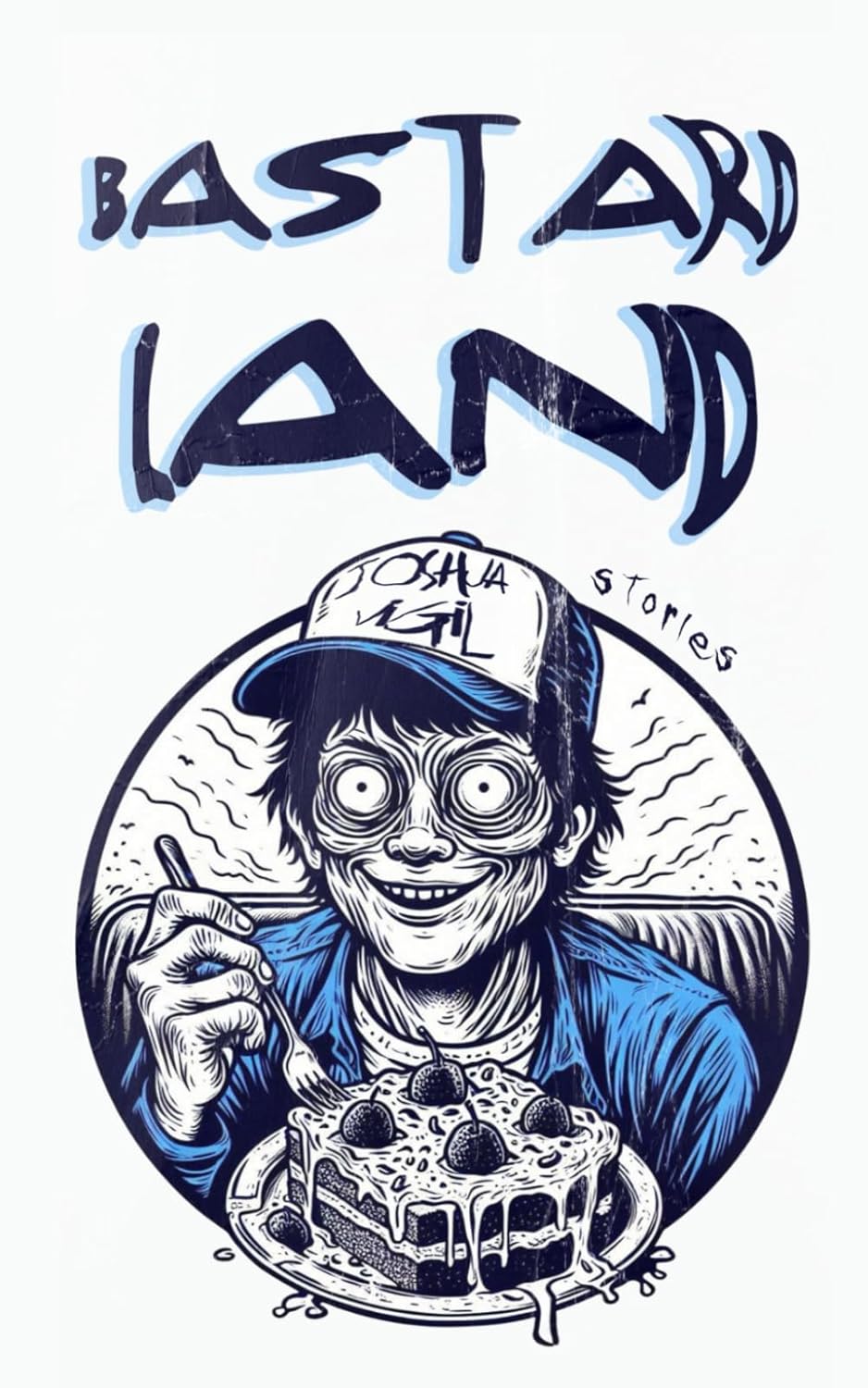
“Ever been to a gay bar? said the older man.” That’s the first sentence in “Bastardland,” a collection of stories that puts Joshua Vigil among the best fiction writers today. Vigil’s stories are gay. They are real, surreal, and speculative. One of the best things about them is their resistance to labels: they are. “Bastardland” is simply good writing.
The late Raymond Carver said, “Get black on white.” That’s what Vigil does. His sentences are crafted in love, his stories born from his need to tell them. While there are moments when his narrator is alone, and moments alone with others, one theme common to all thirteen stories is the need for community. That need plays out in well-wrought scenes, in a narrative timing that keeps readers turning the page to find out what happens next, and mostly in characters that readers care about: family, friends and acquaintances, and lovers.
All of these stories are told in first person. “Cherry” begins days after the narrator’s mother’s funeral. Cherry, a 1998 Nissan Sentra, wants to see emus at the zoo, and the narrator obliges. “That sounds perfect, she said. Thanks, Phil.” Earlier he says, “I was less surprised by her talking than I probably should have been. This was, I thought, because I was in the throes of grief; I wasn’t thinking clearly.” In this story, the father, who lives with the narrator, is more present than in any of the others. Together, father and son weather a natural storm, and in the end …not to give too much away, but Cherry too is a vivid presence.
Ironically, in the title story, the narrator, who blames himself for his father’s death, is with his mother on a cruise ship for convicts, who, like the narrator, are in the last week of their lives. When the cruise ends, all will be executed.
“The Sky is an Organ,” the opening story, revolves around a nuclear family: mother, father, sister, and brother. The sister sleeps in late, counting on her brother to wake her for school, and the father, when not tinkering with his car he never drives, keeps mostly to himself in his room. His mother is interested in UFOs. He asks if his hemorrhoids have anything to do with aliens. “Joshua, she said. Don’t say stuff like that. It’s vulgar.”
In “Beach Rat,” the narrator’s aunt died and left him some money. But in “Sitting Poolside in Outer Space,” his Aunt Margie is vividly present at the Sunnyside Inn, a sort of rehab resort. She is there alone, without Uncle Patrice. “‘I have free will. I left with it.’” She said this and kicked her bag, scarves flying across the sticky lobby air.”
Family, friends, acquaintances, and strangers play a vital part in the narrator’s need for community. Vigil tells readers only what they need to know to care.
Renata, a neighbor in “Hunting Foxes,” is one of the numerous memorable characters in “Bastardland.” She visits the narrator. “Over the kitchen table, she broke apart two capsules,” an offering he accepts. “I haven’t done much of anything at all,” Renata said. “With the baby, you know?” The baby, an infant swaddled in a rocker, is with her on each visit. Then, when he finally visits her, he discovers the baby is really a plastic doll. Strangely wonderful for readers. But he is miffed as to why she’d carry out that deception. Renata, not who she appears to be, raises the idea of trust, significant in this and in other stories.
In the story “Bastardland,” Perry is a would-be lover with a foot fetish. The narrator goes to Perry’s cabin for love, only to have Perry’s dog spring out from the restroom and bite him on the face. Terrence the Tank, a director of underwater films, like Perry, is another of the condemned on the cruise. Perry is with his dog, the narrator is with his mother, but Terrance, recently split from his spouse, is alone, condemned to die because actors died during the filming of The Water Chronicles.
In “The Compassion Myth,” the narrator is a caretaker. His terminally ill client, Hiram, is interested in UFOs, and there is this brief dialogue: “You’re a believer. I’m open, I said.”
In “Straight & Narrow,” the client, a woman of a different ilk, pays him to come to her home and shoot her in a bulletproof vest.
In “The Big Light,” he runs a low-on-funds food pantry connected to a church. Father Berlant, like others, has seen the big light in the sky out over the water off the pier, but that sighting only distances him from the narrator, and by the end of the story, the priest disappears, but not before playing his critical role, as do all these aforementioned characters.
Lovers. Last but not least. The sexual/romantic relationships are marginal, yet central. The narrator is paradoxically fulfilled and looking for fulfillment.
In “The Sky is an Organ,” he is lonesome, in the aftermath of a relationship. “I thumbed at the glass scrap from my first date with Damian.”
In “Rascal,” he suffers the pangs of unrequited love for Humberto, whose partner, Lenny, is arrested for assaulting a man, with whom, unknown to Humberto, he was obsessed. The narrator finds fulfillment with Rascal, a text messenger he finally meets. That Rascal resides at a motel coincides with the transient nature of their affair. The narrator says, “I tried leaving Humberto at the door, but I couldn’t …”
In “Beach Rat,” set in a hostel near an agrarian commune, he is attracted to Eloy, who winds up stealing his credit card. That theft and betrayal sustain the themes of trust, belief, and deception.
Yet these themes coexist with stability, reliability, and genuine caring exemplified in Angus, in “The Compassion Myth,” a lover who asks the introspective narrator, “How is helping someone out selfish?”
In “The Big Light,” the narrator lives with Cecil, a public defender, whose client was arrested for kidnapping a child. At lunch, across a restaurant table, he says, “You know the word awe-struck? That’s what I saw in you. Awe. Not fear or disbelief, but a kind of wonder at the world.”
One of the most compelling characters in Bastardland appears in “Rewards,” Ezekiel. He clerks for Art, the narrator’s lawyer, a sort of ambulance chaser, with his client’s best interests at heart. The narrator, while driving, fell through a sinkhole in a gated community and broke his legs. He’s in a hospital. How his bond with Ezekiel slowly but surely develops is one of the outstanding aspects of the book. There develops a mutual ease, attraction, and trust. Even though the narrator/patient’s boyfriend visits regularly and he has his fellow patient Ruthie to comfort and confide in, it’s his bond with Ezekiel that drives the story and exemplifies the need for community. The narrator, bedridden, in a cast, says of Ezekiel, “His hand was on my thigh again.” And that “again,” connotes dignity, care, desire, fulfillment—all the good things.
“Bastardland” is as gritty and visceral as it is imaginative and speculative. “Hurricaneland” merges mermaids and recovering addicts. The narrator says at one point, he’s “addicted to being addicted.
The Gothic-like “The Spy” juxtaposes the armed and dangerous here with the near-but-far homeland.
While the cruisers in “Bastardland,” the condemned and their loved ones, are all, figuratively, on a ship of death, Vigil’s readers, ironically, find themselves in stories about what it means to be alive.
Vigil’s love for crafting a good sentence is obvious. His storytelling skills, and his talent that lets readers know these stories had to be told, set “Bastardland” right up there with the best fiction being written today.
Purchase Link
previously published in A Thin Slice of Anxiety
Copyright © 2025 Pete Mladinic
All Rights Reserved


 LatinosUSA
Replica a Meelosmom Cancelar la respuesta