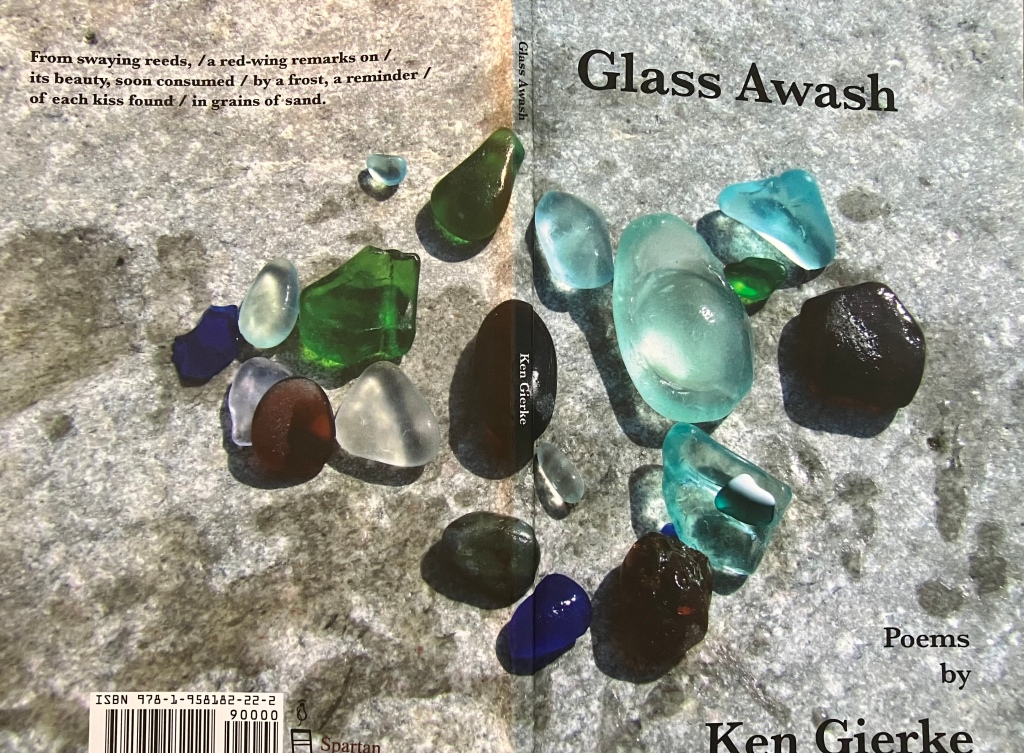
What immediately impresses the reader about is the cover, which displays stones hewn into glass by water and time. Different shades of blue and green, shaped into tears. On the back cover, one stone, a ruby, represents the heart embraced by shadows. When I open the book to view the front and back cover, I can trace a heart around the polished stones.
These images embody the theme of Ken Gierke’s collection of poems, Glass Awash (Spartan Press, 2022): His story of loss, grief, and recovery. As Gierke writes in the book’s epigraph, “Even burnished glass will retain its luster/ when viewed in the proper light. / So it is with memories.”
The early poems prepare us for his impending loss of his mother with riddles and paradoxes. In “Wrestlution”, Gierke navigates his feelings on “these paths / life’s threads, often tangled”. He “wrestles with knots”. When facing loss, we often first look into the mind, the meaning of life, but the soul answers the questions. In “Slow Descent into Darkness”, the poet asks, “Does hardship serve a purpose?” The poem replies,” A thousand butterflies cannot carry the world.”
Gierke explores loss with imagery from nature. “Drought in the Depth of Marianas”, loss is a “drought of imagination” with “little hope of recovery” He describes his loss as the sea walking and taking the shore with it. In “Out of Touch”, he finds himself in a haze with time slipping away like the waves. “Past and future out of reach / the present slips away / with each passing moment.”
In subsequent poems, loss brings him into himself, his “gut hollowed” (“Hollow Man”). He searches for “a way out of this darkness” even though he has the sense he is “reaching into” it (“Reaching”). He is then like a wave both extending to shore and receding into the dark waters. Loss becomes oppressive tinnitus, “The hiss of breaking / foam, the last trace of a receding wave.”
“In Search of Clarity”, the poet takes us on a walk, “Wondering if the next turn / will bring the answer”. His pending loss becomes the hulk of a” bridge”. His hope in “unwound” dissolves as “fragments, scattered / like bits of a broken shell”. On his journey into loss in “cinder and ash”, love is “wasted, scattered / by careless steps / cinder and ash”. He feels at a loss in “Stranded”, “No course set in a mind / looking back for direction.” In “My Road Not Taken”, he resolves that loss is his fate.
As Gierke faces the death of his mother, he becomes “an empty canvas” because his words and thoughts are unable to control his mother’s destiny. The loss of a mother is emblematic of all deep loss. He holds his dying mother in the arms of his memories. His mother is his “Mantle”; her life “the lesson that will guide me / through your coming absence”. As grief descends in “Frailty”, he holds his mother’s hand, and she becomes his companion in loss.
Death is a dream concerto in “Asleep with Grieg”, one of the most powerful poems in this collection. Passing in and out of sleep as he holds his mother’s hand, Gierke hears various piano compositions of Grieg. The music both comforts and cuts. While he is soothed by Morning Mood, The Death of Ace signals the pain of his grief’s knife slicing the neck.
Grief is not linear; it has stages. After his mother’s death, while Gierke finds strength in the memories that become “Visions of Absence”, in “Inclinations”, he still feels rudderless “as water continues / to flow, // or fails to fall.” In “Untapped” he writes,
Like tears denied,
a cistern lies
empty.
With rain comes balance,
and healing begins.
Welcome tears.
Even music returns in “Adiagio for Spring” with memory’s knife “tracing old scars”. He finds comfort in the stars, and this imagery of light becomes “Ruby-throated Fondness”, dancing hazel eyes, like hummingbirds hovering at a feeder.
Woven throughout the poems in this section is light, which becomes bright skies, unfolding possibilities, and acceptance of loss. In “Vantage” he feels no regrets and drops the weight of grief. His heart is open, ready for sensual potential, a tsunami, which immerses him “Into the Blue”. Here the poetic form breaks into wave-like lines, surging with new love, transmuting “Stone to Flesh”.
The imagery of stones being caressed by time into glass in the poems of resolution brings us full circle to the book’s signature poem, “Glass Awash”. Afterall, the healing path is circular. In “Other Voices”, we are with the poet sifting “through stones / at the water’s edge, trying to find / that one that speaks” to us. By so doing, we are creating the glass of our healing. The stones (our memories),
Tumbling again
and again, nudged
finally to lie
beneath the drying sun.
In the final poems, we are taken “Out of the Rain” into the dawn of a new love, with “…eyes / blazing the way, unraveling / the thread of this labyrinth” (“Solace for Theseus”).
For the poet, loss becomes illusory. The past holds stories like stones in the palm of its hand, “thoughts jumbled / memory just a memory” (“Memory’s Stones”). He can “choose the way forward /dare to dream / love life” (“The Journey”).
In the last poem, “Ageless”, Gierke realizes that “even decay // and loss can lead to growth…..// beginnings never really end”. If we trace our fingers around a stone hewn into glass repeatedly and without pause, we can agree.
I highly recommend Ken Gierke’s collection, Glass Awash. Many of us can relate to this universal theme: facing loss, navigating grief, and transmuting pain with new love. We all hold and tumble past memories until they shimmer with hope.
Glass Awash is available on Amazon.
Copyright © 2025 Barbara Leonhard
Author Biography
Ken Gierke is retired and lives in Missouri. He is a Pushcart Prize nominee, and his poetry has been published in such places as MasticadoresUSA, Chewers/Masticadores, Hotel/Masticadores, Ekphrastic Review, Amethyst Review, and Silver Birch Press, as well as in several print anthologies. His poetry collections, Glass Awash in 2022, Heron Spirit in 2024, and Random Riffsin 2025, are published by Spartan Press. He also blogs at rivrvlogr.com.


 LatinosUSA
Replica a Meelosmom Cancelar la respuesta