
Pinturicchio
Lucrezia Borgia was born on April 18, 1480, in Subiaco, near Rome. She was the illegitimate daughter of Cardinal Rodrigo Borgia, who ruled as Pope Alexander VI from 1492 to 1503 and whose family became known for their crimes and debauchery
She could speak and write several languages, among which Italian, French, Latin, and Greek.
Her three marriages into influential families helped advance the political power of her own family.
Historians debate whether or not Lucrezia was the femme fatale, poisoner and plotter, who took active part in her notorious family’s crimes, a role in which she has been portrayed in many works of art, books, and films. Today history seems kinder to her, and regards her as a victim, manipulated by her father and her brother to attain political success.
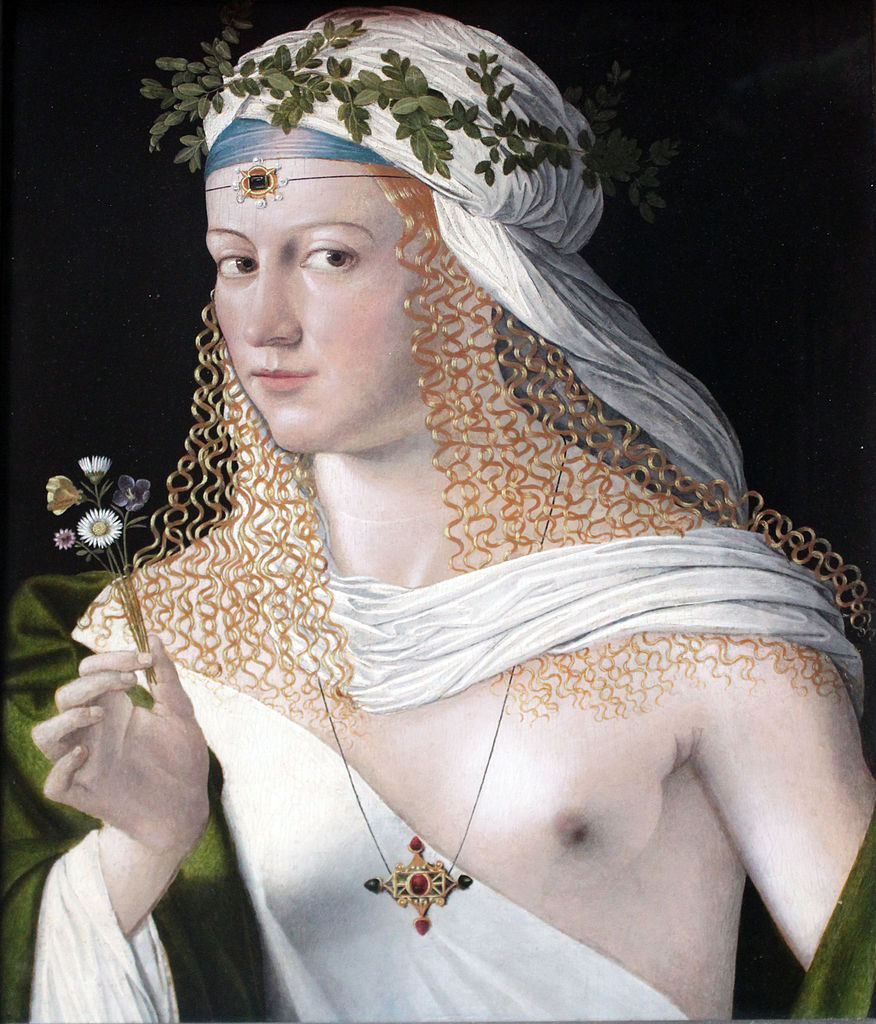
She is described as having very long flowing blonde hair, which she spent a long time grooming, and bleached to keep it light. She had a beautiful complexion, hazel eyes and a natural grace that made her appear to walk on air.
Lord Byron discovered, in the archive of the Ambrosiana Library in Milan, that one of her letters to poet and writer Pietro Bembo contained a strand of hair and defined it “the prettiest and fairest imaginable.”
There are many portraits depicting her, most of them pretty fanciful, but in 2008 a Renaissance portrait was identified as potentially the world’s only painting of Lucrezia Borgia. It is an oval painting by Dosso Dossi one of the great northern Italian painters, representing a lady closely resembling a bronze portrait medal of Lucrezia, made in 1502.

Bartolomeo Veneto: Portrait of a Woman traditionally assumed to be Lucrezia Borgia


 LatinosUSA
Replica a Mary K. Doyle Cancelar la respuesta