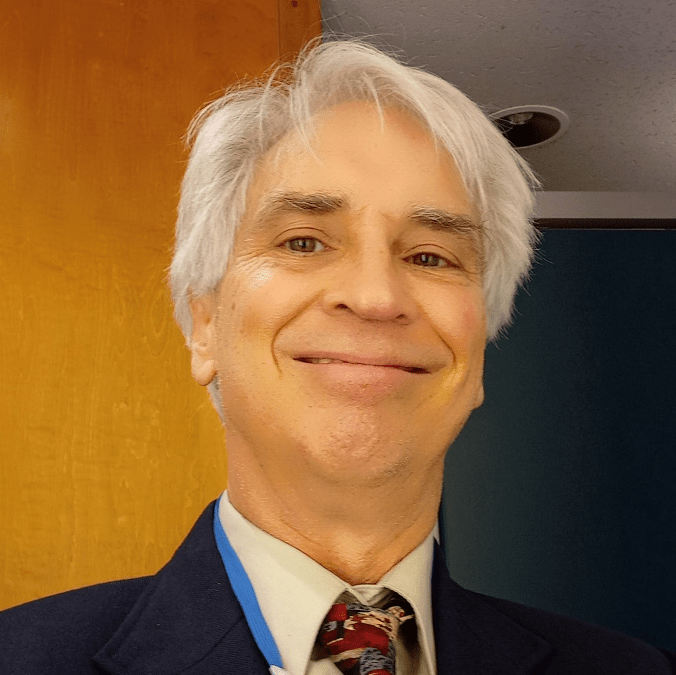
Today I extend my greetings to a phenomenal writer, Gary Gautier, whom you probably know from his blog on WP titled Shakemyheadhollow and well, perhaps from reading his books. In any event I had a most interesting conversation with Gary and here is what he had to say about some important topics I brought to his attention.
LatinosUSA: How do you define the art of the writer, or the poet or the painter or of anyone involved in the creative process of the fine arts?
Gary: The cultural anarchist in me resists rules and definitions, but since you are pushing me, Francisco, I’ll use poetry as my representative art, and I’ll tiptoe around a definition with two images: a garden and a toolbox. Novels and poems are essentially suggestive, not propositional. Propositional language looks for fixed answers. Literary language avoids fixed answers in order to open a range of possibilities. Immersion is more important than meaning. A novel or poem is a garden made of words. You just enjoy the beauty, the smells, the contrasts and surprises as you turn down a path. The artist has planted a garden; now you are free to get lost in it.
Some literature, of course, does rely on meaning, but it’s usually not a fixed meaning. It’s more like a cloud of meaning that condenses around the words, the history of words and phrases, the lines, the sounds. A well-written poem is layered with possible meanings, many of which the poet knew nothing about. Each reader brings the poem to life and imbues it with meaning from their own orientation point on life.
This brings me to the toolbox image. A poem or novel is a toolbox readers can use to create beauty and/or meaning. Don’t worry too much over what the poet intended. What really counts is what you can do with it. Has the poet arranged for you a rich set of materials – images, sounds, ideas, emotional triggers – for reflection? If so, run with it. If you really want to, you can go back later and revisit those building blocks, the tools in the toolbox, to see how they fit together and carry possible meanings and values. But you don’t have to 😊.
LatinosUSA: Do you think writers/poets/artists et al, should proffer political opinions publicly?
Gary: No rules. It’s up to them. They have as much right to do so as lawyers, clerks, or fry cooks. Some may want to do so; some may not. They both have their own good reasons. The only thing they should not do is reduce their own art to a fixed politics. Sure, some art has strong political components, but once you go public, it’s not yours to say. The world decides how to mine significance from those political components. At that point, the artist’s opinion is just one of the many opinions. If the artist is lucky, the range of significance is much more complicated than the artist had intended.
LatinosUSA: How do you see the current state of affairs with regards to literature and poetry?
Gary: I’m totally incompetent here. I read mostly classics from Greeks through maybe the 1980s, then I’m very hit and miss. I’d rather read Woolf’s To the Lighthouse 5 times and find 5 completely different geological strata of imagery and meaning and symbolism than read widely among my contemporaries. Two negatives do occur to me, but I’m only guessing. In the age of self-publishing platforms and Twitter marketing, it seems writing books in series has become a marketing strategy of choice – where someone might write a 3-book series every 6 months. This is good for entertainment but probably a net negative for art. Good books can be written in series, but great books are usually standalones. The other negative – and here I’m looking at the traditional publishers and academics – is the full-on politicization of literature, where crops of newly empowered young editors and liberal arts curricula people screen out books that don’t have the same cookie-cutter politics as themselves in the honest belief that they are doing the world a favor. Again, I am not very qualified to answer this question, and could be wrong about both of my points, but I offer them as starting points for discussion. I defer to your more knowledgeable readers to carry that discussion forward.
SO THAT YOU KNOW A LITTLE MORE ABOUT GARY GAUTIER
Gary Gautier has taught university writing and literature and given numerous radio interviews. Both his poetry and fiction have been shortlisted for the Faulkner-Wisdom Prize, and his novels have earned a #1 Amazon bestseller rank in two categories. His latest novel, Alice, was selected for the Innovative Fiction Book Club, and a screenplay version of his novel, Mr. Robert’s Bones, made the second round (top 10%) at the Austin Film Festival. Gary has hitchhiked through 35 states and 18 countries, and he will soon leave his current quarters in Tokyo for the pueblos mágicos of central México.
AND HERE IS AN EXCERPT FROM HIS BOOK ALICE
In my own writing. I try to hone to the standard of art above in my own poems and novels, with what success your readers can tell. Because that standard is not genre-specific, my novels can probably be lumped together as “literary fiction” while touching on other genres – “Hippies” might cross-categorize as historical, “Goodbye Maggie” as Southern regional, and so on. I’ll save my poetry books for another day. For my sample, I’ll link to the opening scene of my post-apocalyptic adult hippie fairy tale, Alice.
ALICE, page 1
Alice sat by the pond cupping her hand in the water, as if searching for an undersea plant or animal. The sun was going down. She stripped off her gown and dove in to do something but she could not remember what. When she came up, something was in her hand and the stars were above. They were the same stars as ever, but the constellations were different. Virgo and Scorpio and all the others were gone, and some new arrangement had begun. Something moved in the woods beside the pond. Not really in the woods. In a juniper bush. It was too big to be a fairy. Alice did not know what it was that moved in the juniper bush.
As Alice approached the shack, she could hear in the dark the whispering of the forest. She saw the lovely silhouette of Evelyn through the window, sleeping in bed. She entered, and Evelyn opened her eyes.
“I was at the pond,” Alice said.
“Was the rain king there?” asked Evelyn.
“No. Not today. But something happened. I dove in and the whole cosmos changed. The stars are still there but all the old constellations are gone. Virgo and Scorpio are gone now.”
Evelyn sat up. She was taller than average, with a nobility of stature that contrasted with the petite Alice.
“So then it’s a new age,” said Evelyn.
“Yes.”
Alice sat on the bed. Evelyn leaned toward her, pushed a brown curl from the brown eye of Alice, and kissed her twice. Once on her favorite birthmark in the whole world, the pink crescent moon on Alice’s neck just above the collarbone. And once on the mouth.
“We can hope,” she whispered.
“Yes,” said Alice. “And when we can’t hope, we can love.”
And they lay down together in the wood frame bed in the wood frame house in the woods.
The next day, John Wilson came over to the shack. No one ever called him “John.” They always said, “John Wilson.”
“Something happened with the fairies last night,” said John Wilson.
“I knew it,” said Alice . . .
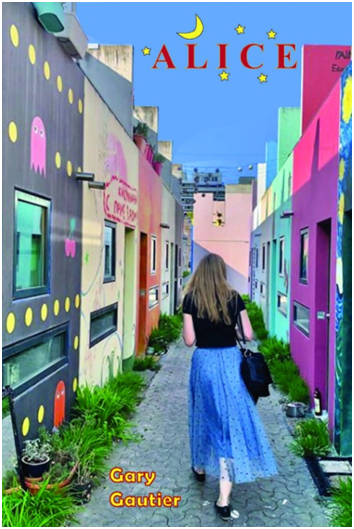
A post-apocalyptic adult hippie fairy tale by two-time Faulkner-Wisdom Prize finalist, Gary Gautier
KEEP UP WITH GARY
web: http://www.garygautier.weebly.com
blog: http://www.shakemyheadhollow.com
facebook: https://www.facebook.com/gary.gautier.3
instagram: https://www.instagram.com/drggautier/
I wish to express my sincere gratitude to Gary Gautier for his time and candid replies. Wishing you the best of luck in all your current and future endeavours Gary and all the best!
CHEERS


 LatinosUSA
Replica a Meelosmom Cancelar la respuesta