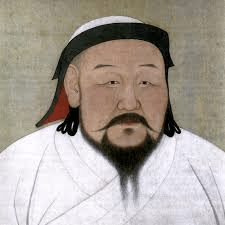
Kublai Khan (September 23, 1215 – February 18, 1294) was the fifth Khagan (Great Khan) of the Mongol Empire. He was proclaimed Khagan in Shangdu in 1260, and reigned as the first Yuan emperor until his death in 1294.
Shangdu (also known as Xanadu), was the capital of Kublai Khan’s Yuan dynasty in China, before he decided to move his throne to the Jin dynasty capital of Zhōngdū, present-day Beijing. Shangdu then became his summer capital and was visited by the Venetian traveller Marco Polo in about 1275.
Kublai Khan and Xanadu are the subject of various artworks, including Samuel Taylor Coleridge‘s “Kubla Khan“. In this poem, written in 1797, the English Romantic poet makes Xanadu a symbol of mystery and splendour
Coleridge described how he wrote the poem in the Preface to his collection of poems, “Christabel, Kubla Khan, and the Pains of Sleep”. We read that it was composed one night when he experienced an opium-influenced dream after reading a sentence portraying Xanadu, the summer palace that Kubla Khan had ordered to build :
‘ Here the Khan Kubla commanded a palace to be built, and a stately garden thereunto: and thus ten miles of fertile ground were inclosed with a wall.’.
While sleeping, he had a fantastic vision and composed two or three hundred lines of poetry . When he woke up he began writing the lines that had come to him during his dream until he was interrupted by “a person on business from Porlock” . Unfortunately, the poem could not be completed as the interruption caused him to forget the rest. He left it unpublished and kept it for private readings for his friends until 1816 when, at the prompting of Lord Byron, it was published under the title “Kubla Khan or A Vision in a Dream: A Fragment”.
Sometimes, the story of the poem’s composition overshadows the poem itself , which is one of Coleridge’s most haunting and beautiful.
As a symbol within the preface, the visitor represents the obligations of the real world shattering the creative one and the “person from Porlock” has become a phrase used to describe interrupted genius.
“Kubla Khan” is about poetry . One of its sections, the Poem, celebrates the power of creative imagination, and compares the act of poetry to the might of Kubla Khan: the other section connects the idea of the creation of a poetic paradise with the land of Porlock: imagination, though infinite, can be interrupted by a “person on business”.
The poem begins with a fantastically prodigious description of Kubla Khan’s capital Xanadu, near a river which passes through caverns before reaching a dark or dead sea.
In Xanadu did Kubla Khan
A stately pleasure-dome decree :
Where Alph, the sacred river, ran
Through caverns measureless to man
Down to a sunless sea. (lines 1–5)
The poem continues describing a sort of paradisiacal garden, and vision of natural and man-made places (also in the first stanza the land is one of man-made “pleasure” with is a natural, “sacred” river that flows through it). This combination of sacred and profane, of natural and artificial elements, light and darkness, represents the reconciliation of opposites, which, according to Coleridge, is the task of poetic imagination.
The shadow of the dome of pleasure
Floated midway on the waves;
Where was heard the mingled measure
From the fountain and the caves.
It was a miracle of rare device,
A sunny pleasure-dome with caves of ice! (lines 31–36)
The pleasure-dome’s shadow floats on the waves, where the blended sounds of the fountain and the caves can be heard. Describing the depths of a dream, Coleridge creates a landscape that cannot exist in reality, like the “sunny pleasure-dome with caves of ice” , another example of reconciliation of opposites.


 LatinosUSA
Replica a thomasstigwikman Cancelar la respuesta