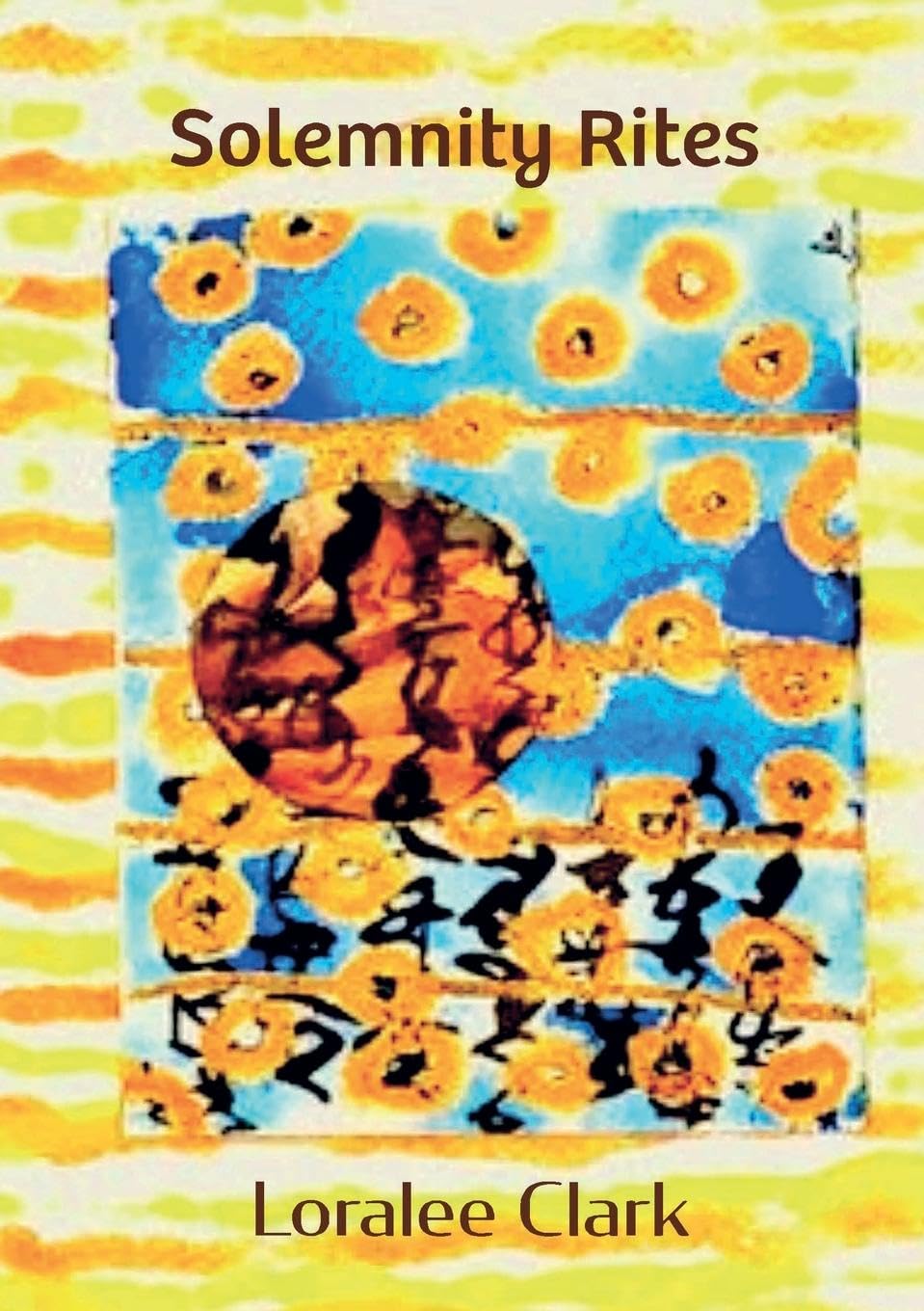
Now, about this author interview. My first victim, er, “featured author,” is writer and artist Loralee Clark, whose first book of poetry, Solemnity Rites, is out now from Prolific Pulse Press.
Loralee and I met in graduate school at the University of Maine. (Go Black Bears!) Back then we immediately connected as writers and creatives and she remains a beloved friend today — one whose creative commitment and talent continues to inspire me. You’ll see from our conversation that she has lots to say about how research fuels her poetry and the importance of perseverance. Don’t worry if you’re not a poet — you’ll find so much here to relate to and learn from.
I hope you enjoy this conversation with Loralee!
Cara: You’ve written in other genres, from academic writing to different types of non-fiction. But poetry seems as though it has been your creative through-line. Why poetry? What has it given you that is different from other creative work you’ve done?
Loralee: Poetry is a genre I began unconsciously studying when I was little—eight. I think my brain has, over the years, molded itself to lyricism and metaphor; I can’t remember not being drawn to poetry or language. When I fell in love with poetry, I did it on my own terms—I never had a formal poetry class until I was in high school. I took a night course in poetry at a community college when I was a sophomore in high school. If I love something, I want to learn everything about it. With poetry I was learning not just about poetic techniques and historical periods and poets, I was also learning how I could be a better poet, what topics and forms attracted me. That passion to understand my interests and be a better writer has never left me.
Poetry is the genre that has helped me grow as a person, through all different stages of my life. As a child, I learned story-telling from Shel Silverstein and how space helps tell a story by e. e. cummings. As a teenager, confessional poets (Plath, Sexton, Atwood) gave me permission to write about all of the emotions and experiences I had in my home which were taboo to discuss in conventional, polite society. Poetry gave me the permission to exist in ways other writing didn’t. As an academic writer I was mostly invisible in that my personality was unimportant to the writing (pay no mind to the man behind the curtain). As a non-fiction writer, organization overwhelms me most times—I don’t trust myself with that genre much yet. With poetry, I am able to chunk my ideas into smaller, more digestible elements that I feel at ease with, as I’ve had a relationship with them for almost 50 years.
I’ve learned from you that your writing process involves a lot of deep research. In what ways have your skills in research informed your poetry?
While I refined my research skills in graduate school, I have always been a book nerd and did a lot of reading and my neighbor, a dear friend-who-was-family, taught me at an early age to think critically, as did my freshman English teacher.
I want to care for my writing topics; one way I do that is to learn all I can about the topic. I want to know not only what’s been written, but what hasn’t been written, who has written about the topic and why—I try to do a really critical overview.
For example, two years ago I began to write poetry about Neolithic monuments across Europe. I wanted to answer the questions, What was Neolithic life like for humans across Europe? Why did they build these monuments? As I began to research different monuments, I found a lot of them were built and rebuilt over hundreds of years on the same geographical sites. What was so sacred about the land to the people who lived there? I learned the first henge of this type was built in Turkey at Gobekli Tepe. What was its connection to European Neolithic henges? The more I researched, the more questions I had. Spiritual, mechanical, ceremonial and landscape questions. How could I write poetry that painted pictures of humans as an ecotone of the landscapes in which they chose to settle? In order to answer these questions, more research was needed.
One poem in this undertaking, that was published first in Dawntreader in 2024 and in my upcoming chapbook Solemnity Rites, “Brynn Celli Ddu: Mound in the Dark Grove” required me to also research pagan rites that took place when theriomorphs (gods depicted as animals in a human form) and oral communication were the norm in human society. There is so much human history that has been lost to us, so I had to determine what would have plausibly occurred. Deep research is needed for this type of poetry.
Writers who do a lot of research often struggle with knowing when to put down the research and start to write. How do you know when it’s time to shift from the research to the writing?
Usually, I can begin writing once I have partially begun to answer a question. So, when I do research, I tend to do art at the same time; it helps me to learn about a topic in different ways. When I was writing my Neolithic poems, taking in historical and mythic information and drawing actual henges and petroglyphs, a poem would usually begin to form itself as an answer to my question became clear. If there were gaps in my poetry, I would fill them in by conducting more research.
Currently, I’m working on poems about bees—native bees, honey bees, sweat bees—ALL the bees. I’m running into some repetition with research, so now I need to start formulating a list of questions. As I come close to formulating some answers, I’m going to start writing more poems. I had one question concerning the Thriae (three Greek bee maidens connected to Dionysis): What tensions arose between wilderness and civilization when humanity began keeping honeybees? When I had a few threads of an answer, I began to write my poem “Rewilding.”
When did you go from writing poetry to submitting it for publication? What was that process like for you – not just externally but internally? What advice would you have for creatives who might be anxious about submitting or sharing their work?
Oh, that was a scary transition for me! And it’s something I did three times over. The first time I submitted my poetry was when I began writing my undergraduate thesis. I got an English degree with a concentration in poetry and my professors were telling me, “Oh, this is a good poem. You should submit it to a journal.” So, I did, without really knowing what the hell I was doing. I had no organization, no one ever explained cover letters or simultaneous submissions. And I didn’t know to ask—I just jumped in the deep end not understanding the basics of swimming. I did get one poem published, but was still so confused. But I was graduating, had to make some life decisions, and poetry submissions were not urgent anymore.
I went to graduate school for Speech Communication and fell in love with gender studies and teaching; poetry took more of a back-seat role in my life. After I graduated, I moved to Virginia and knew no one; I had a lot of spare time when I wasn’t teaching at William & Mary. So, I gave it a second try. By that time the internet was a reality and it was easier for me to research the steps and considerations involved in submitting poetry to literary journals. I took Poets & Writers magazine back issues out of my local library and tried to understand how my poetry could fit into specific journals. It was exhausting! I didn’t understand I was experiencing a learning curve moment and I wasn’t that graceful with myself. After months and months of researching I was getting frustrated. What the articles and websites I read told me to do sounded simple enough, but I couldn’t seem to bridge the gap of understanding into action. I did end up submitting some poems to journals and got 10 publications over four years, but it was by no means a satisfying experience. It felt stop-and-start-hopeful-then-terribly-disappointing. Eventually I got married and had two children; my free time was pretty non-existent.
Skip to twenty years later. The third time I started sending my poetry out for publication was after both my children had been diagnosed with ASD and my life had become a bit more predictable and stable. I had created and led a few small writing groups over the years and was re-building my relationship with poetry. By this time, the internet was reliable and I was more confident in my ability as a writer. I was choosing to submit my poetry not because someone told me I should or because I thought it was something I could do with my spare time. I wanted to submit my poetry because I wanted to share with readers what I had written; I believed in what I was writing. I was mature enough to treat my passion with the seriousness it deserved. Beginning in 2023, I devised an organized system to send my poetry out (I talk about it in this Substack post) and I had a solid attitude. As long as I got one positive comment for each poem I sent out, by the time it had been seen 100 times, I would be happy. Publication would be a bonus.
As for advice, if you are interested in submitting your poetry to journals, it is important to read through what a literary journal has published before. What does it have in common with your poetry? Can you see your poems in this journal? For example, I avoid journals that embrace “genre-less” submissions and form poetry—those journals would not be interested in how or what I write. Trust that if a literary journal says it wants to see no less than 8 of your poems, they mean it. Give the editors what they ask for. Do they want an anonymous contribution? Give it to them. Don’t allow a mistake of not following the rules cause your poetry to be eliminated from consideration.
Other than that, there is no right or wrong way to submit poetry. Some poets I know hardly ever share their work with literary journals. Some send out 10 poems a year. I’m a bit overzealous and I send out anywhere from 15 to 50 packets (a packet is anywhere from 3-6 poems, usually) of poems out a month. I’ve been averaging 150 to 200 packets of poems a year. If you’re anxious about sending your poetry out, let others read it—workshop your words and ideas, get feedback. Chances are probably high that you are just being hard on yourself, and if you aren’t, give yourself the space to improve.
Experiment with sending your “good” work out. By “good” I mean—were you able to write what you intended? Are you pleased with a poem? Treat sending a poem out as an experiment. How does sending your work out make you feel? What would make you feel supported? How can you support yourself in this process if it’s something you really want to try to do? I cover some of these types of topics in my Substack newsletter, There is No Such Thing As Failure.
What would you say to a writer who has never tried to write a poem but might want to start?
I would be encouraging and say that even if you don’t think you’ve ever written a poem, I bet you have—fiction and nonfiction certainly have poetic elements that can be found in them. Even technical writing uses certain poetic elements. When I was teaching public speaking courses, I would tell my students that what mattered most in becoming a successful, or even just passable, public speaker was their topic. If you truly are invested in your topic, then your speaking skills will follow because you’ll be genuine. It’s the same advice I would give to someone wanting to flirt with poetry: technique can come later, but first you need to trust your desires, your interests, your passion.
I think becoming a good poet requires that you become a good student. First, study yourself—only YOU can write about what you know. A lot of people grew up having similar experiences—first love, death of a pet, losing a dear friend. But no one had the epiphanies you had during those moments or felt grief’s sting the ways you did. Just get it all down on paper first—don’t worry about technique or form or metaphor. Don’t bother with alliteration or the poem’s arc—all those elements can come later; those elements will help you to polish your poem but the poem’s heart needs your memory and attention to detail first. I’m a BIG advocate of free writing—just setting a timer or choose a page limit and start writing. Don’t think, don’t stop writing, if you get stuck just write “what I really want to say is…” and get it down on paper. Once it’s down, highlight or underline what you like or think is clever or confuses you. Take those snippets and do a free write for each one. Dig deep.
With art—painting or drawing, specifically—students are encouraged to study “the masters;” which just means they are taught to look at how this artist or that artist made choices. Do that with a poet or poem you like—how could you begin to write about your “passion topic” in the same format? Study how the poet uses language—do they use verbs as nouns? Do they rely on a lot of imagery pertaining to visual or other sensory information? Do they tell a story and then pull the rug out from under you? How do they enter the poem? How do they leave it? How can you do that?
I think the most important thing when you write a poem is to have trust—trust in yourself and in the language—let it carry you where it can. And when you feel stuck—when you can’t answer your own questions, trust in a safe, knowledgeable person to help you through the language until you can accurately describe what is in your head. Ask that person, “How does reading this poem make you feel?” Ask yourself that question too.
Just be gentle and ask yourself, “How can I continue to move forward?”
To purchase Loralee’s book:
Paperback
eBook:
 LatinosUSA
Deja un comentario