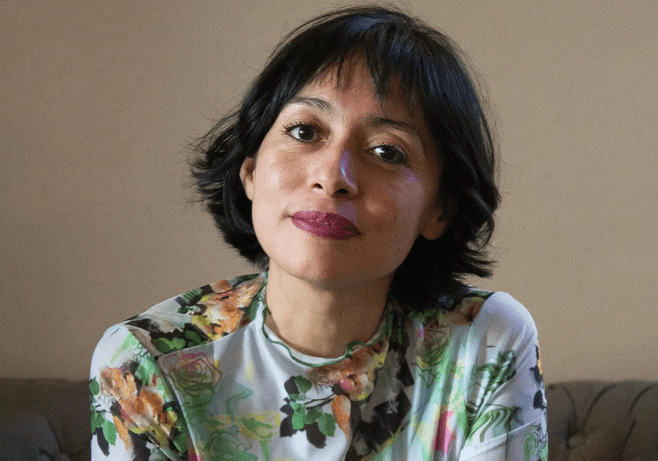
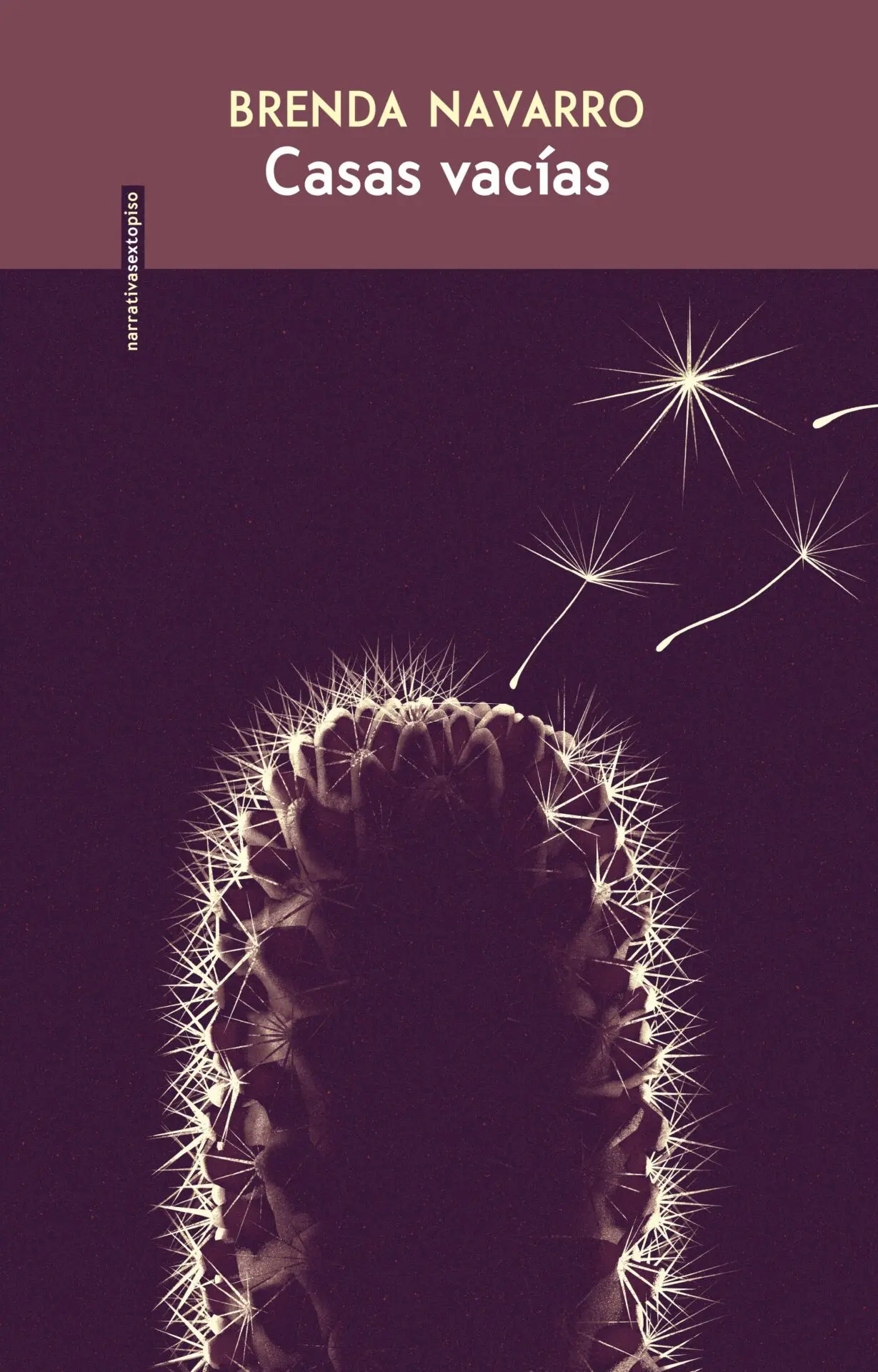
With just two books under her belt, Brenda Navarro (Mexico City, 1982) has succeeded in becoming one of the most compelling Latin American writers of her generation. Hispano-Mexican press Sexto Piso has published her books Casas vacías (2020, translated as Empty Houses by Sophie Hughes) and Ceniza en la boca (2022), two novels whose “characters, stricken by pitfalls and losses, persevere as in real life.” Besides being an editor, scriptwriter, and journalist, Brenda Navarro founded #EnjambreLiterario, a project focused on publishing works written by women. Her novels have earned her a number of honors, including the XLII Premio Tigre Juan and the Premio Cálamo. We had the chance to talk with this Mexican writer about her conception of literature and how she tackles her writing.
Eduardo Suárez Fernández-Miranda: Fernanda Melchor has described you as “one of Mexican literature’s best-kept secrets.” What can you tell us about Brenda Navarro that would reveal some of this secret?
Brenda Navarro: Zero secrets; I’ve been a totally public writer since 2019. What makes me laugh is that, since that phrase appeared, every time they like a new book from a Latin American writer in Spain, they refer to it as a secret. Perhaps we’re not a secret, but rather, it’s that insufficient consideration is being given to the diversity of literature worldwide. I’m grateful to Fernanda Melchor for the affection she has for my novel and for my work, and especially for her collegiality as a fellow writer. It was her recommendation that opened many doors for me, and I will always thank her publicly for this, as I now do here. I enjoy writing, and through the creative process, I’ve found a sense of meaning in life whereby I try to understand the world, and it continues to present me with questions. Gospodinov once said in an interview that sometimes it’s better to ask a good question than to have an answer, and I totally agree with him.
E.S.F.M.: In Casas vacías, your first novel, the kidnapping of a boy serves as a launchpad for you to talk about motherhood from the perspective of two different women. Why did you choose such a tragic event to create a reflection on being a mother?
B.N.: I would phrase it differently: I selected a relevant fact like motherhood in Mexican society so that I could write about the various acts of violence that women experience, and how, as an offshoot, disappearances in Mexico and the impunity that surrounds them are intrinsically linked. When I wrote the novel, I was constantly thinking about disappearances as the zeitgeist of the story. The disappearance of a person disrupts the world, leaves it dislocated, incomplete, and that’s what happens to the two women. One loses her son, but the other has a disappeared brother. In both cases, the starting point is the same pain. Motherhood becomes a consequence of the circumstances that prevent these women from acknowledging an autonomy they are denied, regardless of their social class or personal desires. A person you love disappears and, in Mexico, that’s a sociological and political fact that I’m interested in continuing to decipher, but also, when you are a woman, it’s as if, as you mature and become embedded in the world, you disappear and turn into the stereotypes and desires everyone else foists upon you.
E.S.F.M.: Ariana Harwicz in Matate, amor (translated as Die, My Love by Sarah Moses and Carolina Orloff) and Samanta Schweblin in Distancia de rescate (translated as Fever Dream by Megan McDowell) have already looked at motherhood in literature. What motivated you to write a novel about this topic as well?
B.N.: As I was saying earlier, I never thought of motherhood as the main theme of my novel, but I’ll try to explain myself better. There’s no question that motherhood continues to be “the issue” for women, because socially, we are biologically destined for it. It is “the issue” to such a degree that I have been saying since 2019 that my novel is not about motherhood, but reading it inevitably leads one to talk about this topic as fundamental. It is a reading that is foreign to my personal objective, however. I understand that the literary fact is submerged in the presence of those who are reading, so I’m not going to tell whoever is reading that their interpretation is wrong. What I can defend is that I didn’t intend to make motherhood the problem, but rather, everything that surrounds it. I like to start from a strong event and then recount the debris. I like to think that what I write is closer to the dissection of the debris than “literature about women.” Why do I make the case that the novel is not about motherhood? Because motherhood is a consequence of various decisions and events involving these two women, but if you were to look at them from the perspective that what they most desire and suffer from is the loss of a leg, rather than not wanting to be mothers, there’d be a different reading of these characters. It would be understood that this fact, which triggers everything, is a consequence, not a cause. But since it’s socially impossible to stop assuming that motherhood is “the issue,” we’re still talking about this in 2023.
 LatinosUSA
Deja un comentario