Mira Quien Viene por Ahí!
El Caballero de París!
Barbarito Diez, El Caballero de París (popular Cuban song)
It was a sunny afternoon in the late spring of 1959, and I recently turned sixteen years old. Havana, and Cuba at large, were experiencing what would prove to be a short-lived period of exultation: a grassroots revolution only a few months earlier deposed a hated tyrant and sent him into exile. Fueled by civic pride, there was a freshly awakened interest in Cuban culture, and people were flocking to book fairs, movie festivals, concerts and exhibitions.
I was in the eleventh grade. While a private institution run by foreign Piarist priests, my school was caught in the patriotic fervor. Its management made an extra effort to render students more conscious of their heritage, and one of the activities was to take the students to places of historical and cultural interest. It was thus that one of our teachers treated my class to a tour of Havana’s Palacio de Bellas Artes (Fine Arts Museum). The Palacio was a new building, having opened only five years earlier, and was designed to house fine arts alongside historical artifacts, archaeological finds, and other items of general interest.
Needless to say, Cuban male teenagers had little interest in the arts and accepted being taken to the Palacio as a chore to be endured and suffered through as briefly as possible. Only I and a couple of my classmates were even mildly interested in the exhibits; this was not unusual, for the main art forms my fellow students favored were action movies (Rio Bravo had just opened and was the talk of the town), and rock and roll songs, which were already polluting the airwaves.
The moment our teacher let us loose in the museum with instructions to gather at the front desk an hour and a half hence, the students dispersed, in groups of three or four, for random walks around the many rooms and exhibits of the museum. I found myself alone, going through every room, dutifully reviewing each painting and piece of modern sculpture, making little sense of much of what I saw but enjoying a couple of pieces that I thought I understood.
I was standing in front of a large religious oil canvas when I was approached by three of my classmates. They were not among my friends. They were of the rough-and-tumble type, not caring for art but more interested in chasing girls and sipping a beer or a glass of rum whenever a consenting adult would allow them. They rushed to me, talking excitedly: “There you are!” said one of them. “We have been looking all over for you!” declared another.
I knew they thought I was a worthless nerd; they respected my high academic standing, but had little personal regard for me. For that reason, I was taken aback by the greeting and asked suspiciously: “What do you want from me?”
“There is a person we want you to meet,” said the third. “A very important person,” emphasized the first.
I suspected there was trickery involved, but asked again flatly: “Who is that person?”
“Come with us, and you’ll see. It’s only a couple of rooms away!”
Rather than arguing, I felt it was easier to go along. This was a public place, so whatever they had in mind could not be that bad.
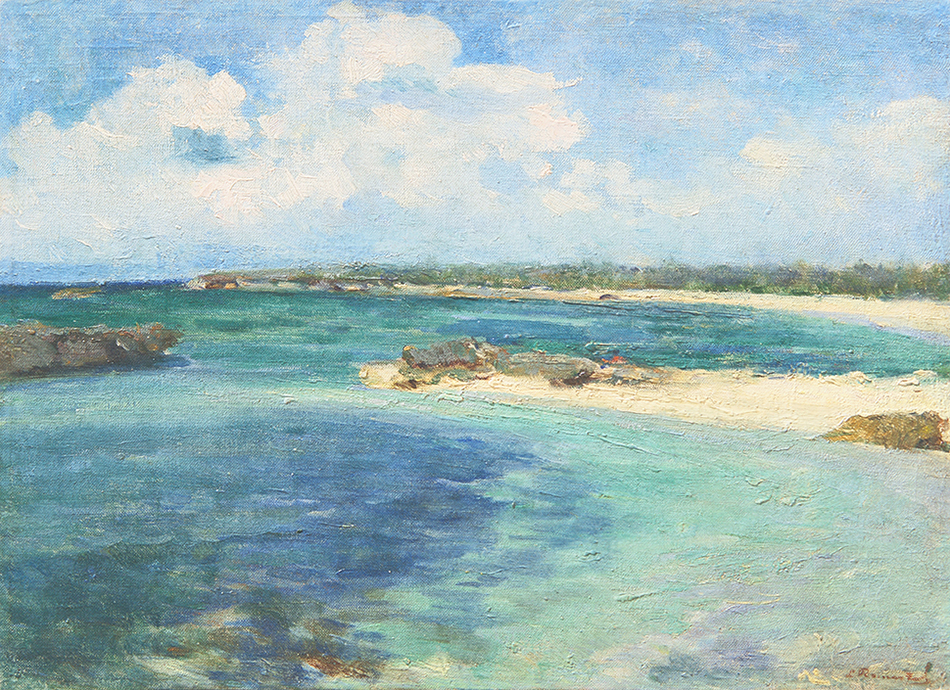
A couple of minutes later, we entered a room that mainly displayed paintings by Leopoldo Romañach, a famous artist of the early years of the Cuban republic. Standing in front of a seascape was a strange man in his fifties, dressed in rumpled black clothes and wearing a black cape, even though the temperature outside was in the high eighties. You could smell him before you came into his immediate vicinity, for he exuded a noxious mixture of sweat, urine, and cheap perfume. His unkempt curly hair and pointed beard were dark but already showed patches of white. His long fingernails were not cut in years and curved out like the claws of a parrot. He was certainly a vagrant, yet he was carrying a leather-bound notebook from which protruded pens and sheets of paper of various colors.
One of my classmates took me by the arm and placed me in front of the man, announcing: “Please meet El Caballero de París (the Gentleman from Paris),” and he and his companions broke up in a raucous chorus of laughter. I had no idea what the guffaws were about.
I just started taking Introductory French and, trying to show off, I proffered my hand and said: “Bonjour, monsieur,” followed by, as I had been taught since an early age, “Mucho gusto en conocerlo” (“happy to meet you”). The man took my hand and shook it. My classmates bent over with laughter.
The man dropped my hand and whispered in a gentle tone: “Pay no attention to these ruffians. They are trying to make fun of us. We are not going to let them, are we?”
I was later told that the Caballero de París was a famous homeless man known to roam throughout Havana, sleeping on park benches. He was the victim of some mental disorder, but was popular with all people, young and old. He was no beggar, and instead of seeking alms from the people he met, he engaged everyone in learned conversations on a variety of subjects.
At the time, I knew none of this, but the man was harmless and deserved my respect. So, I replied: “Claro que no. Cómo está?” He responded in all seriousness: “I am fine, thank you. I am here enjoying the works of one of the bright stars of Cuba’s artistic firmament, Leopoldo Romañach.” He then proceeded to give me a lecture on Romañach’s life and works, and pointing to the picture that he was examining, remarked: “Romañach’s seascapes are perhaps his best works. You can almost smell the salty breeze and listen to the roar of the breaking waves.” He then mentioned the broad brushstrokes of the waters and compared them with the tiny dots of the grains of sand on the beach, and so on; a docent could not have done a better job.
Soon my classmates, bored and perhaps a little embarrassed, turned around and left. El Caballero looked at me and winked: “See, they are gone. And they will never know what they are missing. Who is the fool now?”
I thanked El Caballero profusely and took my leave. That day I learned two important lessons: you can find wisdom even in the oddest places, and you should never judge a book by its cover.


Deja un comentario