Previously published on Chewers
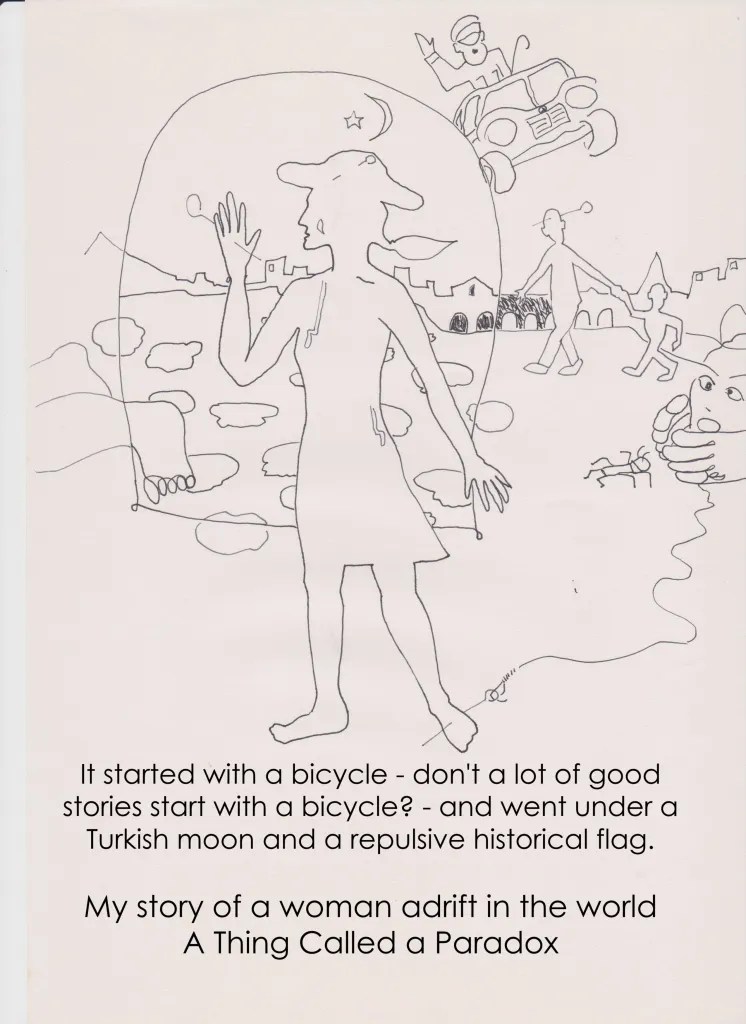
illustration by the Nick Sweeney
I was a crossing the road at the edge of an Anatolian village late one August afternoon and had just ambled out of the way of a rheumatic truck, its back full of women and children on the way home from harvesting. I was distracted by their colorful clothes and the golden dust that lit up the air around them. It seemed impossible that the dust could have hidden the cream car that came at me, but it did. Later I recalled my sole sensation of the accident as it happened: the driver’s eyes wide and mouth open, disbelief on his face but also shock and a little annoyance.
I woke at the center of a circle of faces. Somebody was loosening my collar, somebody else holding my wrist. When men tried to move me, another man shooed them away and assigned somebody out of my sight to direct the traffic around me. I heard the cars crawling by, children’s voices filling up the background. “My back.” I coughed out the alarming thought. “Is it broken?”
The word came back at me. A big-eyed woman who’d been eating garlic said, “Of course not,” into my face.
My trip to Turkey had started in Dublin the moment I went into a Dun Laoghaire bike shop to buy a cable tie and came out with a racing bike, down from five to three hundred Euros because of an inattentive paint job and a few storage dings and scratches. The guy in the shop threw in a fancy lock, but decided I was flaky enough neither to lock it properly nor get insurance. Sensing its fate, he insured my new buy then and there over the phone.
It was an evolved, elegant machine, light enough to balance on a finger, spoiled only by my presence on it. It attracted lots of admiring glances. One glancer was obviously a chancer too, and soon carjacked that lock outside Phibsborough Shopping Centre in broad daylight and in full view of Phibsborough shoppers, I had to assume – thanks, people – and relieved me of the burden of attraction. I’d never been able to live up to the thing anyway, so I was unmoved at its loss and then a click beyond glad when the insurance money livened up my bank balance.
I kind of liked the sound of Anatolia – those pleasing syllables were all there was to it to begin with – so I got on a plane and went there. Well, two planes. And a bus – well, two, and at least one minibus. None of that meant anything once I was there.
The accident diverted me from heading home to Clontarf. It led instead to a three-week spell in a hospital in Kayseri in central Turkey, and all for noticing the dusty children and women and not the cream car. I spent another four months at the home of Sinan Bey, that cool-headed man from the crowd.
I never knew how old he was, but he said one time that he remembered the death of Kemal Atatürk in 1938, and the country in mourning. I cut his unruly hair for him. I unblocked his sink. I simplified some of his haphazard wiring, put in on the fly the weekend the house was illegally built. I filled the cracks in his walls and re-painted all his rooms in white. I cooked meals, often at his vague direction, the way his wife had once cooked them.
He knew I’d never be any man’s girl, so I never became his. The men in the village thought I did – which at least kept their own interest in me at bay – and some of the women. I asked Sinan Bey what orospu meant: slut. I heard the word distinctly out of an undercurrent whenever I went shopping. He didn’t want a girl, nor a new wife, just liked to fill his life with broken things he could mend. I seemed to be one of them.
He wore off-white cotton shirts with a hint of fray at the collars and cuffs, and patched-up twill trousers from old suits. He sometimes put on a mismatched suit vest. He smelt of lemon cologne. His teeth were long and crooked and brown at the edges. He was happy with talk and with silence, to read his endless newspaper or to listen to the radio tuned to an abominable thing called Turkish Art Music. He got up early to catch the best part of the day, to fill his life with light and those white walls with shades I’d not imagined, and went to bed early so he could miss the darkness.
Most people would have noticed the cream car, I know, might have been nimble at its approach, but then they would have missed the farm workers on their way home. They would have missed the solicitude of a kind man too and the light of Anatolia and its unrolling of every shade ever and the photos of Sinan Bey’s relatives from the time of Sultan Abdul Hamid the Paranoid and the later ones who died in a battle with the Greeks at the Inönü river. All those faces, I see them now, and cannot separate them from those in the back of that truck, a circle completing itself, spinning in my mind.
***
Staying in Turkey forever was an option I entertained in the occasional daydream, but for all the obvious reasons it was never going to happen. I went to work for some of Sinan Bey’s contacts in Frankfurt. They were relatives of relatives. They were toxic people. Maybe Germany did that to them but I think they were just plain bad, and up for any opportunities for badness in a continent in flux.
Sinan Bey wasn’t to know that they exploited sweatshop labor and were, probably, involved in people-trafficking. I wrote him a card that vented all I had to say about their deeds. I wrote him another, asking how he could have imperiled me by sending me to such men. I wrote yet another, saying I was going to shop them to the police. I didn’t send any of those cards. I didn’t call the police, either. I probably ought to have.
What I finally sent him was a trite and gushing – not me, really, not me at all – thanks for the contact, but I had to leave Frankfurt because I’d got onto a study course in Nuremburg, to do with some reciprocal initiative thing between the EU and Trinity College, attached to the BA I’d almost forgotten I got there. There was an elastic deadline and I’d been procrastinating about it, but decided I would head to Nuremburg because it was something real to do and somewhere real to go, something I didn’t have to daydream about. It also featured free money – I called them to check, twice – in the form of a small study grant.
***
In Nuremburg I daydreamed of Anatolia and sometimes dreamed of Sinan Bey. I wondered why I’d not had an answer to my last postcard, sent months before – no, an undeniable year and a month. I knew deep down he was never going to answer. I walked down the corridor and into the hallway and down the big staircase and I was in Anatolia, standing in yellow sunshine over a trench of red earth that hid a kindly man forever. I pulled the door open and could barely believe I was still in Nuremburg.
There was not enough flying dust there to conceal big cream cars, but I kept half an eye out in case they might be hidden in the sleet and rain. I walked around the city with my head in the air, my eye caught by reliefs, blind niches with busts in them, or only graffiti, and stone flowers and urns from which the sparrows called and hopped. There were windows that framed dreaming office clerks stealing moments from their working days, haughty secretaries making tea, mischievous cafeteria ladies attracting pigeons with bread and smokers getting the opposite of fresh air. I once heard somebody doodling scales that turned into Mozart’s Una Donna a Quindici Anni. It was an aria I loathed after practicing a piano accompaniment to it one whole term only for our high school diva to succumb to her dad getting the chance to use a villa in Nice the very week of the summer concert. It conjured up a soprano that got me hurrying.
There was a march on, I remembered, Pegida, a boots-on-the-ground expression of hatred of foreigners – people like me. I knew too that, even more, they hated being called Peggies. I knew a few newspaper readers who showed me how well they could read, and their incisive understanding of events. They kept me up with the stuff I was hoping to block out of my life – sure, thanks. I heard a band playing and the white noise of a nearby crowd.
Those Peggies loved their marching music. They never bothered to keep time with it though; it was like they didn’t realize what marching music was for, just knew they had to have it. They preferred shouting and banner-waving, pointing – pointing really hard – and those we-will-slit-your-throat-for-you gestures.
The marches scared me because I was aware of history, my own and that of other people. I trusted myself to learn from it, mostly, but other people? What could you trust them to do? Knock you down in a car, at least. And those who were aware of the past often seemed to want to repeat it anyway, whether it caused the same misery and violence and death or not. I used to be mystified by this, but Sinan Bey told me that the past became the only certainty in those people’s lives. They were comforted by it even though deep down they knew it would poison and kill them.
At times I couldn’t stop thinking how Nuremburg had given rise to and hosted the night-haunted terrors of history, and if you weren’t careful you could become steeped in them. In buildings still standing and on the sites of others, demons had been unleashed to populate those lit-up nights to such an extent that generations since had found them hard to believe, and had used this as an excuse not to believe in them. I blocked out the band and looked at the buildings and walked.
My eyes upwards, I bumped into a woman a touch smaller than me. She had her hair hacked short, like me, and wore heavy boots like my own; she also sported a grey shirt and a black skirt. She cursed me somewhat lazily. I stared at her retreating back, stung to reply but stuck for words. I saw the group she was heading for, banner-holding boys with shaved heads and bony faces. I stopped and retraced my steps.
I turned the corner and stepped into a Turkish café, all fumes of coffee and fried food. Men were at a table near the counter, and on another table were slats of wood ready to nail over the windows and, just as ready for use, a baseball bat. The men stared. One made the minute shakes of his head that, in Turkey, mean Can I help you? “We’re closed,” one of them said patiently, but they were taking in my terrible short hair, my green nylon flyers’ jacket – not actually mine, just long unclaimed at the rooming house where I lived – and my awful hobbledehoy boots. I knew what they were thinking.
“I knew a man in Anatolia,” it came into my mind to say in my less-than-perfect Turkish, which may or may not have made them laugh. I didn’t think You don’t look like baseball fans would work, and in any case hadn’t a baldy notion how to say that in Turkish.
“We’re closed,” the same man repeated just as undramatically, though he looked around at his friends this time, eyes rolled, hand raised, palm up. I hovered, frustrated at having nothing intelligent to say in any language, then left.
***
Home was hot and stuffy and, despite all its lights, dark, because it was one of those days on which the morning had segued into evening with barely a glimpse of afternoon. Such days are romantic when you’re with somebody you love, when you have your health, and money, and the leisure to walk in a city without bumping into flag-wavers, finger-pointers and eye-rollers. I was cut off from most of those things.
The vaguely Spanish guy from the room next to mine was actually a Mexican who went under a variety of names. Each one I memorized was greeted with disdain or the feigning of puzzlement, so I was intimidated into not calling him anything. He had discarded his book and was watching the TV. The Afghan, who called himself Kabul Johann, sat hunched, his newspaper clutched, a prop against his habitual attention-deficiency. Our landlady Frau Heimbold sat in her corner at her crotchet. The guy who described himself as Persian, and not Iranian for some reason, and was known for some other mystifying reason as Anthony, was in the kitchen. By way of greeting, he called to me, “You want eggs? My spatial eggs?”
I didn’t. He meant his special eggs, poached, with chili flakes and cinnamon embedded in them. I was in fact intrigued by the idea of spatial eggs, and wished they were a genuine thing, a mixture of the culinary arts and quantum physics, but Anthony cooked his eggs so regularly they had ceased to be even special. He cooked in a hotel, and approached food like it would soon cease to exist, the way only somebody from a country that no longer technically exists can do.
“What came first?” Johann said. “The chicken or the Persian?” Frau Heimbold laughed indulgently. Intent on the news, the Mexican sshed the two of them.
“And how are you?” the good Frau whispered to me. “You look so pale. You didn’t come home last night. Nothing wrong?”
For a second, I couldn’t remember why I hadn’t come home. My hand flew to my mouth when I recalled the girl with the short hair, and how I’d left the Turkish café and found her adrift from her rally and called, “Hey, Peggie, Peggie.” She’d flashed her eyes and bared her teeth, but got them all to smile a little when I finally said something to please us both, which was, “Why don’t we let the boys do the marching today?”
She’d said, “We?” but had laughed, so it was back to her place, to beer, pizza and bed, under the awful fascist flag on her wall.
***
Nothing was wrong, yet it felt like everything was on the verge of it. The rally, and the grubby thug addressing it, were depressingly familiar, as if I’d been there when it happened before in Nuremburg in the nineteen thirties, had taken part in it all, my hair short, my boots big, under those terrible flags.
“I’m an immigrant,” I’d told the girl.
“I can see that.” She’d nudged me, then traced a finger down the line of my ribs. “Have you never heard of a thing called a paradox?”
I went to Frau Heimbold’s hallway and opened the window. I heard nothing out of the ordinary. The quiet was unreal, and the stillness didn’t seem like what you found before important events that would change lives.
“You missed your letter.” Frau Heimbold held an envelope out to me.
“Letter?”
It was from a lawyer in Kayseri and, except for my name standing out starkly, an interloper at the ball, was in Turkish. I’d not kept up my Turkish, which had been lamentable in any case. I would take the letter to Zeynep in the Turkish grocery store next door to translate it, but in the meantime a highlighted date helped me work out that Sinan Bey had finally broken and been discarded. As I’d already pictured his resting place in the soil of Anatolia, the news wasn’t a shock. I cried because you ought to. I knew that would make Frau Heimbold put her arms round me. I didn’t need another mother and it wasn’t like I’d lost a father, not really; it was just a cabaret I thought we’d both enjoy.
I skimmed through the letter over Frau Heimbold’s shoulder. A sum of money stood out, tailed with an exciting fuse of zeros. I’d forgotten the exchange rate for Turkish Lira, and anyway it would have been… unseemly to get too excited. I saw my face in the hallway mirror. I looked at it critically and tried to forget the end of people, to forget even that they’d existed. Life had to go on, fracturing and fragmenting, getting fixed by kindly men, or not, in imperfect little rooms that caught the sun, a fake mother in one, a surrogate father in another, or maybe not, and in another, hidden under flags that gave you the creeps, a thing called a paradox.
Copyright © 2024 Nick Sweeney
All Rights Reserved
 LatinosUSA
Deja un comentario