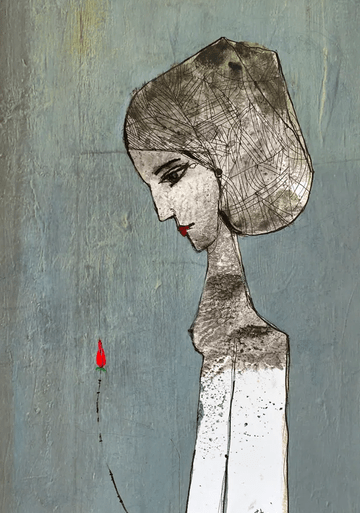
A short story in Vietnamese by Mai Thảo
Translator: Nguyễn Thị Phương Trâm
[Published on VĂN NGHỆ BIỂN KHƠI]
The ring of the bell rises, the sound carries with it an image of the direct thread of a journey, truly far and truly deep into an abyss, where silence lies at the centre of a generous pool of sediment. Rings of the bell rises gradually to fall away to then absolutely disappear. The bell was far too high on the door. Nhị had to reach for it, stand on his toes, Nhị’s mousy frame stretched as far as physically possible, before at the tip of one finger pressed the button to ring the bell. The tightly shut door completely still, completely silent, not a sound of movement came from inside. The silence stretched out like a string. And at home inside Nhị, was a mixture of frustration and indecision. There was nothing left to do but wait, Nhị dropped the suitcase on the completely closed off steps of the house, turned around, surveyed the unfamiliar streets that he had just walked through, saw it for the first time in his life.
That afternoon. The September sky was low and grey. Summer vacation was done. Brilliant royal poinciana fully bloomed in clusters, wove into natural eaves, home for the butterflies in the field, playful formative years lost in their own world, and the bus took Nhị slowly further and further away from the bamboo shaded footpaths of his childhood, away from the thick fog. Left behind one horizon, Nhị packed neatly at the bottom of his school bag tuổi hồng, the memories of his years in primary school, before a rusty wagon carried him to the centre of the province, dropped him off at this annoying unfamiliar house. The street was old and out of the way, full of potholes, full of puddles. Nhị faced a long row of single storey houses. Homes of elderly women leaning onto the shoulders of homes of elderly men. The walls creaked, threatens to fall, leaned, tried to lift themselves up and on their heads and shoulders were rows of disheveled bent eaves. A heavy load on the stretch of depressing roofs nodding off was the moss-covered tiles, each tile about to slip off, break into a thousand tiny pieces on the road. The afternoon was a smudge that covered the whole desolate scene in a flickering layer of thin smoke. Autumn had just turned up. Nhị could feel the sudden chill. Spreading pockets of cold air, in the air, slowly took over the darkness.
“Who’s there?”
The sudden sound of a voice from behind made Nhị jumped, Nhị turned to look. The fright, loss of composure, Nhị automatically reached for the handle of his suitcase. The country kid’s first trip into the province, civilization, bit his lips, held his breath. His tiny heart beating rapidly, about to burst out of his chest.
The person who just opened the door to see who was outside, just spoke up was a woman.
Nhị’s baby rabbit wide eyes yet had the ability to differentiate age. A raw custard apple just opening its eyes in the garden after the evening rain, and a warm mushy custard apple wrapped in sweet potato leaves, an old bird with sharpened beak, the smiling petals of a bud and the glorious full bloom of a flower, Nhị can tell the difference. Cultivate the maturity of a blade of grass. Or how new was a new the budding leaf. But people, Nhị had no idea. All he could extrapolate was that the face that had just appeared from behind the slightly open door was the face of a woman. Though in truth, it was the face of a girl. Her name was Châm. She was a lot older than Nhị. But because they were related and because of the nature of rank in a Vietnamese household. Châm had to refer to Nhị as her uncle. And she was his niece. Nhị was fully unaware of such societal dignitaries. His face turned bright red, tongue-tied, stammered:
“Good evening madame…”
The girl lifting her hand to cover a smile. Nhị already inept, felt even more inept. In the end the words finally came:
“Is this not the house of bà phán Tuyên!”bà phán: title of a French government office worker’s wife.
The girl studies Nhị for a bit before asking:
“Are you uncle Nhị?”
Taken aback, Nhị pulled back. City people were amazing. They recognized Nhị even though they have never met. Nhị wide-eyed, nod. The girl laughing now audibly, crosses the threshold, picks up the suitcase, as though she has known him for years quickly invites him in, left him there standing. Ran into the house shouting:
“Mum! Uncle Nhị is here. Mum”.
Deep inside the shifting darkness of the house in a nameless province covered in a shroud of afternoon fog, the sound of flapping flip flops came down from an unseen stair. A few more minutes passed by as Nhị stood there at the doorway. Bà Phán Tuyên taking her time appeared. Bà Phán Tuyên Nhị had met on previous occasions. Recognizable. She had frequently visited his parents in the hamlet; she would bring delicious snack that you can only find in the province. Like chuối ngự, cốm Vòng, cakes and cookies. Often in summer, she would lug along a few kilos of ice packed in sawdust so it wouldn’t melt. She would stay in the hamlet for a few days, when she leaves, Nhị’s mother would pack meat and fish, fresh vegetables that she said she couldn’t find fresher or nearly as good compared to those she buys at the market in the province.
Partly because of Bà Phán Tuyên, Nhị’s parents allowed him to start high school a year early in the province. Nhị’s parents thought it was inevitable that he will have to say goodbye to the bamboo groves, golden rice stalks, grass lined dirt road in the spring, leave for high school in the province. But it was supposed to be next year. Worried Nhị was still too young. That year Nhị had just turned eleven. Still held on to the hem of his mother’s top if they went anywhere far from home. But Bà Phán had managed to convince Nhi’s parents to let Nhị start high school exactly a year early. My house is your house. Please let us do it, we will take good care of uncle Nhị. Both our boys Chuẩn and Tài are around uncle’s age. They will get along fine, go to school together, it will be no trouble at all. Children these days should gradually be allowed to leave home. It will toughen them. That’s basically what bà Phán said. In the end, Nhi’s parents followed her advice. And that September afternoon marked the beginning of Nhi’s school days far from home.
*
Compared to the last time in the province, an interaction now blurry, but the image of his cousin was still there in his mind, bà Phán Tuyến had changed a lot. A withered change in appearance. Caused by worries, illness and inconvenience. No longer does she smile. Forehead filled with furrows. Her black hair, Nhị remembered was carefully brushed like velvet now coloured with strands of grey hair. Only September and yet the fresh wind from the north at the beginning of the season in the air was cold enough that she had to put on a thick black woolen cardigan, that was buttoned all the way to the neck. Her eyes tired. The look brimming of pain and sadness. On top of all of it was her persistent cough. She patted his head: “How wonderful! Is that you uncle. You can go to school with your nephews”. She pointed a finger to introduce them: “This is Châm. She is your niece”. She told him that his parent had sent a telegram to inform them that he was coming yesterday afternoon. She said that Nhị should go and freshen up, wash his face, change his clothes and wait for Ông Phán to come home for dinner. Bà phán, left Nhị standing there on the ground floor, she hugged her chest, the cough tired her. She struggled as she climbed the stairs.
Nhị could never forget that first afternoon far away from home in the province. The mousy form, a soul as pure as a spring, as fragile as the calyx of a flower, eleven in the rice fields a native cocoon in a warm cradle in his formative years, that first afternoon in the province, was already awkward, baffling in a severed state of great separation. The grownups plucked Nhị from a familiar world and thrown Nhị into a place where Nhị was completely lost, a complete foreigner, everything was completely unfamiliar. He could no longer see his home in the hamlet wildly blowing in the wind. Now far away were the mornings, the sun sparkled brightly on each tile on the roof. Flocks of brown sparrow swarmed danced in the sun, gentle scents of chaste ylang ylang at the tips of branches, thousands of bamboo leaves like fingers beckoning on the way to school, and the kind and small river was subtle like silk, peaceful, the clearest mirror reflecting the vista of his warm childhood. Lost was the friendly sound of ducks and chickens out of their coops in the morning in the country, Nhị running along with them, throwing grains at them turning it into a storm of raining flowers. Out of sight were the raised dikes where the sunrises, the bridge where the sunsets, the winding path in the shades at the back of the temple with the curliest of eaves where he found himself in the middle day during summer. Gone were the full moon shining on the huge tiled courtyard, the moonlight that used to chase after Nhị. The whole time Nhị was on the road, Nhị looked back on those memories. The further the bus took him away from home where his memory was impossible to contain, the further away, the more boundless. Ấu, Thóc, Phiên and Phượng was the only girl in their group, he wondered what they were doing right now? Nhị missed them. Nhị was far away from anyone he could poke fun at, and he missed his friends, so much, at every single stretch of the road going further and further away from them was how much he missed them. Ấu had a starfruit tree in his yard. Really sweet. In the village no one had starfruit as sweet as the starfruit from his tree. One bite, and the juice came oozing, on your tongue, filled your mouth, the starfruit was as sweet as rock sugar. Ấu was Nhị’s bestfriend. From kindergarten to preparatory. From preparatory to elementary. No matter the place there was Nhị, Ấu would have an arm over his shoulder, or standing there right next to him, baby rabbit feet side by side with tiny sparrow feet. Nhị get to eat at least a dozen starfruit from the tree in Ấu’s garden. The day Ấu found out that Nhị had to leave for the province for school, Ấu had two starfruits rolled up at the bottom of his shirt, he had cut through three fields, and ran down a path through the village, to give it to Nhị. Ấu black skin. Lots of tricks. Like snake eyes his eyes were dominantly white. The people in the village said that Âu’s father was an outright robber who was caught by a mandarin official with an ebony badge, who had brought soldiers from the district to capture him. Ấu’s father broke through the fence, wade through a pond in an attempt to escape. But in the pursuit, he was shot in the leg by a soldier, fell. They tied his hands, before they took him away. And died incarceration. Like father like son. Ấu was like the snake’s head of organised crime, and his forehead protruded like a tumour, notorious as the most bullheaded and stubborn student in class. Professor Chử more than often had to use his rattan whip on Ấu, once he referred to Ấu as the son of a bandit chief, made Ấu lie on the floor faced down, and Ấu received the whipping. Ấu’s body squirmed like a worm but accepted it like a hero making not a sound. Nhị was there to witness the whipping, each time he remembered the incident he would turn pale and green like a leaf. The bandit chief father was nowhere to be found, just the filial son. Ấu’s love for his mother strangely goes beyond caring. Ấu’s mother lives in a small hut, his mother sell bits and pieces like drinks at the open-air stall near the banyan tree at the entrance to the village. In the morning Ấu would balance all they things his mother might sell on his head to the stall, on the way to school. When he did anything wrong, his mother would tell him off. Ấu would fold his arms quietly, lowered his head, stood there without say a word and listened, never talked back. Ấu was as strong as a water buffalo rolling around in the mud, rooted like a tree he would always stand his ground, fought till he was black and blue, no matter how much it hurt he held his chin high, and you will never hear him cry. And yet the day Nhị left, the day he gave his friend the last two starfruits ending their formative years as a team, Ấu had tears in his eyes.
Nhị with Ấu alone had so many memories. There was no storage space big enough to store them. What kind of school bag will be big enough to hold them. And there’s Thóc. He’s Nhị’s second closest friend. Thóc was a good student. His mind was full of words. Contained in Thóc’s mind were what kind of words, words like staying back, turned into lessons learned off by heart read out a loud bang bang bang in a single breath, turned into mathematical problems solved without a single mistake, turned into times at the black board, Thóc’s clear voice always precise and on point, with a ruler in his hand, during geography pointed at the map as he talked, named each river without making a mistake, never mixing up a single mountain. A rogue and saint both. If he was not a rogue, there was no way Thóc would come first three years in a row in primary school. If he was not a saint, then how could their professor submit to him. The professor insisted that Thóc was the perfect example everyone to follow, everyone should be as studious as Thóc. Nhị wanted to but couldn’t. Keeping up with Thóc meant running out of breath. Studying like Thóc, in one go, breathless and dizzy. The day before Nhị left, Thóc asked Nhị to go to the market with him. Thóc wanted to pay for last meal they ate together, they ate so much bún riêu they couldn’t fit anything else. Like an order, Thóc announced: “Whatever you want, you can have it. I’ll give it to you”. Thóc had lots of things Nhị liked. Thóc had a canary caged in a red lacquered cage, a complete box of 12 different colouring pencils, a leather-bound book filled with pressed butterflies of all shapes and sizes, and a fairy tale book that was Thóc had received as an award for coming first in class, which Nhị remembered borrowing once for a quick glance.
Then there was Phiệt. They were not very close but one Sunday afternoon, it was Nhị who took the first step to befriend Phiệt. Nhị love fishing and Phiệt’s family had the largest pond in the village. And Phiệt’s family pond was Nhị’s ultimate passion. The thought of it was understandable, at night in his dreams he could still see the pond with schools of fish splashing wriggling their tails like a blur everywhere in his dreams he didn’t know where to look where to focus. The pond behind the house accessible by two side doors surrounded by bamboo. But in truth you could only access the pond via the front door, where Mr. Xã, Phiệt father, sat, on the first step, as though all day.
Once, Nhị gathered enough courage carrying his fishing rod, but could not go through with it. Mr. Xã inquired off hand: “Master Nhị, what are you up to”. Nhị answered: “I’m looking for Phiệt uncle”. Children are incapable of deceiving old people. The old man was quite cruel, still in that offhand manner said: “You can look for whoever you want, be my guest, but none of this looking for a way to catch any of my fish”. The old man guarded his fish more meticulously than the red-haired guardian guarding his treasure, Nhị had read about in a fairy tale. Disheartened, he gave up on fishing, dragged his feet home that day. The one who dobbed Nhị in for fishing in the pond and stealing Mr. Xa’s precious fish was actually Phiệt. Seeing how much Nhị loved fishing, Phiệt found a way for Nhị to bypass his father. Make a shorter fishing rod and hide it under your top. If my father asks, tell him you’re looking for scutch grass at the back of the house. Once you reach the pond, you can take the rod out. You can sit under the fig tree and fish. It’s surrounded by vegetation, you will be out of sight, my father won’t be able to find you. If you manage to catch any fish, just leave it under the fig tree, I’ll take it to the gate for you. The whole of one summer, Nhị followed Phiệt’s plan exactly. And sure enough, every week he managed to steal a dozen of Mr. Xã’s carp. Now it’s all gone. No more shrimp or worms for bait. Gone were the gobies with their bulging bellies, the slimy black perch, the red-eyed catfish, the slippery snakehead, and the heavy carp so heavy they bent the small fishing rod; gone were the overgrown hiding spot hidden behind the fig tree with branches stretching over the watery surface of that pond.
Goodbye. Fairwell. Leaving. Left behind. Phượng, her eyes as round as marbles, black and shiny, smiling, crying, often insistent on coming along with Nhị on his exhilarating and intoxicating adventures through the trees, through the gap in the fence, they squeezed through the bamboo slats, jumped over ditches, though scared she still wanted to come along, the fear did not stop her from insisting that Nhị should let her go with him, each time, Nhị refused. But Nhị’s friend would stomp her feet on the ground, threatened him that she would cry or scream if he refused to take her with him, Nhị just want to cry for heaven’s sakes but instead he would grab onto Phương’s wrist lined with chubby folds, took her running headfirst and in the middle of all that thick blue cool shades endless fun and games in that garden of Eden had always reserved for Nhị alone new and wonderful discoveries. Phượng, what are you doing right now? I’m now so far away, Phượng! Who will help you catch the butterflies in the middle of the day, the sunstroke, scutch grass, damselflies, and the dark nights, flickering fireflies, and rainy days, who will be, by my little friend’s side, excitedly send paper boats down the overflowing rivulet? Goodbye, Farewell. Left behind. Break up. So far away from you. Leaving. Images of street numbers. And now just an unfamiliar street, no butterflies, no old friends. The bright red clusters of royal poinciana of their formative years now all in bloom. Fallen petals. The start of a new school year. A year of school in the province full of unfamiliar hostility. Hostile from the moment Nhị set foot in that street. Hostile from that day onward in that boarding house had begun with Nhị’s dreadful premonition of a life in exile.
*
A house built in a different era, old and falling apart. Like all the other houses built the same way, dull and sad leaning against each other in a row trying to hold each other up, dark and buried at the heart of an unseen quiet street. It wasn’t until much later, Nhị’s mother explained, that around the time Nhị turned up as a boarder for high school, his older cousin – bà phán Tuyên – was faced with a huge misfortune. Her family before that lived comfortably, they had money. Their home from morning till night was full of laughter. Ông phán would go off to work. Bà phán did this and that to make extra money. They were well off, before bà phán lost a fortune. Bà Phán had a friend who was a good talker, she managed to convince bà phán to give her all her money for a new business, one day, she was just gone, there was not a trace left of her. In a flash she had nothing but debt. Ông phán punished his wife’s kind heart by making her stay home day and night. It was the start of a miserable life from that point on. Half of his wages were used to pay off the debt, half were handed over to his eldest daughter Ms. Châm, Nhị’s niece, to run the house. The meager finance was never enough no matter how careful his niece tried to shuffle it. The household bared one misfortunate after the other sank into an air of sombre dark depression. Bà phán was always sad, often sick because of it, lay in her bed in the attic in the dark all day all night. The laughter disappeared from their closed up, depressed faces. Remained were the pairs of eyes always lowered always sad, brimming with silent tears and the long sighs.
That first afternoon, that chill in the air, listless household void of happpiness was a confusing reality forced upon the mind of a small child like Nhị. Night. Turning on the light. Even the light was a sickly yellow, sad and dejected. Ông phán home after leaving the office. Tired, cranky. He greeted Nhị because society dictates the polite pleasantry. During dinner, his sons glared at Nhị, did not bother to hide their hostility. Ms. Châm, their oldest sister to Nhị felt more like family. But the eldest daughter of a family in decline could not be a cheerful young woman; instead, she was soon burdened with nameless worries and all kinds of problems. The first meal, marking the beginning of Nhị’s boarding school days, was anything but joyful. Everyone ate with their heads down. Then the lights were turned off. Everyone went upstairs.
Nhị went outside and sat down at the front steps of the house. The bottom floor of the house was pitch black behind him. In front of Nhị, the tiny provincial area stretched out slowly under the dim streetlamps. Under the low eaves, silence, here and there were the odd movement, odd person. Sometimes, swaying in the dark was a street vendor’s lamp slowly rolling by. Their voice, hoarse, exhausted. Scattered sounds lost forever in the silence together with the smaller and smaller flicker of the flame at the end of the street. A cold September night. Disturbing sound of a leave falling into the deep gutter in the roof. The streets damper and more wet by the minute. Shifting fog, a deep-sea blue. Nhị rested his chin in the cups of his palms missed the bright moonlit night in the village. Nhị’s home was right by a river. On a moonlit night, everyone in the village came out to swim or wash their clothes on the rocks. Kids like Nhi’s played in the river, waves and splashings of yellow moonlight on the water. Farewell to the old moon. O moon of his childhood, from here on, goodbye. Nhị was deep in that kind of endless memory like that, until Nhị saw the door of the house, on the other side of the street opened, a light turned on and someone was crossing the street.
The figure headed straight to where Nhị sat. Nhị was not sure if he should stand up or stayed sitting, the form now closer, stopped in front of him. A gentle voice, an extraordinary gentle and warm voice:
“Tài, is that you?”
Nhị confused:
“I’m sorry, Tài?”
The shadow leaned down closer to get a better look at Nhị’s face. And Nhị saw the face of the woman who lived on the other side of the street. The same height as chị Châm his cousin but this woman was thinner, more dainty, more fragile. On her oval face, a pair of deep dark eyes. That face, later Nhị came to realise hid a hint of sadness, was extraordinarily beautiful. As lovely and was as kind as that sweet voice Nhị just heard. Giggling:
“Ah no! Sorry. I thought you were Tài, Châm’s little brother. Do you know where she is?”
“She’s home.”
“And you are?”
She did not wait for an answer, placing a hand on Nhi’s head, a warm soft hand:
“Ah, you are the boy boarding here for school from the hamlet?”
“Yes mame”
“Ms. Châm came over this morning, she did mention it. What are you doing sitting here all alone?”
“Looking at the street”.
Again she giggled, congenial:
“Looking at the street? The oldest and ugliest street. There’s nothing to look at. It’s foggy now. You shouldn’t sit at the door like that. It’s very cold. You can look at it as much as you want in the morning. My house is over there. The door with the light on, can you see it?
Nhị nodded. The woman patted Nhị’s head, straightened her body:
“What is your name?”
“Nhị, my name is Nhị miss”
“Nhị? Okay good. Stay here and go to school and when you’re bored, like this Sunday for instant, you can come over. Come over for the cookies I just baked, you can eat as much as you like. Now, stand up. Go in and get Ms. Châm for me, tell her Ms. Thời wants to see her”.
*
Years after that, each time the royal poinciana bloomed, each year came the start of a new school year in September, the country boy had to again became accustomed to the light in the street, again in a new school, new friends, again leave his room and board at the heart of another old and decrepit street, firmaments of small towns in the province would fade away except for the affectionate and vivid memory of that lovely face. That gentle image, kind face of Ms. Thời. Her sweet voice. Understanding eyes, the warmth of her hands. Between the young master and the young woman, formed a thread of friendship, a thread that became and unbreakable bond, spun tighter as time passed by, the memories Nhị shared with Ms. Thời build a foundation of respect and cherished affection, remained forever substantial and whole in Nhị’s mind, was the most touching and carefully preserved part of the first days of studying away from home.
Once again Nhị thought about Ms. Thời. Her small and withdrawn world, quietly flows through the fields, passing insignificant blades of grass. The way she moves, her existence, not a sound, in that old house, where she had spent her youth, gone were that rosy spring, it passed her by. Then there’s the backyard, moss strewn and lonely surrounded by four tall walls, a string of days where Ms. Thời spent in the sprinkling rain, where not a single ray of sunshine could find its way in, even during cloudless summer days. Then there’s her face, kind, sad, hiding something that could never be revealed. Then her sad eyes. And like a gentle breeze were her long quiet sighs, that Nhị sometimes caught, but Nhị was too young, to understand the real reason.
*
Those first days feeling lost living away from home passed by. The street in the province without those playful childish mornings, happy skips on the paths through the fields in the hamlet. But Nhị slowly got used to it. There was no other way. Except Nhị could not find any resolution for his cousin’s family, persistently drowning in one problem after another, there was no way for him to become a part of their family. Bà phán sleeps all day in the dark in the attic. Wearing a cardigan buttoned up to the neck, hollowed round eyes and coughing spasmodically each time the weather turned cold. Ông phán, came home in the afternoon, always tired, grumpy. They didn’t have a live in helper, Ms. Châm spent the whole day in the kitchen. While the brothers Châu and Tài were not like his friends Ấu or Thóc. They didn’t want anything to do with Nhị, they don’t want to be his friend. More than often, Ms. Châm would tell them off: “Why don’t you let uncle Nhị play with you?”. The two boys would look at each other for a second and continued with whatever they were up to and ignore Nhị. They said Nhị didn’t know anything. They laughed at Nhị because he was a country bumpkin. They made fun of Nhị every chance they got. If uncle want us to be our friend, he should try harder. And yet, whatever Nhị tried was never enough, both of his nephews were the same age as him, ignored Nhị. Heartlessly they rejected him. One time, bà phán gave all three of them money, uncle and nephews, for the cinema. The movie was The Three Musketeers. The movie had sword fights so fast it was like lightning, and horse riding like flying—Nhị was totally fascinated. But as soon as he ran inside to grab his white hat and came back out, the two damn musketeers had sneaked off, and Nhị the third musketeer had to stay home. That afternoon, when Nhi’s two evil nephews got home, excitedly they talked about how great the sword fight was, Nhị was so angry he almost burst into tears. But they’re stronger, and they had each other’s back, Nhị couldn’t touch them. The book full of butterflies pressed between their pages, a present from Thóc the day they said goodbye and left, they stole it. Asked, they said they liked it, and when they didn’t like it anymore, they tore it up and burned it. Obstinate, rude, and ignorant to no end. Hence even though they lived under the same roof, go to the same school, go home the same way, there were no love lost between the tiny uncle and his two nephews, there isn’t that kind of friendship that you think was natural and easy, childhood friendships.
But Nhị didn’t care. Nhị had one new friend. Kindred. Benevolent. Kind. That person was Ms. Thời. Daily Nhị came over to visit Ms. Thời. At least once a day. Spending the whole Saturday afternoons there. The whole day, Sundays. In the beginning Nhị was worried bà phán might object. Ms. Thời assured him it will be fine; she will talk to bà phán. And she did. And bà phán objected weakly out of duty. Gradually, Nhị slowly moved his life over to her house, executed the shortest migration to the other side of the road.
Ms. Thời’s house was also a house from a different era with its giant columns and deep curved eaves, moss strewn wall like all the other houses in the street. But it was spacious with plenty of room. And very clean, very peaceful. Ms. Thời had two older brothers. Much older, married, both found a life far from home, sometimes home for the death anniversaries and tết. The big house inhabited by only Ms. Thời and their elderly mother. A seventy yearly old elderly woman. Her hair completely white. She lived a life devoted to prayer without human desire. Kind and benevolent, gentle like her daughter. Sometime passing the small room next to the courtyard inside the house, Nhị looked in, saw the elderly woman sitting there, in front of an altar of Buddha. Threading a string of prayer beads slowly through her thin fingers. Candle flames shimmered. Scents of incense. The elderly woman sat there praying one hour after the other, rhythmic taps on the wooden fish in time with the deep chants. Except for that small room, the rest of the house became Nhi’s private world. Ms. Thời adored Nhị, said that Nhị was kind, and a good kid, allowed Nhị complete freedom in the house. Noon, it’s cooler here than Bà Phán’s house, Nhị can come over here and sleep. After school in the afternoon, don’t forget to come over for the fresh cinnamon rolls. She also said if Nhị loose a button, bring it over, she can mend it for Nhị. And any math problems too hard, bring your exercise book, she will help Nhị find an easy way to solve it. Nhị loved those summer afternoons falling asleep on the ironwood rocking chair that was cool like human skin in the shade of Ms. Thời’s loving home. The house seemed covered by thick, leafy branches. The air was still. In the corners, there was a kind of intimate darkness. And on the polished floral stone floor like a mirror, Nhị’s drowsy eyes sank into an unbothered innocent sleep, watching Ms. Thời gracefully moved from here to there, around the house, the figure that had consoled and made Nhị so happy during all those midday summer after summer years ago.
Later older, each time Nhị thought about Ms. Thời, Nhị realised that Ms. Thời possessed all four virtues of a Confucian woman, qing xian zhen jing, calm compose chaste quietude, the ageless beautiful face of a soul and virtue both, now, Nhị realised was celebrated like poetry in essays on ethics. Ms. Thời was truly amazing. Like Thóc coming first three years in a row in primary school, Ms. Thời excel in all aspect of running a household and as a provider surpassed many girls her age, Ms. Châm, Ms. Hiền, Ms. Thảo, her girlfriends down the street. Embroidery, cooking, sewing, everything was subtle artistry to Ms. Thời. Now, Nhị was oblivious to all of it. Heard again and again from everybody like Ms. Châm, Ms. Hiền. Some say on the other hand. About her. Clever, polite, calm composed like that, so well spoken, and yet Ms. Thời, strange epiphany and destiny had never found love.
The young women her age got married one after the other, Ms. Thời alone remained in her world of indifference. Done was a season of rain. Through a season of sunshine. Done was one year then another. When she first came to live in the street, Ms. Thời’s house each Sunday morning was a place where all her friends met up. The girls baked, embroidered, enjoyed each other’s company. A mixture of chatter plus laughter reverberated through the house. Then Nhị saw those faces less and less. Came each spring walking down the street, parades of people wearing red sashes around their waist, and quả song on their head. They move with ceremony, in a long row. They carry bronze platters, piled high with biscuits and cakes wrapped in bright red glitter and cinnabar paper. Kids in the street, all of them came out to watch, clapped, cheered: wedding, there’s a wedding. A few days later, a convoy of black-painted hearses turns up, a parade of people lined up in a row. In all the burnt smell and smoke of red firecrackers, the startling noise and movement in the middle of the restful street were happy faces of people celebrating. And after these happy days, gone was another Ms. Hiền, Ms. Lụa. During the total of four years Nhị boarded at bà phán house. Ms. Thời’s friends one after the other took turn “lên xe hoa”, got married, moved away, or move in with their husband’s family. In the fourth year, bà phán also gave away her daughter, Ms. Châm was married that year. The wedding was glorious thanks mostly to Ms. Thời. She came over to help, nearly with everything. When they said their goodbyes, Ms. Thời had refused to be her bridesmaid – the pair held onto each other, cried. Weddings are supposed to be fun, the grownups said, Nhị didn’t understand why they were crying. By the afternoon, the heart of the old city returned to its lonely state. Bà phán’s house was deserted and sad. Nhị again ran over to Ms. Thời’s house. She didn’t see Nhị come in. She sat in the dark as the afternoon draped slowly over her hair, head lowered, motionless, depressed and sinking deeper and deeper, and again she lifts her hands up to support her chin, cupped them in her hands. Nhị had never seen Ms. Thời as sad as that afternoon.
She pulled Nhị closer:
“Ms. Châm had left the both of us”.
Nhị said, innocently:
“Girls when they get marry, they have to leave”.
“You are absolutely correct”.
Tilting his head thoughtfully Nhị asked suddenly:
“What about you, when are you getting married?”
Smiling sadly:
“No one wants to marry me”.
Nhị found it impossible to believe. Innocently Nhị asked:
“Why did they marry them then?”
“They are luckier than me”.
Then as though she didn’t want to continue, to talk about it anymore, Ms. Thời would say, you’re too young to understand, there’s no need for you to worry about grown up stuff. And she you get off her sit to fetch more biscuits she just baked for Nhị. Out of the ordinary that afternoon was that Nhị was allowed to enter Ms. Thời’s private chamber. It’s a small room, no different to Ms. Châm’s bedroom. But as soon as the light was turned on as Nhị entered, Nhị was startled by what he saw. The walls of private chamber were unlike any other, they were completely covered with framed photographs. Yes, photographs. What surprised Nhị even more was that they were not photographs of Ms. Châm, Ms. Lụa, they were photographs of actors. Silver screen actors. Photographs of projected actors in the cinema. So many of them. More than a couple dozen, big and small of all shapes and sizes, each photograph framed in glass and a gorgeous leather frame, hung neatly together with no gap left between them. And the last ultimate surprise for Nhị’s juvenile underdeveloped brain: the actors on the walls were all men, not one female actor.
The fourth year living away from home, Nhị discovered the joy of the silver screen. Loved the cinema. Loved it a lot. Mê như điếu đổ, fall and crumble for the silver screen like crumbling cigarette ash, it was an uncontrollable obsession. But going to the cinema “weekly” like that was a huge cost for a poor student living away from home. Father gave him a dollar. He had to make sure it lasted him the month. And that was already a lot. So much and yet it was not enough. His cousins, the two boys, beef jerky and prawn chip, the stingy bastard with the spinning wheel with a tiny flag stuck in the middle, the racket Chinese man made with his two bamboo sticks, the old man scraped with his dirty fingernails and the hurricane lamp flame flickering, had almost divided all of Nhị’s one dollar among themselves. And there were marbles. And there were horned spinning tops too. Before the middle of the month, Nhị was already a bona fide proletarian school student. Fortunately, there was Ms. Thời. She gave Nhị money for the cinema at least once a week.
Looking at all the actors covering completely all three walls of Ms. Thời’s bedroom chamber, opened Nhị’s eyes, as though he had attained something valuable. He recognised all the faces of the actors. There was Robert Taylor, his hair as black as ebony, curly like waves. There was Tyronne Power dressed like a nineteen-century knight, eyes, bright pools of reflection, brilliant white teeth, luring smile. There was Clarke Gable and his curated mustache. There also was Franchot Tone and Douglas Fairbank Jr. Perhaps you can say that all the stars, idols, faces Nhị later learn were the most beautiful time in a woman’s life, and it was there in Ms. Thời’s bedroom chamber. These photograph collection of the stars, to her then, to later on when I was older was the same. Besides the photographs on the walls, Ms. Thời had dozens of photo albums. Robert Taylor alone, there were hundreds of photographs. Also very beautiful were Ms. Thời’s collection of albums. The whole collection was covered in satin and labelled with gold letters. Satin the colour of purple palm lily. Satin in yellow flamboyant flowers. Aqua satin the deepest colour of the sea. And satin in royal silver, shimmering and shiny.
A true discovery. A surprising discovery. The last thing that surprised Nhị even more was that Ms. Thời rarely go to the cinema. Not an avid movie goer. Only during tết. And it had to be a truly outstanding movie. Then why did she have hundreds and hundreds of actors on the walls no matter where you look in her private bedroom chamber? Nhị said:
“Do you really like the cinema?”
“Enough”.
Like it enough. Only like, the photographs were her passion. Again, another secret beyond Nhị’s childish mind.
“What is the point of liking anything so much?”
“No point at all”.
Ms. Thời pat’s Nhị’s head, serious suddenly, as though she was somewhere else, as though she was talking to a grown up:
“The only thing left for a woman like me are these photographs”.
“I don’t understand”.
“When you’re older, you will. Now go outside and play”.
*
Farewell to all the dark corners of those streets, deep curved eaves possessed by a deserted soul fading through so many seasons of falling leaves, farewell to the sky in the province retreating behind curtains of sprinkling rain and fog of the past, life, one wave a time pushed the young man towards a new landing, bigger, brighter. There will never be another opportunity for Nhị to return a place that had marked four years completely new and lost in the streetlight in the district. Ms. Châm took a husband. Ông phán was transferred completely different department, took his family with him. At the end of one year, in the middle of a suffocating war, Nhị got news of bà phán passing. The old streets, that quiet place unaffected by the rest of the world, the sad and depressing life in the province, had severed all ties with Nhị. When Nhị had a chance to look back, Nhị could only see glimpses of those memories. But Ms. Thời remain always vivid in his mind. An unfortunate old maid who had missed all her opportunity to get married, the floral carriages of marriage passing her sad stop, never stopping to celebrate, no bright crackling laughter of exploding red firecrackers, no beautiful memories of a completely new frontier like marriage, a memory as brilliant as the sun, a kind warm sun that will remain forever bright in his memory. Nhị wished that he could have one more chance to see Ms. Thời again, at least once. But people say her family was no longer there in that old house. Drifting, facing struggle was Ms. Thời’s destiny. Missing Ms. Thời, Nhị missed the old house. The green moss strewn yard. The water feature and the pot plants. The elderly mother, Buddha’s altar. Scents of incense and glow of shimmering light. The midday afternoons when darkness became shelter, where Ms. Thời’s kind face stayed, as the child far from home nod off to sleep. And the comfort, in her voice. And her collection of photographs. “All I have are those photographs. It is my life. When you are older, you will understand”. Now older, Nhị understood. Those photographs of actors were the picture of the dream man in her life, a dream that had remained unfulfilled. The sad princess remained in the cold tower, in the lonely castle. The springs turned up. To then leave. Inside her the flowers bloomed. The butterflies flew in the fields. Floral carriages. Red hues of wedding firecrackers. But when it came to Ms. Thời, not a single knight on a white horse turned up, at the gate of her castle. And that sad princess continued to live with a dream that will never come to be. And one day those photographs will also fade. Where is Ms. Thời now? Where had her boat drifted to, landing where? Nhị wanted to know if she was fine. Wanted to send her the best regard. Wished her happiness. Wished that she will have the spring of her dream, even if when it will turn up late.
Mai Thảo [1927-1998] real name is Nguyen Dang Quy, another pen name: Nguyen Dang, he was born on June 8, 1927 in Con market, Quan Phuong Ha commune, Hai Hau district, Nam Dinh province (originally from Tho Khoi village, Gia Lam district, Bac Ninh province, the same hometown and related to the painter Le Thi Luu), his father was a merchant and wealthy landowner. Mai Thao absorbed his mother’s love of literature from Bac Ninh. As a child, he studied at a village school, went to Nam Dinh high school and then Hanoi (studied at Do Huu Vi school, later Chu Van An). In 1945, he followed the school to Hung Yen. When the war broke out in 1946, the family evacuated from Hanoi to Con market, in the “House of the Salt Water Region”, from then on Mai Thao left home to Thanh Hoa to join the resistance, wrote for newspapers, participated in art troupes traveling everywhere from Lien Khu Ba, Lien Khu Tu to the Viet Bac resistance zone. This period left a deep mark on his literature. In 1951, Mai Thao abandoned the resistance and went into the city to do business. In 1954, he migrated to the South. He wrote short stories for the newspapers Dan Chu, Lua Viet, and Nguoi Viet. He was the editor-in-chief of the newspapers Sang Tao (1956), Nghe Thuat (1965), and from 1974, he oversaw the Van newspaper. He participated in the literature and art programs of radio stations in Saigon from 1960 to 1975. On December 4, 1977, Mai Thao crossed the sea. After 7 days and nights at sea, the boat arrived at Pulau Besar, Malaysia. In early 1978, he was sponsored by his brother to go to the United States. Shortly after, he collaborated with Thanh Nam’s Dat Moi newspaper and several other overseas newspapers. In July 1982, he republished the Van magazine, and was editor-in-chief until 1996, when due to health problems, he handed it over to Nguyen Xuan Hoang; Two years later he died in Santa Ana, California on January 10, 1998.
Nguyễn Thị Phương Trâm, the blogger, poet, and translator, was born in 1971 in Phu Nhuan, Saigon, Vietnam. The pharmacist currently lives and works in Western Sydney, Australia.


Deja una respuesta