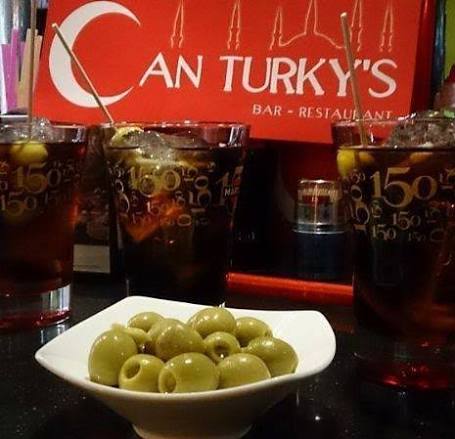
The Turkys bar is much more than an anecdotal biographical detail: according to studies on the author (The portable Honeland, Writing on the margins of the world by Rafael Julivert), it is the setting where much of Crivello’s later literary work takes shape. Located in Vilanova i la Geltrú, a city that becomes both the setting and almost a character in his mature work, the Turkys is «the first counter of the day,» the office and the parish where the author writes every morning on the terrace.
These studies interpret it within a consistent biographical structure: the man who was a guest in ghost hotels and overcrowded apartments, they say, «transferred the hotel to the bars.» Before, it was an office on the Rambla with two-euro beers; in his old age, it is the Turkys. Along with the network (Masticadores) and his blog Barcelona, the bar forms one of the three «windows» of the only home Crivello was able to furnish to his liking: writing itself, that portable homeland of which Heinrich Heine speaks, to explain that, unlike other peoples whose identity and symbolic immunity depend on a physical territory or geographical land, the Jewish people managed to preserve their cohesion and survive centuries of diaspora and exile. Turkys, in short, embodies the specific place—Catalan, everyday, chosen—from which Crivello narrates Europe using the informal «vos» form, and from which he only returns to Argentina through memory and dreams.
Excerpts on which it is based
CHAPTER 1 The Son of the Hotel Patria: A Life Between Two Hemispheres “I do remember the Hotel Patria, my grandfather J. Crivello bought it; it cost him a fortune at the time.” —Juan Re. Crivello, Memoirs of a Stupid Man Yesterday Boca, today Barça. Juan Re. Crivello, The Pizza The foundational scene of this work is not in any civil registry, but in an article from 2025: an eight-year-old boy, abandoned by his parents, pedals a tricycle, day after day, along the iron balcony of a hotel in the Argentine Pampas. The hotel was founded by his grandfather…
Source: The Portable Homeland · Books
Bar R and WhatsApp. When Bar R got nervous, he would buy chicken feet at the market and grill them on a griddle he had in the yard. His wall faced the Dolans’; the shouts from the other side alerted him to the imaginative family living in that cockroach-infested cesspool at the far end of the shared courtyards. He compulsively chewed on chicken feet and tossed them almost a meter into a bowl that lit up with a red light. The homemade contraption was a remedy for loneliness, which his longtime friend from beyond the Dolans’…
Source: D-Roccosick (n.d.) · Works (corpus)
There is a legitimate unease with critical studies dedicated to authors who do not belong to the established literary canon. Why this writer? By what criteria is it decided that a work deserves the time and effort required for extended analysis? Aren’t there already enough books on enough canonical writers to justify the diversion to less frequented margins? These questions are neither rhetorical nor malicious: they pose a real epistemological doubt about the criteria that govern attention…
Source: Writing on the Margins of the World · Books
The last aspect of hybrid identity that deserves analysis is Crivello’s relationship with the idea of return. Exile literature has produced two major models on this issue: the one that aspires to return as redemption—Ulysses as the prototype—and the one that renounces return as a condition of maturity—the one that accepts that the country of origin no longer exists because the subject who left no longer exists either. Crivello unequivocally belongs to the second model, but he embodies it in a way that lacks the bitterness that frequently accompanies…
Source: Chapter 10 — Exile, Migration, and Hybrid Identity · Critical Study


Deja un comentario