Note: This essay was originally published by The Montreal Review.
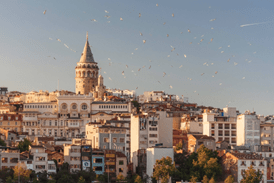
“Allahu akbar!” The repeated Arabic call to prayer issued by the nearby mosque (‘cami’ in Turkish, ‘masjid’ in Arabic) is the first sound I hear early each pre-dawn morning. The modern mecca of Istanbul has been known historically as Byzantium, Constantinople, and Stamboul. The country’s historical complexity and multicultural allure, now known as Turkey (or, more accurately, Türkiye) across the centuries, is illuminated in its modern manifestation as envisioned by its founder, Kemal Atatürk (Father of the Turks). It is now in its 75th year as a modern country (politically and culturally) as created by Atatürk – who virtually overnight changed the Ottoman (Arabic-based) alphabet into a Latinate translation. Perhaps in its linguistic history and the interconnectedness of language, the country and the duality between the old and new, the East and the West, is most clearly delineated. The call to prayer in this country is in Arabic, but most Turks do not speak it. The second most common language is Kurdish, followed by small minorities that speak Laz, Armenian, Arabic, and other ‘tongues’. The professional segment of society is likely to speak English or perhaps German or French. That said, walking down any street or avenue in Istanbul, particularly in the sprawling central area of the city, one can hear a multitude of world languages now, as has been the case for many decades and over succeeding centuries, due to the travellers and tourists who flock to this fabled place to experience its delights. Historically, Istanbul was – and is – the crossroads of the world. For example, what many people around the world do not know is that there has been a Jewish presence in this country since the 4th century BC. Currently, a population of approximately 26,000 Jewish Turks live here, the second-largest Jewish community in a Muslim country.
When I go to purchase fresh bread from the nearby bakery (fırın) each weekend, I take a shortcut through the courtyard of the local mosque. The bakery is on the far side of the mosque’s courtyard. The archway above the gates through which I walk has inscriptions in Arabic. Many in the neighbourhood, whether or not Muslim by religion, use this same useful shortcut to the bakery. The haunting and beckoning call to prayer (‘adhan’) issues from the ‘muezzin’ (servant of the mosque) five times each day: firstly, at dawn, noon, afternoon, sunset, and lastly, at night. Although I am not a Muslim, the call to prayer touches a place in my heart, mind, and soul, as does the sight of the mosque as I take my regular shortcut through its marbled courtyard. In a corner of the courtyard, men and boys of all ages sit, washing themselves in a ritual cleansing before entering the mosque for prayer. This act of ablution is known as ‘abdest’ in Turkish and ‘wudu’ in Arabic; regardless of the language, it is essential. Emerging from the peaceful courtyard, as I enter the street outside the far gate of the mosque, I am immediately met with the sights, sounds, and smells of the metropolis of Istanbul. In the district of Mecidiyeköy where I live, as in all other parts of this fascinating city in which I am an inhabitant, there is always a cacophony of sound and a feast for the eyes.
The complexity and character of this massive city are further revealed in a myriad of ways. For example, seeing two women walking down the street, side-by-side, one covered and the other in a miniskirt; or observing two men walking arm-in-arm in the Muslim manner of brotherly love; or seeing an immediate and large group of people become involved when any crisis arises on the street, such as an argument between a shopkeeper and a customer, with observers quickly becoming active participants and taking sides. Turkish people are social by nature and view themselves as part of a community extending far past the boundaries of their neighbourhoods. A common question from one Turkish person to another, particularly in Istanbul, is to inquire as to their ‘memleket’ (‘hometown’ or ‘area of the country’) because the average Istanbulian has moved to the city from another part of the country at some point in the past or has parents or grandparents who did so in previous decades.
Along virtually every street or on street corners, one can see tea or coffee houses, full of people inside and in good weather, sitting outside on stools at low tables drinking their tea or coffee, reading newspapers (Turks are voracious newspaper readers), many smoking cigarettes or perhaps inhaling from the glass bottle with a pipe known as ‘nargile’ in Turkish, and others playing ‘tavla’ (backgammon). Although it appears that most are men, women too enjoy their chats and drinking hot beverages outside these cafes. Due to Istanbul being one of the most populous cities in the world, walking on the street can be a challenge due to the constant crowds. For that reason, on the side streets, many people walk on the road if they want to get somewhere quickly. On the sidewalks, one needs to keep a watchful eye when walking because, unfortunately, dog owners are not constantly vigilant about cleaning up dog poo! Also, depending on the neighbourhood, the sidewalks are not always level and well-maintained; thus, one must be careful. When one of my sisters visited me several years ago, we were chatting and walking along in single file down a narrow sidewalk; suddenly, my sister stopped speaking in mid-sentence. When I looked back behind, I saw that my sister was nowhere in sight. I looked down, and my sister was flat on her face! She had not been watching where she was walking and tripped on a sharp rise in the cement, where concrete had been incorrectly poured.
Aside from cafes and teahouses being extremely popular in this country, bakeries and pastry shops are on many streets. Freshly baked Turkish bread is delicious, and the desserts are indeed mouth-watering; one of the favourites is ‘baklava’, a pastry made of dough, drizzled with a syrup that usually contains honey and rosewater, and often with ground nuts on top. Turkish people also love cakes, especially birthday cakes, which have an inordinate amount of icing on them and are very sweet. There is always a reason to celebrate with a cake, with birthdays being the main one. Turkish people love celebrating birthdays, and asking someone their age when the big day arrives is acceptable. Culturally, this can be a change for some foreigners who live and work in this country because they could be reticent about sharing that information with others.
Although Ankara is the country’s political capital, Istanbul is the cultural capital and the hub of art, music, and literature. Many of the country’s finest artists, musicians, and authors live in this cultural mecca. In Istanbul, in particular, art from the ancient past to the contemporary is embraced; music of all types is enjoyed, from ‘Türk Halk Müziği’ (Turkish Folk Music) to Jazz, Rock, and everything in between, as well as authors that are championed from home (Orhan Pamuk, Elif Şafak), and abroad (Margaret Atwood, Michael Ondaatje). On a personal and musical level, I am a faithful listener of TRT3, a 24-hour station that plays classical and jazz music most of the time. If you walk into my home anytime during my waking hours, TRT3 will be playing on my music set in the living room.
At this point in my personal dispatch, I would like to acknowledge ‘the elephant in the room’ – or, more accurately, the elephants. Friends and family sometimes ask me, “What is it really like living in Turkey?” as if I am holding back some truths despite constantly telling people how much I love the country and living here. Other times, and more likely recently, they have asked me about the political and economic aspects of the country. I am not a political person by nature, and thus, I am not the best one to ask questions. I do not follow economic trends much within this country or abroad. That said, there are significant concerns by the Turkish populace in general about the economy (inflation is affecting everyone) and the possibility of yet another natural disaster in the form of an earthquake (the country has the unfortunate reality of being in the world’s most seismically active fault zones).
Regarding the socio-politico-economic trends and reality, as regards the country in which I live, due to a hectic work life (which includes two jobs, with my writing), I tend not to pay much attention nor have an opinion, except in one significant way. I am indeed highly concerned about my Turkish friends and the effect of the very high inflation on their lives. As regards the ‘Sword of Damocles’ that hangs over the heads of anyone living in this country – earthquakes – I am at all times concerned about the possibility of a repeat of what occurred in 2023 and 1999 (both of which I experienced), resulting in deaths and devastation. My main concern is not for me but rather for my 10-year-old Turkish goddaughter, Nisa, whose life and future lie ahead of her.
Due to the reality of earthquakes in this country and the various problems and issues that they face, I am occasionally asked by those who live abroad, “Why don’t you move back home?” My answer always is this: “I am at home.” I love Canada and am proud to be a Canadian. I am abundantly aware that my Canadian passport opens doors; I seldom need a tourist visa to travel. Yet, it can be a long and unsuccessful process for Turkish people when they apply to travel abroad; my Turkish friends have experienced this frustrating reality. To return to what I wrote a few sentences earlier, my long time in this country has solidified that I have found another homeland on ‘this side of the pond’. When Turkish friends ask about my relationship with their homeland, I often respond: “Ben kendimi Türk gibi hissediyorum” (‘I feel like a Turk’). In saying those words, I am constantly reminded of a famous Turkish proverb (‘atasözü’) from the Father of the Turks, Kemal Atatürk: “Ne mutlu Türküm diyene” (How happy is the person who can say I am a Turk). These words resonate with meaning for me, a proud Canadian in my adopted homeland, living in what I consider the most fascinating and glorious city in the world: Istanbul!
Recent Publication: “Heimat” (Poem) March 14, 2025 – Overgrowth
Website: https://johnrcpotterauthor.com
Twitter: https://twitter.com/JohnRCPotter


Deja una respuesta