A bit about Anton Chekhov
Anton Chekhov was a Russian playwrite and short-story writer who revolutionised modern theatre and literature by focusing on ordinary every-day life rather than traditional plots. He maintained a successful career as a physician throughout his writing life, famously stating that medicine was his ‘lawful wife’ and literature his ‘mistress’. Chekhov often treated the poor for free and was considered to be a very good physician and diagnostician.
In 1888, Chekhov won the Pushkin Prize for his book ‘At Dusk’. The literary principle called ‘Chekhov’s Gun’ is attributed to his statement that if a gun is shown in the first act of a play, it must be fired by the end. This means simply that every element in a story must be necessary.
Chekhov died of tuberculosis at age 44. At the time of his death he was considered second only to Leo Tolstoy in Russian literary fame.
Key facts about Anton Chekhov’s stories
Anton Chekhov wrote fictional stories set in late 19th century Imperial Russia. His stories were largely set in anonymous provincial towns and the Russian countryside. He originally wrote in Russian and his stories were first translated into English in 1903. He makes use of regional dialects and class accents in his writing.
Anton Chekhov’s stories are largely dramas with a key focus on the minor details and commonalities of people’s lives during this time period. He made use of the technique of playing on the reader’s expectations but leaving how things turn out for the characters to the readers imagination.
Chekhov made use of a wide variety of protagonists from all walks of Russian society including landowners, peasants, and the insane. He also wrote from the perspective of both males and females as well as both young and elderly people.
My Review of The Lady With the Little Dog and Other Stories
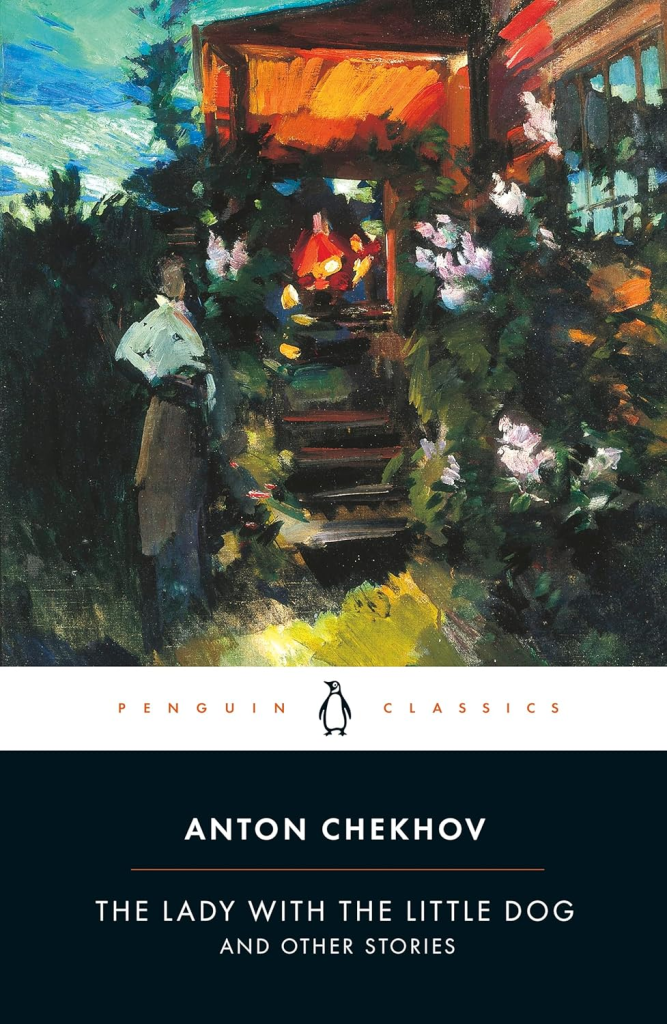
I read a recommendation for this book, decided to give it a try, and I’m so glad I did. I learned a great deal about life and society in Russia during this time period through reading this insightful collection of short stories. The writing is compelling and brings the living conditions and restrictions for both the poor and the wealthy to life. I enjoyed all the stories in this collection but I’m only highlighting two stories that impacted me the most.
1. Peasants – this novella is an eye opener about life for the peasants in Russia in the late 19th century. Nikolay Tchikildyeev, a waiter who has been working in Moscow, returns to his rural village due to ill health. His wife, Olga, and his daughter, Sasha, accompany him. Life in Nokolay’s old family home is very different from his romanticized recollections and his family are shocked by the poverty, crowding, and filth. The villagers are illiterate and do not behave in a community-minded way. Nikolay’s brother, Kiryak, is a drunkard and beats his wife. One night, his other sister-in-law is stripped naked by a group of men in the village while out at night and is forced to return home in that state. Olga tries to help her but Granny is humiliated and angered by this event. Olga and Sasha are astonished at Nikolay’s family’s lack of religious understanding and devotion. The heavy taxes levied on the peasants and the harsh penalties for non-payment or late payment are also exposed. Finally, Nikolay dies and Olga and Sasha decide to return to Moscow where Olga will work as a servant. Kiryak decides to accompany them and look for work as a porter. Before leaving, Olga reflects on her time in the village and recognises the humanity of the peasants and the hardships they endure.
2. The Lady with the Dog – this short story is powerful because it recognises how meetings someone you truly love highlights everything that is wrong with an existing loveless relationship that has previously been bearable. Dmitri Gurov is married with a daughter and two sons, but his not happy with his life and is often unfaithful. While vacationing in Yalta he meets the younger, Anna, who is also unhappily married. The two have an affair which they expect to end when they both return to their normal lives. Dmitri, however, cannot forget Anna and sets out to find her. After he finds her, the two commence having an extended affair and realise they are in love and wish to spend their lives together. They try to come up with a plan to achieve this but the story ends with no resolution to their situation.
I recommend this book to readers who enjoy drama, history, and stories that stay with you for a long time after you finish reading the book.
Purchase The Lady with the Little Dog and Other Stories by Anton Chekhov here: https://www.amazon.com/gp/product/0140447873
You can read The Project Gutenberg Collection of Short Stories by Chekhov for free here: https://www.gutenberg.org/files/57333/57333-h/57333-h.htm
Last words (or quotes)
From Peasant Wives
“Well, that’s how it was, old man. Two years later we got a letter from Vasya from Warsaw. He wrote that he was being sent home sick. He was ill. By that time I had put all that foolishness out of my head, and I had a fine match picked out all ready for me, only I didn’t know how to break it off with my sweetheart. Every day I’d make up my mind to have it out with Mashenka, but I didn’t know how to approach her so as not to have a woman’s screeching about my ears. The letter freed my hands. I read it through with Mashenka; she turned white as a sheet, while I said to her: ‘Thank God; now,’ says I, ‘you’ll be a married woman again.’ But says she: ‘I’m not going to live with him.’ ‘Why, isn’t he your husband?’ said I. ‘Is it an easy thing?… I never loved him and I married him not of my own free will. My mother made me.’ ‘Don’t try to get out of it, silly,’ said I, ‘but tell me this: were you married to him in church or not?’ ‘I was married,’ she said, ‘but it’s you that I love, and I will stay with you to the day of my death. Folks may jeer. I don’t care….’ ‘You’re a Christian woman,’ said I, ‘and have read the Scriptures; what is written there?’
“Once married, with her husband she must live,” said Dyudya.
“‘Man and wife are one flesh. We have sinned,’ I said, ‘you and I, and it is enough; we must repent and fear God. We must confess it all to Vasya,’ said I; ‘he’s a quiet fellow and soft—he won’t kill you. And indeed,’ said I, ‘better to suffer torments in this world at the hands of your lawful master than to gnash your teeth at the dread Seat of Judgment.’ The wench wouldn’t listen; she stuck to her silly, ‘It’s you I love!’ and nothing more could I get out of her.
From The Lady with the Little Dog
«I shall remember you … think of you,» she said. «God be with you; be happy. Don’t remember evil against me. We are parting forever—it must be so, for we ought never to have met. Well, God be with you.»
The train moved off rapidly, its lights soon vanished from sight, and a minute later there was no sound of it, as though everything had conspired together to end as quickly as possible that sweet delirium, that madness. Left alone on the platform, and gazing into the dark distance, Gurov listened to the chirrup of the grasshoppers and the hum of the telegraph wires, feeling as though he had only just waked up. And he thought, musing, that there had been another episode or adventure in his life, and it, too, was at an end, and nothing was left of it but a memory…. He was moved, sad, and conscious of a slight remorse. This young woman whom he would never meet again had not been happy with him; he was genuinely warm and affectionate with her, but yet in his manner, his tone, and his caresses there had been a shade of light irony, the coarse condescension of a happy man who was, besides, almost twice her age. All the time she had called him kind, exceptional, lofty; obviously he had seemed to her different from what he really was, so he had unintentionally deceived her….
Here at the station was already a scent of autumn; it was a cold evening.
«It’s time for me to go north,» thought Gurov as he left the platform. «High time!»
About Robbie Cheadle
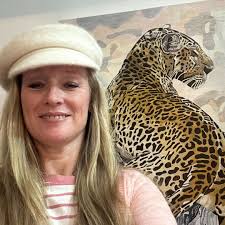
South African author, photographer, and artist, Robbie Cheadle, has written and illustrated seventeen children’s books, illustrated a further three children’s books, written and illustrated four poetry books and written and illustrated one celebration of cake and fondant art book with recipes. Her work has also appeared in poetry and short story anthologies.
Robbie also has two novels and a collection of short stories published under the name of Roberta Eaton Cheadle and has horror, paranormal, and fantasy short stories featured in several anthologies under this name.
You can find Robbie Cheadle’s artwork, fondant and cake artwork, and all her books on her website here: https://www.robbiecheadle.co.za/
Social Media Links
Bluesky: https://bsky.app/profile/robbiecheadle.bsky.social
YouTube: https://www.youtube.com/channel/UCVyFo_OJLPqFa9ZhHnCfHUA
Goodreads: https://www.goodreads.com/author/show/15584446.Robbie_Cheadle
TSL Publications: https://tslbooks.uk/product-tag/robbie-cheadle/
Amazon: https://www.amazon.com/stores/Robbie-Cheadle/author/B01N9J62GQ
Unsplash profile: https://unsplash.com/@r_cheadle


Deja un comentario