The beauty of Japanese poetry forms lies in both their strictness in form and
flexibility in substance. There is renku, which split up to allowing individual
hokku (which became haiku). Then haiku led to haiku sequence, haiga (which is
haiku scribbled on a photo or image), and haibun (haiku accompanying a prose
poetry). And then came haibunga, which is either a haibun scribbled on a photo or image, or the haibun written separately then followed by an image, or a haiga simply accompanying a prose.
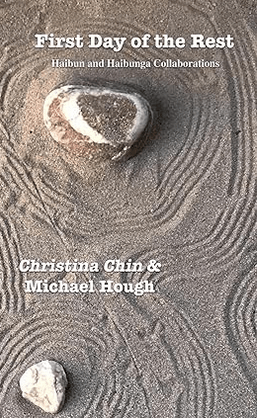
In this their collection of haibun and haibunga, Christina and Michael choose
the second approach, just that in their haibunga, we sometimes have the photos preceding the haibun. Also, while some haibun have two images, there is «Face to Face» which is simply a picture and prose (bunga) with no verse (hai or ku).
Seeming like an ekphrasis, the picture appears before the prose and is an image of a snail and a dragonfly facing each other in parallel. There is a feel of
enlightenment that an attached image adds to a piece, whether it links or shifts.
The book welcomes us to a beach with a haibunga titled «Dolphin Girl»,
which portrays a girl and her camaraderie with sea waves, and the poetry
personam’s confusion with same. What we are not told in the haibun, the photo
(ga), directly linking to the prose, reveals them.
In the titular piece, «The First Day of the Rest», a haibun followed by a bird
image narrates a resting moment between a couple who are exchanging warmth in their bed. The bird sitting on a branch that holds two fruits symbolises a harmonizing spirit, empowering the couple which are the fruits.
«Writing Ones and Zeros» and «Before the Fires» easily pass as my favourite
pieces in the collection. In «Writing Ones and Zeros», we witness the slippery
slope of human endeavour and creativity. See the line:
“Glory is fleeting like some smoke from your beach fire…»
Its accompanying haiku suggests the relentless passage of time and cycles of
nature:
blustery wind
this winter repeats
an old story
The haiku provides a moment of stillness that invites reflection, complementing the prose by conveying the idea that, despite human creativity and the pursuit of lasting glory, our stories are part of a larger, perpetual cycle that
nature continuously tells.
I will like to reproduce «Before the Fires» for your read:
Before the Fires
Willing but afraid, a young bird perches at the roof’s edge with untested wings.
Summer wind over new blossoms . . . horses grazing near, now a scent of rain.
Mother snapper crawls slowly back to her chosen pond . . . egg laying done.
The hawk drifts on an updraft and sees whatever dares move.
fallen seeds
on the gravel lane
sasanqua blooms
The vivid imagery used in narrating the scenes in the prose poem sets the
stage for my fondness with the haibun as a whole. The haibun captures a moment
on the brink of change and new beginnings. The young bird’s perch embodies both
courage and uncertainty, and creates a metaphor for readiness and tension that erupts at the beginning of new adventure.
In the images of «summer wind», «blossoms», «grazing horses», «scent of
rain», and the «mother snapper» that returns to her pond after laying eggs, we find a combined lush sensory experience that illustrates completion and renewal.
The presence of the vigilant «hawk» introduces a subtle tension, representing
the predator-prey dynamic that underscores natural order, or food chain.
The haiku, while focusing on natural transitions, suggests the end of one cycle and the potential for new life as reflected in the prose. And in the «sasanqua blooms», we perceive a sense of beauty and renewal. From its reflective narrative to its fine closure, this haibun reinforces the theme of survival and vulnerability, as well as vitality and fatality.
The haiku below from «Sugar Moon» is another favourite that reflects the
simplicity and immediacy expected of an aesthetic haiku:
sudden shuffle
a gecko falls off
the branch
The phrase «sudden shuffle» immediately introduces movement and sound,
engaging readers’ senses and invoking a feeling of anticipation. The fleeting
moment of the falling gecko, probably caused by a wind that shook the tree,
highlights an instance of vulnerability and clumsiness. The haiku’s concise
structure allows each word to carry weight, creating a snapshot of event that
invites reflection.
Furthermore, the imagery in the following line from «After the Storm» has a
replaying effect in my senses:
«we hear the sounds of engines roaring and see the headlamps of snow machines weaving through the trees.»
Quickly, I observe that some of the prose are accompanied by senryu, and not
haiku, which makes them ‘senrbun.’ Some of the senryu verses are:
shedding possessions
the packer asks
where she has gone
waiting room
the caregiver struggles
for words of comfort
intoxication
my spirit in another
realm
Be that as it may, with this solid collection of Japanese poetry, Christina and
Michael took us through childhood, covid, friendship—with human and animal,
intimacy, and natural phenomenon.
—Taofeek Ayeyemi February 2025
―The Mamba”
Journal Of Africa Haiku Network
https://www.amazon.com/dp/B0DRT9JC2H
xiv―The Mamba”
Journal Of Africa Haiku Network
(꧁꧂)
Christina Chin is a painter, haiku poet, and author of Japanese short form poetry books. Her book «First Day of the Rest» has achieved #1 Top New Release, #2 Best Seller in Haiku and Japanese Poetry, and #21 in Nature categories. She’s been nominated for the Pushcart Prize 2025 three times, Red Moon Anthology 2023, Touchstone Award 2024 & 2020 and for Best of the Net in 2023. Chin has been honoured as a four-time top 100 recipient in the mDAC Summit Contests, with her works displayed at the Palo Alto Art Center, California. She is the sole haiku contributor for Randall Vemer’s «MusArt» book, published by ArtReach in Portland, Oregon, and has two haiga showcases in THF Haiga Galleries. Her accolades include first prizes at the 34th Annual Cherry Blossom Sakura Festival 2020 Haiku Contest, the 8th Setouchi Matsuyama 2019 Photohaiku Contest, and two awards from City Soka Saitama’s 2020 haiku contests. Her work appears in numerous prestigious journals, multilingual publications, and anthologies, including Japan’s esteemed monthly Haikukai Magazine.
Michael Hough is a retired musician and professional photographer, with decades of experience in both careers. He toured as a member of the Mustards Retreat folk group for 44 years..
He lives in Northern lower Michigan, USA continuing to write poetry across several genres, songs, and short fiction. He has been a writer since high school and college.
Book Review by Taofeek Ayeyemi
Taofeek Ayeyemi, fondly called Aswagaawy, is a Nigerian lawyer, writer and author of a haiku chapbook «Across the Full Moon» (Mamba Africa Press, Ghana 2021) and a haibun chapbook «Dust and Rust» (Buttonhook Press, California 2022). A BotN and Pushcart Prize Nominee, his haiku and haibun have appeared in The Mamba, the QuillS, Akitsu Quarterly, Haibun Today, Frogpond, and elsewhere. He won the Honorable Mention Prizes in the 2019 Morioka International Haiku Contest, 2020 Fujisan Taisho Tanka Contest, and the 2021 ITO EN Oi Ocha Shinhaiku Contest. His haibun «Banga» won the 2021 Loft Books International Flash Fiction Contest.
Amazon link:


Deja una respuesta