Hi, all:
I bring you the review of a non-fiction book on a topic I’ve been reading about a fair bit, recently.

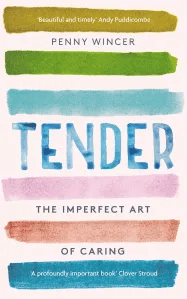
Tender: The Imperfect Art of Caring by Penny Wincer
A personal, positive and essential book for the many carers among us.
‘A beautiful and timely reminder that each and every one of us has the ability to care, the capacity for empathy, and the potential to grow.’ ANDY PUDDICOMBE, author of HEADSPACE
‘Tender is a profoundly important book, full of wisdom and bright insights on what it really means to love someone, by a fearless and generous writer. ‘ CLOVER STROUD
‘A wonderful book: compassionate, honest, carefully-reasoned and genuinely helpful… This will benefit many people.’ KATHERINE MAY, author of WINTERING
‘An invaluable tool for any invisible carers or anyone who wants to learn how to better support their loved ones… we ALL have many, many things to learn from Penny’s beautiful, wise, charming, thoughtful words’ – SCARLETT CURTIS, Sunday Times bestselling author
‘Moving and beautifully written, nuanced and wise, alert to every paradox at the heart of love. A hugely important book not only for current or future carers, but anyone learning to accept that life tends to resist our control.’ – OLIVIA SUDJIC, author of EXPOSURE
‘Tender captures the powerful capacity of people to care for others, and all the heartbreaking and heartwarming complexity that this involves. Penny brings the crucial, yet often overlooked, role of caring into our collective consciousness and, in doing so, demonstrates what it means to be human.’ -DR EMMA HEPBURN, author of A TOOLKIT FOR MODERN LIFE
‘Penny Wincer’s TENDER manages to combine both unromanticised honesty about the realities of care with a genuine uplifting hopefulness… is a must-read.’- RUTH WHIPPMAN, author of THE PURSUIT OF HAPPINESS
We are all likely – at some point in our lives – to face the prospect of caring for another, whether it’s a parent, child or partner. It is estimated that there are 7 million people in the UK caring for loved ones. And yet these are the unpaid, unsung people whose number is rising all the time.
In Tender: the imperfect art of caring, Penny Wincer combines her own experiences as a carer with the experiences of others to offer real and transformative tools and insights for navigating a situation that many of us are either facing or will face at some time.
Penny Wincer has twice been a carer: first to her mother, and now as a single parent to her autistic son. Tender shows how looking after oneself is a fundamental part of caring for another, and describes the qualities that we can look to cultivate in ourselves through what may otherwise feel to be an exhausting task.
Weaving her lived experience with research into resilience, perfectionism and self-compassion, Penny combines the stories of other carers alongside those who receive support – offering an often surprising and hopeful perspective.
https://www.goodreads.com/book/show/53590653
About the author:
Penny is an author, freelance writer and non-fiction book coach based in London. She is the author of Home Matters: How our homes shape us, and we shape them and Tender:The imperfect Art of Caring .
Penny hosts the podcast Not Too Busy To Write
My review:
Since my new role as a carer was bestowed upon me, I have been trying to combine my fiction reading with some non-fiction (and the odd fiction one as well) related to the subject. I must confess that I started reading this book after seeing it recommended, a while back, and I couldn’t get into it at the time. But then, I tried again more recently, and I would also recommend it to anybody who is a carer or knows people who have taken up that role (by choice or otherwise). Most of us are likely to be in that position at some point, so that is a pretty wide recommendation.
The author sets the book’s aims from the beginning: she is the mother of a child with a diagnosis of autism and a younger daughter, and she has become a single parent as she is separated from her husband (although he does look after the children on alternate weekends at the family home, to avoid further disrupting the routine of the boy). She is Australian, although she has been living in the UK for quite a few years, and she was also a young carer, as her mother suffered from mental health difficulties, an alcohol addiction, and committed suicide. So, although she has previous knowledge of some of the issues related to caring and knows she is resilient, she has no relatives in London, and misses the advice and help her mother could have given her.
She explains that she had to struggle, not only with the situation, but also with the feelings of isolation, and with the lack of easy ways to find information about the condition, and also about how to navigate the paperwork necessary to apply for assistance from health and social services, among other issues. But, she explains that what she intends with this book is not to offer practical advice on how to look after people (of different ages, with different diagnosis) with a variety of needs, but rather to collect the experiences of many carers who share how they are living or have lived the role, what it meant for them, what was the hardest part of it, and what they found helpful in not only coping, but also finding fulfilment and a new meaning in their roles.
The author includes sections on resources (like books, charities [from the UK, Ireland, Australia and New Zealand], and others related to some of the topics mentioned in the book, like Self-Compassion or Mindfulness Apps), a bibliography (with books, articles and websites), acknowledgements, and references, because she also quotes plenty of data from a variety of studies as she covers the different topics. The book is relatively recent, as it was published in 2020, but there might have been some changes, in case people are interested in checking the data or the websites mentioned.
I don’t want to elaborate too much on the contents, because I think most people will find experiences that move them and/or feel quite close to their circumstances. The stories are told without excessive detail, but it shouldn’t come as a surprise to readers that they might find some of the content difficult to read and emotionally hard, especially depending on one’s circumstances. On a personal level, I missed reading an account by a carer looking after somebody suffering from Alzheimer’s or dementia, especially elderly parents, but that was not the author’s intention, and a big variety of conditions are indeed covered in the book, and some people have had to look after their parents (like the author of the book and two sisters whose mother suffers from Huntington’s), although they are at the younger end of the age spectrum.
To give you an idea about the book, I include the titles of the chapters: Foreword, Introduction, Why is it so hard to talk about caring?, Perfectionism, Ableism, Expectations, Grief, Self-Care, Self-Compassion, Community, Purpose, Joy, Conclusion. I was moved by many of the stories and impressed by how much carers adapt and achieve despite the odds against them. And I was particularly interested in the concept of Self-Compassion, which sounds important and useful, and I intend to investigate further.
This is a book that I’m sure I will go back to in the future, and I think its resources and bibliography will also be added to my list of further material to explore.
Thanks to the author for this book, and thanks to all of you for always being there. Take care, and keep smiling!
 LatinosUSA
Deja un comentario