
Meet Elizabeth Gauffreau
Today, I am thrilled to introduce talented author, Elizabeth Gauffreau, for my April author interview on LatinosUSA.
Elizabeth (Liz) and I have been blogging friends for some years and I enjoy her interesting posts on her personal blog. You can read one of her charming posts here:
Tell us a bit about Elizabeth Gauffreau and your writing journey
I fell in love with literary fiction when I read “Barn Burning” by William Faulkner in the ninth grade. I also wrote the usual bad teenage poetry through high school. I still write poetry, but I never received formal training in the craft. I write it by ear.
After high school, I went the traditional route for learning the craft of fiction. I enrolled in a Bachelor of Arts program with Old Dominion University in Norfolk, Virginia. I majored in English with a creative writing concentration. I was in the charter class for the creative writing concentration, which was very exciting for me. The primary method of instruction was workshop. There were tears.
After I graduated, I still didn’t know everything I wanted to know about the craft, so I enrolled in a Master of Arts in English/fiction writing at the University of New Hampshire. More workshops. More tears. At the end of the program, I knew the basic craft principles, and I just needed to sit my butt in a chair and write.
Unfortunately, my day jobs for paying the bills interfered with my “real” writing. It took me fourteen years to write my debut novel, Telling Sonny. I did write a great deal for my day job. (I was pushy in grabbing the writing projects for myself). I retired from my professional career in higher education five years earlier than I’d planned to, and my writing has taken off. I’m doing more experimentation with new poetry forms and taking some risks with my fiction. And of course, my output has increased, which I’m very happy about!
What was the inspiration for your book, Telling Sonny? The storyline and setting were unique and interesting to me and I am curious as to how the idea developed.
The idea for Telling Sonny came from a scribbled note on a scrap of notebook paper from my mother when I was writing my dad’s biography for the family after he died. The note said, “Elliott I. committed suicide and had a sister Dorothy.” Elliott I. was my paternal grandfather, about whom I knew very little about except that he had once played vaudeville, was very charming, and treated the women in his life very badly. He divorced my paternal grandmother when my dad was five and subsequently had very little contact with him. When I got that scrap of paper from my mother, I thought it was a very strange way to characterize someone’s life.
As for the setting, I had acted on the Enosburg Falls Opera House stage when I was in high school. Everything else was based on a LOT of research. At a certain point, I lost control of the big, baggy middle. Luckily, I was able to attend a workshop on the ‘W’ method of storyboarding (twice!). Without that workshop, Telling Sonny would be in a drawer, never to see the light of day again.
Who is your favourite character in your book, The Weight of Snow and Regret, and why?
I’d have to say Hazel, the last matron before the poor farm was closed. She overcame tragedies in her life to care deeply about the disadvantaged and give them the best possible quality of life. Joey, one of the poor farm residents comes in a very close second. He wants nothing more than to help others and see that they’re happy.
Do you think that it was the correct decision for government to close the poorhouse? Do you think it was a better life for the people who were transferred to other establishments?
I think the state replaced a flawed local model with an equally flawed federal and state model—just with different flaws. No, I don’t think it was a better life for the people who were transferred to nursing homes, Brandon Training School for developmental disabilities, and the Vermont Hospital for mental illness. Nursing homes are grim, regardless of how good the care is. I just looked up the closures of the Vermont Hospital and Brandon Training Center and confirmed that both institutions had perpetrated abuses on the people in their care. The fact of the matter is that, as a country, we still haven’t gotten it right. Honestly, I don’t know what the answer is. It all comes down to money.
What’s next for Elizabeth Gauffreau?
My next book project is a collection of short stories set in Enosburg Falls, Vermont, titled Enosburg Stories. I have a complete manuscript that I’d submitted to a couple of small presses with no luck. I also just finished a new story for the collection. Before I started college, I’d decided that I wanted to be the Sherwood Anderson of Enosburg Falls. (Silly, but a gal can dream.)
My review of The Weight of Snow and Regret
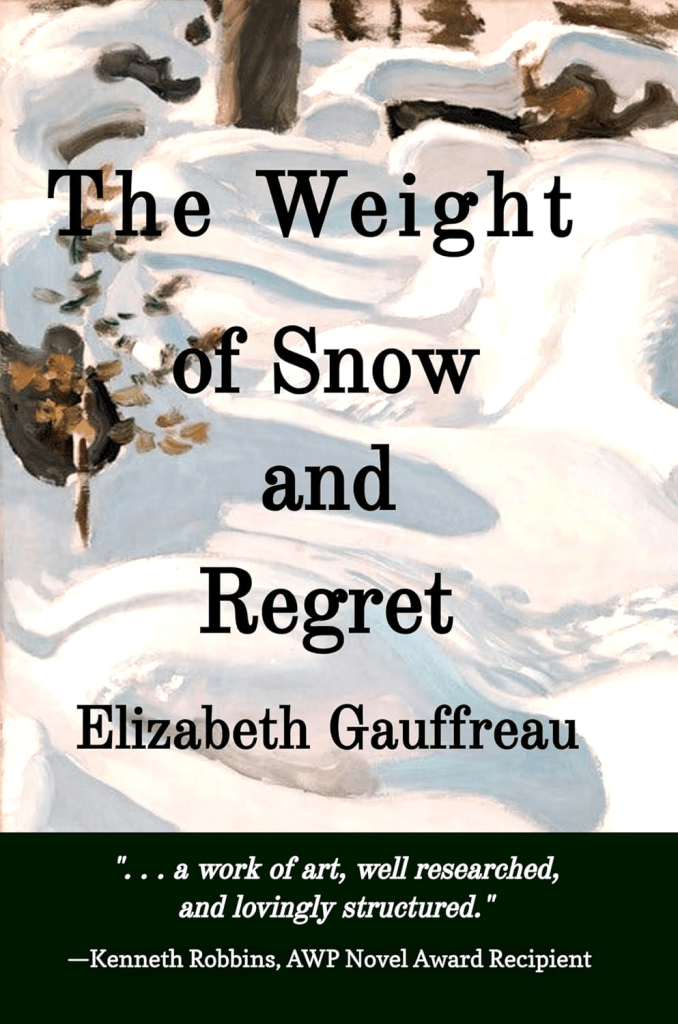
This book is a historical novel set at the Sheldon Poor Farm in Vermont which burned down in 1978. While the characters are fictional, they have been developed with meticulous attention to historical fact and they feel so real it is hard to believe they were not real residents. As indicated by the title, this is not a happy tale but, as with all human lives, there are moments of joy that make the sadder content easier to bear.
The story revolves around two women, Claire and Hazel, who meet at the Poor Farm in 1968 when Claire, in a state of destitution, is submitted into Hazel’s care as the matron of the institution. Hazel, and her aging husband, Paul, have run the Poor Farm together for many years and are deeply attached to its remaining residents. It is clear from early in the story that the Poor Farm’s days are numbered and the State is intending to close it down in the foreseeable future. The residents comprise of elderly people who have nowhere else to go and mental disabled people who are unable to look after themselves. The author’s skillful pen brings each of them to life and they quickly find a place in the reader’s heart. I felt especially attached to Hazel who spent a short period of her childhood at the Poor Farm following the deaths of her parents under soul destroying circumstances. Hazel is quickly left orphaned and sibling less and is removed from the Poor House where she has formed some attachments as children were not allowed to become permanent residents.
Some years later, Hazel returns to the Poor Farm with her husband in the joint roles of caretaker and matron. Hazel rekindles some of her lost relationships and the couple make a great success of running the institution. The closure decision by the State is a big blow to both of them.
Claire story is compelling as she is a woman from a middle class family who ends up at the Poor Farm as a result of ill advised decisions. She is bored with her life and irritated by her husband who is obsessed by his business. She acts on poor advice and ends up in a difficult situation culminating in her spending time at the Poor House, first as a resident and then as an employee. Other than the fact that Claire spends time at the Poor House, her story is not related to Hazel’s and almost stands alone. Claire transitions out of the story and doesn’t reenter it. I preferred Hazel’s story and found her to be a much more stable and relatable character.
This is a heavy story and does not have many happy interludes. The one scene I really enjoyed was when Paul took Hazel to a dance at a ‘posh’ venue early in their marriage. That chapter was full of magic and delight and gave me a respite from the difficulties and drudgery of Hazel’s life. This being said, Hazel’s story is not unrealistic and I do believe her lot was very likely at that time in American history.
Paul was an interesting character. He was very much the male stereotype of the era and although he does seem to love Hazel in many ways, some of his attitudes and behaviours were oppressive. His decision to fight in World War II has far reaching results and his silent blaming of Hazel for unfortunate events was unreasonable. That part of the story was upsetting for me.
This is a well researched and compelling story along the lines of Dickens many works about social injustice and inequality and is topical given the current macro economic environment. It is a worthy read and does end on a relatively upbeat note. I recommend this book to readers who enjoy family dramas and stories about socio economic problems.
Purchase The Weight of Snow and Regret from Amazon US here: https://www.amazon.com/Weight-Snow-Regret-Elizabeth-Gauffreau-ebook/dp/B0FBMWBSKQ
My review of Telling Sonny
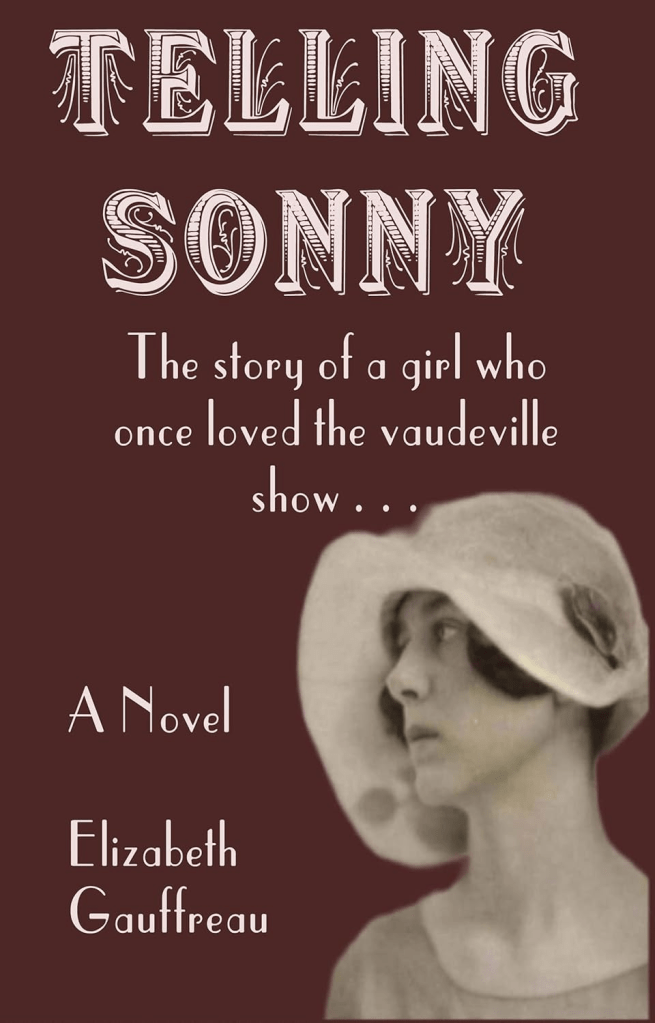
Telling Sonny is a moving and poignant book about a young girl, Abby, growing up in the rural town of Enosburg Falls in Vermont, whose dreams and aspirations are altered forever though her choice of man.
Faby is fun loving and full of idealism about the life of entertainers who participate the the vaudeville shows in the early 1920’s. It all looks so exciting and different from her own staid life with her parents and sister. She aspires to more than becoming the wife of a farmer and continuing her rural existence. When the vaudeville show visits the theatre in her small town and one of the «hoofers» Slim White shows interest in her, it completely turns her head and she ends up disregarding the advice of her sister and her sensible and conservative family upbringing. Faby shows Slim White around town and, on his last evening in town, succumbs to his sly advances, losing her virginity in the back of a borrowed car.
Faby discovers that she is «in trouble» a while later and manages to contact Slim White who, after leaving her in limbo for a few weeks, decides to marry her and settle down. Faby believes she has no choice but to marry him, thereby averting bringing shame on her family through her unfortunate pregnancy. The author’s ability to convey Faby’s doubts about her husband due to his careless and insensitive behaviour towards her and her parent’s seeming ignorance of the reasons for her shotgun wedding is amazing and I am in awe of Elizabeth Gauffreau’s beautiful writing.
Ms Gauffreau’s characterisation is incredible and the reader fears for Faby’s future life in the hands of as selfish and self centred a man as Slim White from early on in the story. Slim, whose real name is Louis, is not deliberately unkind or negligent, he just has very limited sensitivity to Faby’s needs and situation and, while he is happy to have her accompany him on his nomadic jaunts around the country in pursuit of work, he will not allow her to restrict him in any way or interfere in his lifestyle and plans.
Faby is innocent and selfless, she wants the best for her baby and hopes that she and Slim will create a family together. She cannot see that a life on the road of a small time hoofer is total unsuited to this ideal, but she really does try to make the best of things.
I found this book utterly heart wrenching in how it portrays trust and innocence betrayed and also Faby’s parents own ignorance of the ways of the world and their inability to arm their daughter with the tools she needed to protect herself in the world of adults. Maman Aurore, Faby’s grandmother, while hard on her and quite a difficult nature, is the most sensible of them all. She knows up front that this situation is unlikely to end well for Faby and tries to give her good advice to act upon when the time comes.
Sonny is the result of Faby’s impetuous behavior and grows up to be an excellent young man, despite any bumps in his own personal road. When Louis dies unexpectedly, Faby is left with the unpleasant task of letting Sonny know.
Purchase Telling Sonny from Amazon US here: https://www.amazon.com/Telling-Sonny-Novel-Elizabeth-Gauffreau-ebook/dp/B0BY92VV76/
About Elizabeth Gauffreau

Elizabeth Gauffreau writes fiction and poetry with a strong connection to family and place. Her work has been widely published in literary magazines, as well as several themed anthologies. Her short story “Henrietta’s Saving Grace” was awarded the 2022 Ben Nyberg prize for fiction by Choeofpleirn Press.
Liz has published a novel, TELLING SONNY: THE STORY OF A GIRL WHO LOVED THE VAUDEVILLE SHOW, and two photopoetry collections: GRIEF SONGS: POEMS OF LOVE & REMEMBRANCE and SIMPLE PLEASURES:HAIKU FROM THE PLACE JUST RIGHT. Her second novel, THE WEIGHT OF SNOW AND REGRET, based on the closing of the last poor farm in Vermont in 1968, is due out October 1, 2025.
About Robbie Cheadle
South African author, photographer, and artist, Robbie Cheadle, has written and illustrated seventeen children’s books, illustrated a further three children’s books, written and illustrated four poetry books and written and illustrated one celebration of cake and fondant art book with recipes. Her work has also appeared in poetry and short story anthologies.
Robbie also has two novels and a collection of short stories published under the name of Roberta Eaton Cheadle and has horror, paranormal, and fantasy short stories featured in several anthologies under this name.
You can find Robbie Cheadle’s artwork, fondant and cake artwork, and all her books on her website here: https://www.robbiecheadle.co.za/
Social Media Links
Bluesky: https://bsky.app/profile/robbiecheadle.bsky.social
YouTube: https://www.youtube.com/channel/UCVyFo_OJLPqFa9ZhHnCfHUA
Goodreads: https://www.goodreads.com/author/show/15584446.Robbie_Cheadle
TSL Publications: https://tslbooks.uk/product-tag/robbie-cheadle/
Amazon: https://www.amazon.com/stores/Robbie-Cheadle/author/B01N9J62GQ
Unsplash profile: https://unsplash.com/@r_cheadle

 LatinosUSA
Deja un comentario