Let’s get this out of the way right up front…book reviews are very often a great big circle jerk. You know what I mean…I liked yours…did you like mine? And they’re even more jerky and even more circle-y (is that even a word?) when the offending reviewer has his name smack dab at the top of the back cover praising that book to high heaven. Well, as pretty much anyone who knows me knows, I don’t believe in heaven, and where books are concerned…and my opinion of them…I only tell the 100% straight and honest truth…especially after that incident 20 or more years ago with a book that was crap and a writer (yours truly) who was trying to be kinder to that book and its author than I should have been.
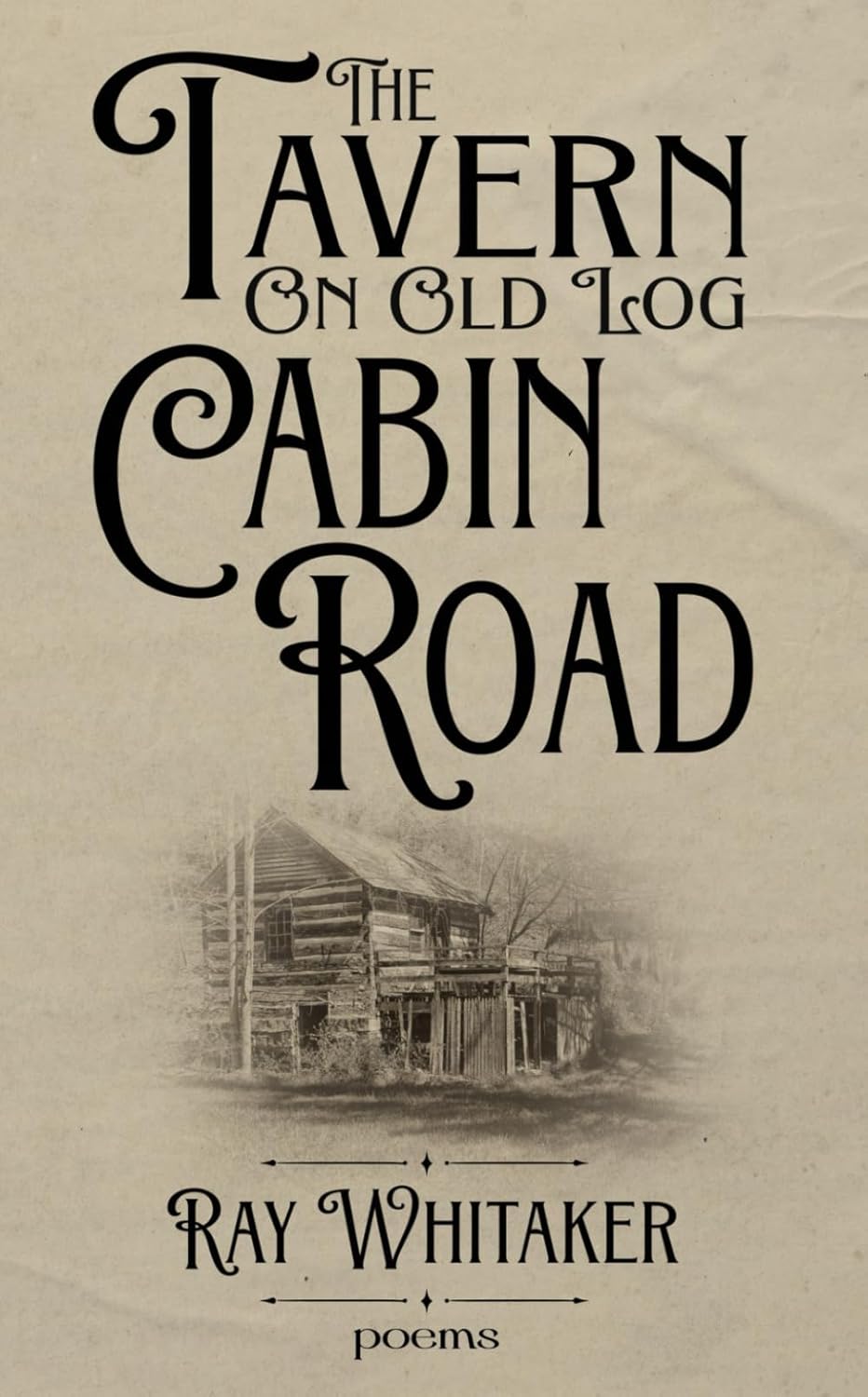
Anyway, like I said, I DID write a complimentary blurb for Ray Whitaker’s new book, “The Tavern on Old Log Cabin Road,” and I WAS very complimentary in what I said…in fact, let me quote what I had to say:
“This is old school poetry that pulls no punches. It hits hard, straight and fast, right to the gut. Not everyone can do this. Especially at such a consistently high level. This is the kind of storytelling in verse that conjures up names like Vachel Lindsay and Langston Hughes. For my money, this is a very good book that actually might be great.”
That’s what I said in the blurb, and I meant every single word of it. Especially when I compared him to Langston Hughes and Vachel Lindsay. This is storyteller poetry, not punch-line poetry. These are the kind of poems where you, as a reader, can imagine yourself sitting back in a comfortable chair and listening to Whitaker read to you. He’s not really trying to make a big score or tattle the walls…he’s just there, telling his tale, and you get to be there and listen.
Another comparison that comes to mind – to MY mind, at least – is Ezra Pound’s “The Cantos.” In Pound’s masterwork, tons of seemingly unconnected voices do their best to simultaneously confuse and enlighten the reader. It’s crammed with seemingly unrelated things that eventually all come together and fit.
That’s the feeling I get with this book. It’s so much more than any single page or poem…in fact, maybe this book is not even exactly what one would consider poetry…it’s NOT prose, I know that…but, unlike a book of poems, this book’s divided up into nineteen CHAPTERS. Who does that? And…well…it is poetry, but it’s different.
And then, there’s the actual story of the book, which spans something like 250 years of the story of the tavern on Old Log Cabin Road. But this story is not history, and it’s not true…I mean, it doesn’t so much as follow the facts as it more precisely uses the facts to create a brand-new reality and history.
Confused yet? You really shouldn’t be, because this is really a user-friendly book that you can take up into the bathroom with you, and open up at any page and start reading, and expect to have a good experience…which is more than one can actually expect on most trips to the bathroom.
I know…by now you’re thinking why is this guy (yours truly) beating around the bush and not coming to the point about this book…it’s because I can’t really find the point…and I say you can open it up on any page and glean something good from it, because this book (like I said) is user-friendly, kinda like the dog Shosho that Whitaker writes about so beautifully on page 145…there’s even a photo of Shosho there for you to look at and to wonder if this is really Shosho or just some random pooch the author grabbed a picture of, and slipped into the book as yet another thing for the reader to wonder about and think about.
This book also makes me think about Neal Cassady in Jack Kerouac’s “On the Road”…more precisely of Cassady as he appears in Kerouac’s famous scroll version of the book, which was the teletype roll of paper that Kerouac jammed into his typewriter and wailed out the entire story of “On the Road” from start to finish in one great big long thought. Twenty-two days of writing that changed the face of modern literature…and in that draft of the book, Cassady is described bouncing around from thought to thought and story to story and adventure to adventure. I don’t know why it is, but this cabin and these stories make me think of old Neal Cassady, who really wasn’t old when Kerouac turned his light in his direction, just like Whitaker is turning his own bright light on that cabin on that road.
In my head, I keep thinking back to Pound and “The Cantos,” and how you can just pick it up and start reading at any point in the book. Both books (Whitaker’s and Pound’s) are fluid…just like history. Sure, it’s linear, I’d be a dope not to admit that. But, it’s also a bit of a crap shoot.
Another feeling I get when reading this book is how, at every turn of the page, I think I can smell wood fire smoke. Cabin smoke. Wet, musty flannel shirt smoke. The smoke of memory and Time…Time with a capital T.
This book makes me think back to days when I was a kid, and we used to spend summers in a cabin with my Aunt Helen and Uncle Dutch. I can smell the kerosene lamps and remember how it felt being in bed with that warm but scratchy plaid blanket…laying there, looking up at the log beams in the ceiling. I can still see my uncle, who when he worked in the coal mines, lost the pointer finger on his right hand, and I can see him in my mind rolling a cigarette and striking a match, all with that one hand…all four fingers of that hand.
Listen, if I were any kind of a real book reviewer or even any kind of a writer with any talent or brains, I’d lay out and better describe this book for you, but I’m not and I can’t, and the only thing I can say is this book makes me think. It brings back old memories and conjures some that are new. It’s a good book. It’s a real book. It’s as real as old Shosho on page 145.
Order a copy right now and see if you don’t agree.
 LatinosUSA
Deja un comentario