
A Christmas Carol tells the story of an elderly miser, Ebenezer Scrooge, who is visited by the ghost of his deceased business partner, Jacob Marley, on Christmas Eve. Jacob Marley is described as having a pigtail and a waistcoat, tights and boots and looking much the same in death as he did in life except that he is transparent and bound in chains which are locked around his midsection. Marley has come to warn Scrooge that he will be visited by three spirits over the course of the evening, The Ghost of Christmas Past, The Ghost of Christmas Present and The Ghost of Christmas Yet to Come.
Marley and Scrooge were the same in life, mean and selfish and obsessed by making money. Marley died unrepentant of his sin of greed and now wanders the world, a spirit dragging heavy chains forged by what he valued in life – wealth and money. Scrooge is on the same path, but is being offered a change to change his ways and redeem himself before he dies.
Quote: “You are fettered,” said Scrooge, trembling. “Tell me why?”
“I wear the chain I forged in life,” replied the Ghost. “I made it link by link, and yard by yard; I girded it on of my own free will, and of my own free will I wore it.”
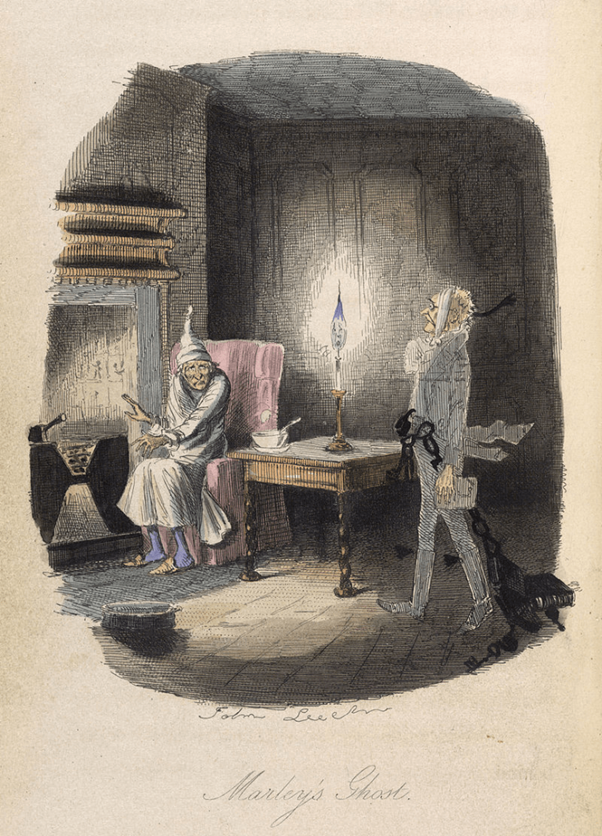
Each of the three ghosts is a metaphor for the memories that shape our characters in life.
The Ghost of Christmas Past is the first of the ghosts to visit Scrooge and symbolises the experiences and memories that have moulded him into the callous and selfish man he is when the story starts. The head of this ghost glows represents memory.
The Ghost of Christmas Present is the second ghost to visit scrooge and is a metaphor for generosity, empathy, and the Christmas spirit.
The Ghost of Christmas Yet to Come is the last ghost to visit Scrooge and is a metaphor for death and the legacy of our lives that we leave behind when we die.
A Christmas Carol is an allegory as it features events and characters with a clear and fixed symbolic meanings. Scrooge is the antithesis of the spirit of Christmas and represents greed, selfishness, and a lack of goodwill towards his fellow men.
A Christmas Carol includes social commentary although this is not the central theme of the story. There are various statements made by Scrooge that relate to the Poor Laws that governed the lower classes during Dickens’ lifetime. Some examples are as follows:
“If these shadows remain unaltered by the Future, none other of my race,” returned the Ghost, “will find him here. What then? If he be like to die, he had better do it, and decrease the surplus population.”
Scrooge hung his head to hear his own words quoted by the Spirit, and was overcome with penitence and grief.
“Man,” said the Ghost, “if man you be in heart, not adamant, forbear that wicked cant until you have discovered What the surplus is, and Where it is. Will you decide what men shall live, what men shall die? It may be, that in the sight of Heaven, you are more worthless and less fit to live than millions like this poor man’s child. Oh God! to hear the Insect on the leaf pronouncing on the too much life among his hungry brothers in the dust!”
“This boy is Ignorance. This girl is Want. Beware them both, and all of their degree, but most of all beware this boy, for on his brow I see that written which is Doom, unless the writing be erased. Deny it!” cried the Spirit, stretching out its hand towards the city. “Slander those who tell it ye! Admit it for your factious purposes, and make it worse. And bide the end!” “Have they no refuge or resource?” cried Scrooge. “Are there no prisons?” said the Spirit, turning on him for the last time with his own words. “Are there no workhouses?”
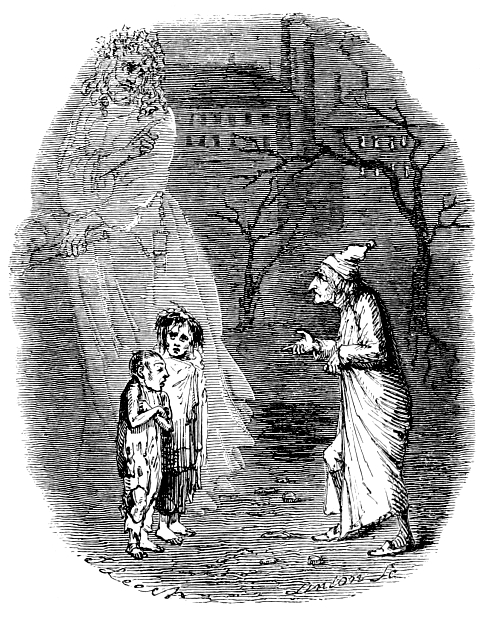
Ignorance and Want from the original edition, 1843 https://archive.org/details/christmascarolin20dick
Ignorance and Want are two hideous and emancipated children that the Ghost of Christmas Present shows to Scrooge before he disappears. Ignorance and Want are allegorical characters who have no personalities and only symbolise Scrooge’s own ignorance and want. The spirit warns everyone to be wary of both of them. Want represents the plight of the poor in Victorian society and Ignorance represents societies ignorance of this plight.
Tiny Tim, the disabled young son of Scrooge’s employee, Bob Cratchit, is a symbol of what must be prevented in society, namely, the disease and dependence that comes from poverty and industrial exploitation. Tiny Tim represents the value of human beings outside of the contribution they make to caretakers or society.
The message of A Christmas Carol is that those who are generous and kind will be rewarded on Earth as well as in Heaven.
The novella has a happy ending and Scrooge sees the error of his ways and undertakes to change his behaviour going forward. He seizes the second chance he is given.
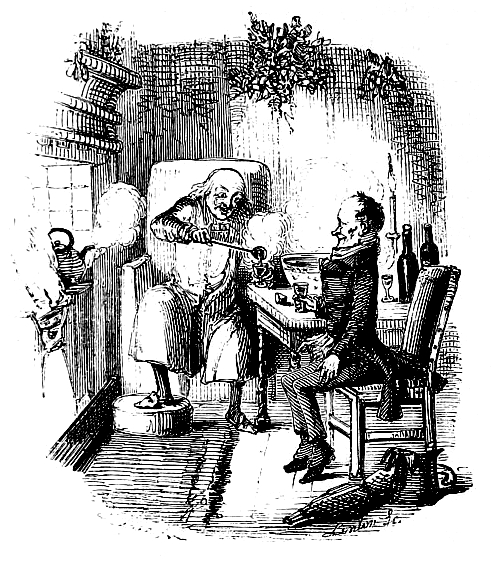
Scrooge and Bob Cratchit celebrate Christmas in an illustration from stave five of the original edition, 1843. https://archive.org/details/christmascarolin20dick
I enjoyed A Christmas Carol as a lovely and inspiring Christmas story. Dickens’ idea about selfish and greedy actions and behaviours during a person’s life forging chains they must carry with them in the afterlife is a concept that has always fascinated me. I remember reading a similar idea, except the chains were described as burdens, in Enid Blyton’s The Land of Far Beyond which I read as a child. I never forgot that story and I tracked this book down about ten years ago and I acquired a hard cover copy.
The visits of the three ghosts were entertaining and insightful and each of them also made their points well. The representations of goodness in the forms of Bob Cratchit and his family and Cousin Fred were interesting contrasts to Scrooge and the ghost of Marley.
Have you read A Christmas Carol? Did you enjoy it? Let me know in the comments.


 LatinosUSA
Deja un comentario