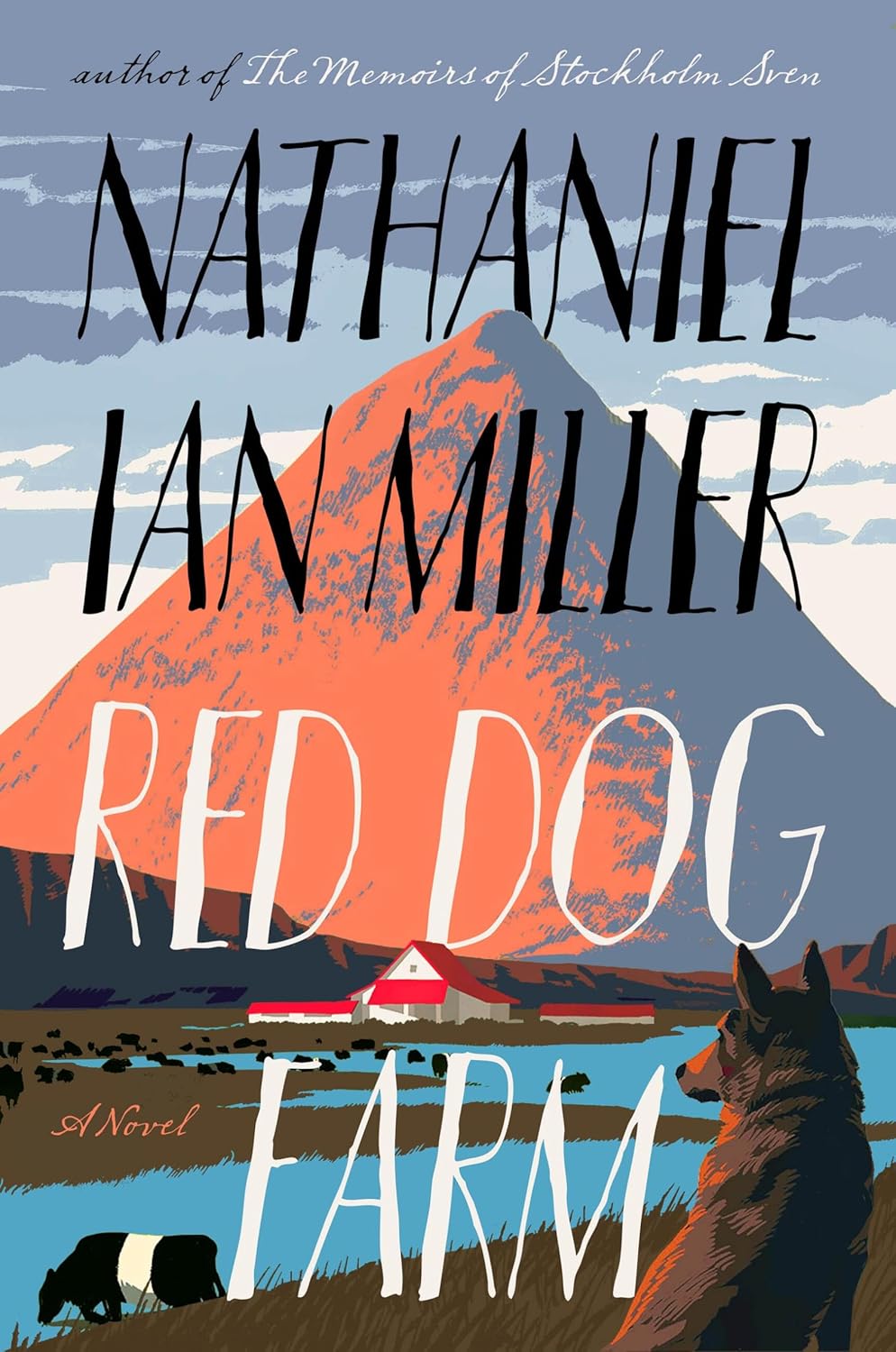
Iceland and its archipelago were formed by the magma erupting from the separating North American and Eurasian tectonic plates; or more accurately, are still being formed. As recently as April 1, 2025, a fissure ruptured on the Reykjanes Peninsula, releasing magma and forcing the town of Grindavík to evacuate. Iceland must be maddening for cartographers with its near-constant changes in shape and size brought about by flowing, shape-shifting, and hardening magma. As difficult a task as mapping must be, agriculture must be even more odious, with the short growing season and absence of sunlight for a good portion of the year. Not even forests thrive there; as the old Icelandic saying goes, «What does an Icelander need to do if he gets lost in the woods? Stand up.» The protagonist in Nathaniel Ian Miller’s latest book tells us, «A farmer needs to endure a great many things.» Sounds like a banal triviality, but in Iceland it’s a gross understatement.
* * *
Red Dog Farm is Nathaniel Ian Miller’s second novel, coming almost three years after his first (The Memoirs of Stockholm Sven). Miller makes sure the reader gets good and dirty here with farmwork. There are no less than thirty-eight mentions of feces in some form or another, not counting the four-letter expletives. Our main character’s father has been running a cattle farm for decades, but now he’s getting tired and, his son and wife suspect, emotionally depressed. The animals are not dairy cows. They are beef cows taken to the slaughterhouse upon maturity, so it seems odd when we learn early on that all cattle are given names at birth. Then it becomes not so odd when we find out that Icelanders name pretty much everything—rocks, patches of moss, farm implements. Our farming family has a hay wagon named Ein, and an older hay wagon named Tvaer. The temperamental eighty-five horsepower Valmet farm tractor is named Kolkrabbi. With our dramatis personae complete, we’re ready to begin.
Unless you read the jacket copy, you won’t know our main character’s name is Orri—it isn’t mentioned until well past the halfway point of the novel. He’s the only child of his parents—his father runs the farm and his mother teaches at Bifröst University (there’s a pronunciation guide in the back of the book for umlauted and aigued words). Their dog, an Australian kelpie named Rykug, helps keep the cattle rounded up and guided through the chutes. Rykug (translated into English means dusty), is described as having black ears, so the book’s title is not taken from the farm dog. With a good beloved dog in a rural setting, I couldn’t help but wonder if we’ve got a new Old Yeller on our hands, but Red Dog Farm bears no resemblance to Fred Gipson’s book. «Farm-raised children don’t grow up to farm much more often than farm-raised eggs grow up to be chickens,» Orri says, and he enrolls in the University of Reykjavik to study psychology and «a touch of law.» While away at university, Orri gets one of his mother’s routine telephone calls, and she tells him that his father, Pabbi, seems depressed. Orri had been planning to come home to the farm in two weeks to help with calving season, but after this bit of news, he decides to start his furlough early.
Every so often, a piece of journalism comes along listing the world’s deadliest occupations. People are often surprised to learn that it isn’t police or firefighters—farmers are much more likely to be killed on the job than cops are. (I myself put a farm tractor in a ditch at age thirteen, and if it tipped over, most certainly would have killed me.) Orri’s father has accumulated a few injuries over the years and lately, the injuries are taking longer to heal. Then one day as he and Orri are trying to get the last few stubborn steers into the chute to administer vaccines, one of the steers gives Pabbi a kick in the chest and breaks two of his ribs. The docs wrap him up, and now there is no question—Pabbi is most definitely depressed. A few days later, Ingi Robertsson is walking around their farm, and Pabbi tells his wife, Amma, and his son, Orri, to stay inside while he hobbles out and talks to Ingi. Ingi is a real estate tycoon who specializes in farms and ranches.
Living out in remote rural areas can make it difficult for young people to find mates, especially for queer people. Runa, the daughter of farmer Drunk Stephan, asks Orri if he wouldn’t mind asking around Reykjavik when he returns to university if there might be any lesbians there interested in meeting her. She also asks Orri to be her beard, a decoy boyfriend, so that she doesn’t arouse suspicion from her father or anyone else that she’s a lesbian. Orri at first looks through social media (he finds dating apps distasteful) on his laptop while he’s still at the farm for any potential interests for Runa. He doesn’t find any for her, but he finds a woman, Mihan, he might be interested in for himself. He makes a few comments on her social media page about her taste in music and the pics that she’s posted on her timeline. Seems to be going okay until a few days later, he asks if she has any face pics he can see. Mihan shuts him down immediately and stops responding to his messages. Orri’s apparently blown it.
Hill spends a little too much time on Icelandic description—the volcanic hills, the craters, the volcanic rocks. (He goes on for two pages where Orri and his mother Amma are having lunch, describing the area around the rim of an inactive volcano.) There are too many mentions of Halldór Laxness, Iceland’s 1955 Nobel laureate, and of course, the endless mentions of animal droppings. One of those mentions, though, is not of their incontinent cattle, but of a murder of ravens marauding their wrapped hay bales that had been left in the field. They not only tore the bales open, but left all their droppings on all of them as well. Orri wonders if Pabbi will retrieve a gun from the farmhouse to kill the ravens:
Pabbi’s face darkened. Death was all around him. Furthering its dominion was like leaving the doors and windows open on a January night and standing on the threshold and saying, Come. The prospect of killing a raven was exceedingly bleak to him. To me as well. They were intelligent and charismatic. They were residents of this farm, too, and they were Odin’s birds. It was bad policy and bad luck put They were residents of this farm, too, and they were Odin’s birds. It was bad policy and bad luck put by ravens. These guys will kill a single raven, pull its corpse in two, and lay one half at each end of the long rack. Apparently it keeps the birds away. Ravens don’t appreciate seeing one of their own like that.»
Orri asks him if that would work with their hay bales, and his father says that while he curses their little souls, he wouldn’t kill even one.
Hill sees the world as a writer, and so do his characters—sentimental, overthinking, melancholy. With the exception of Orri’s Latvik grandmother, everyone in the novel seems to be afflicted with year-round Seasonal Affective Disorder (SAD). Hill also gets a little too didactic when he’s explaining how things work down on the farm; he almost seems to be an advocate for Galloway cattle, going into the differences between them and typical Icelandic cattle, and defending the farm family’s choice to use them. One passage even reads like a veterinarian’s handbook. He’s also pedantic on the Soviet refuseniks (Orri’s Latvik grandmother was a refusenik), but double-checking him shows his facts to be accurate. However, he only glances over how Icelandic homes are heated by the earth’s natural hot water, something I really would have liked to have seen him go into with much deeper detail.
Three weeks after Mihan had cut Orri off, Orri gets a call from an unknown number, which he of course lets go to voicemail. «The caller was a precocious kid introducing himself as Mihan’s nephew, Óskar, and saying that he’d like to meet me sometime, he’d always wanted to meet a ‘cowboy,’ and that maybe I should come and visit.» This is of course Mihan’s ploy to restart their relationship, and Orri readily agrees to meet her nephew. He makes the three-and-a-half-hour drive to Akureyri where Mihan lives—and ends up staying for two weeks. When Orri finally calls home, his mother is delighted and wants to know when she can meet Mihan, practically ready to make wedding plans.
Orri delays returning to uni, and delays again. He’s starting to like working on the farm, even after losing control of Kolkrabbi while driving down a hill and having an accident. (Kolkrabbi means octopus in English. We’re given no explanation as to how they came up with such a name for a farm tractor.) Orri’s own prophecy of children never staying down on the farm is turning out to be false. Runa’s father, Drunk Stephan, has passed away, and she, too, is finding that she likes farm work and wants to keep it going. And—spoiler alert!—Rykug doesn’t have to be taken out back and euthanized. There are no epiphanies in Red Dog Farm about giving up a life of higher education and returning to a life of Mother Earth, no life-altering message. I can’t help but wonder, though, when those first Viking ships arrived at the coast of Iceland centuries ago, what they were thinking when one of them said, «This looks like a nice place to live. Disembark.»
 LatinosUSA
Deja un comentario