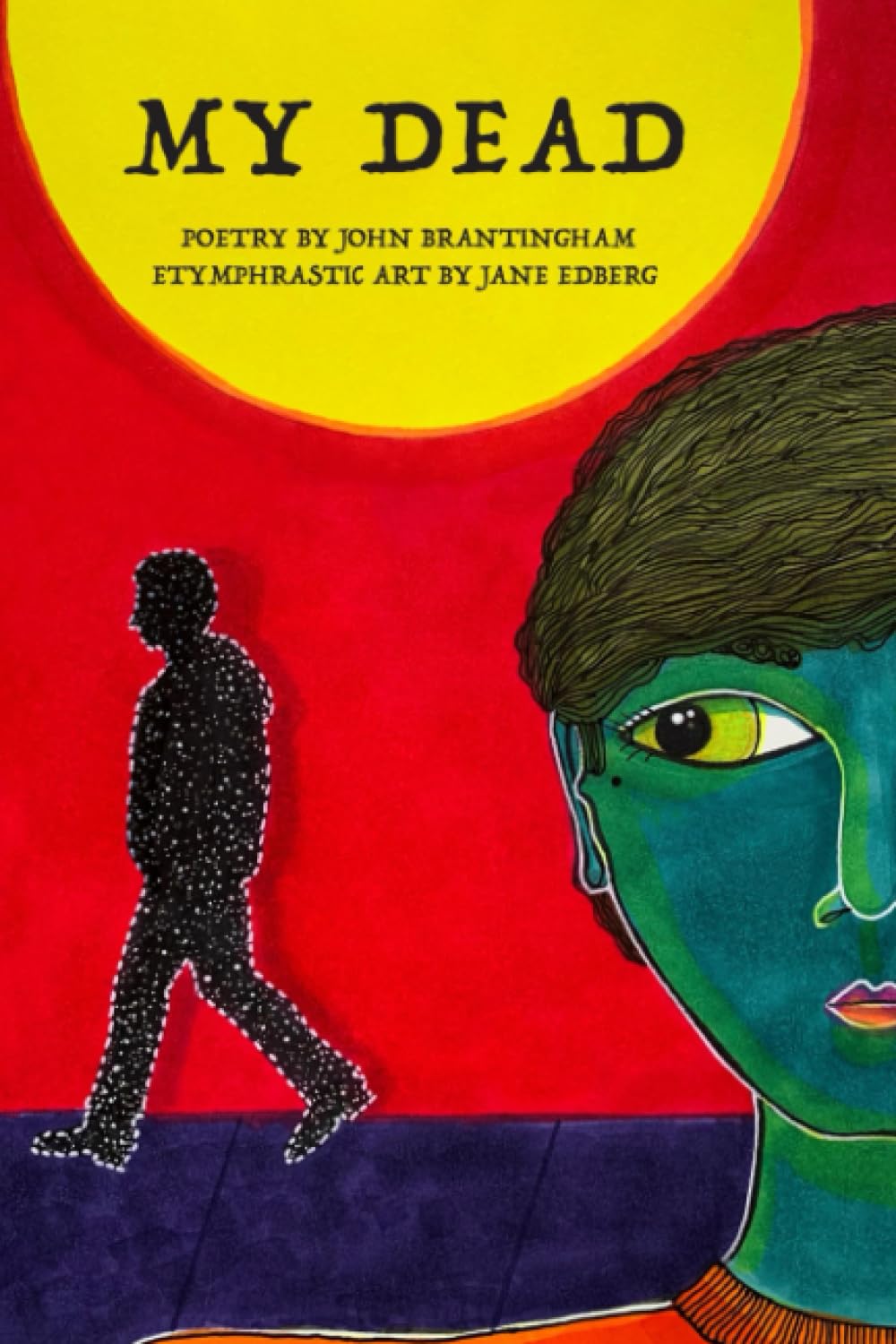
NF: How did the two of you connect?
JB: My wife and I ran a program up in Sequoia and Kings Canyon National Parks that combined art and poetry. I was always shocked at the high level of writing and art that happened there. Jane probably surprised me the most when she came and was one of our students. She’d been an art professor for decades and a writer for just as long or longer. Her work was amazing, and she has the gift of allowing you to see the world differently from how you’ve ever seen it before. The three of us were instantly good friends.
JE: A friend of mine suggested I attend John and Ann’s workshops in the Sequoia National Forest, hiking, drawing, and writing. That was perfect, as I was combining art and writing for the past 20 years, and I loved the idea of joining a group of similar-minded folks in the wilderness of such a gorgeous place. Turns out John and Ann were more terrific than I had imagined, such supportive and informative people, both so talented and inspiring.
NF: I am in love with My Dead. There is a deceptive simplicity to both the art and the poetry. Why did you decide to create this book together?
JB: This was all Jane’s idea. I’d been writing through the pandemic and feeling lonely. I think that comes through my work. Jane probably was too. We’d worked on ekphrasis before, but she wanted to turn that process on its head and draw to the writing. The conversational element of it is fabulous. She is a brilliant and insightful artist. I think this kind of collaboration is wonderful because I can let go of ego completely and allow the art to come from those places that I’m often too insecure to access. I love working in collaboration and especially with Jane.
JE: After reading much of John’s writing, every time I came away with vivid images in my head. And you are right, there is something so very simple about his words, but don’t be fooled, his prose packs a whole lot into few words, brevity at its best. But his imagery stuck, emotional imagery, and I felt compelled to ask him if I could respond to his writing. He gave me an enthusiastic yes.
NF: I had never heard the term etymphrastic art before. Please describe how you collaborated together.
JB: In this project, Jane was doing all the important collaborative work, so I’ll let her explain. I’m not a visual artist anyway, so although I understand her art, the method eludes me.
JE: Etymphrastic is the artistic response to prose, whether it is fiction, memoir, or poetry, the artist can draw, paint, and I suppose, dance, play music, etc., to respond and communicate back to the writer. Etymphrastic is not illustration. Illustration tries to duplicate what is being said. Although illustration is a form of interpretation, it usually steers towards what the writing is referring to, whereas etymphrastic response interprets, but then brings up other things, ideas, feelings, it might question or reorder the meaning of the words. Maybe even disagree. Etymphrastic is the artist having a dialogue with the writer and what the writer has written. Etymphrastic can be a suggestion, a reference, a springboard to new stories, a dreaming into the writer’s words.
NF: John, some of the poems obviously refer to your dead. Other poems (such as “Sunday Morning,” “Light,” and “Canopy”), not so. How did you choose the poetry for this book?
JB: I have always loved the work of imagists most. This is not strictly imagism, but it certainly uses lessons taken from their work. What I wanted with all of these poems is to evoke an emotion about that time in my life, and through it construct arguments that cannot be directly expressed. If they could be, I wouldn’t need poetry. These are all about the alienation and my desire to reverse the depersonalization inherent in the quarantine and shutdown. In effect, I was attempting to re-personalize myself and those around me.
NF: Jane, your use of color and lines convey both movement and stillness. What medium did you use?
JE: I wanted to work quickly and small 6” x 9” because I wanted to respond without too much cumbersome preparation of materials, and didn’t want to be overwhelmed with large canvases. I didn’t need anything precious to work with because I knew the finished work (prose and image) would most likely be in print, not hung in a gallery. I wanted to make my work with John immediate, convenient, and simple. I chose Bristol board, which is relatively inexpensive and has a nice flat surface. I used Copic art markers, good quality ink markers with great saturated colors that are semi translucent and layer beautifully. I wanted bright colors to make vivid drawings. Fast sketches really.
NF: Jane, why did you choose this art form instead of another, such as photography?
JE: I had been working with another friend/writer producing small black and white images for her poems. I used Indian ink and brushes. Her work was ethereal and dark. Fluid. But John’s poetry required matter-of-fact imagery, bold and colorful to match the matter-of-fact way he writes. I imagined serious cartoons. I think it is intuitive how I choose my materials for the most part. But I didn’t see messy, mushy, gushing in his writing. I saw clean, precise, to the point, and ink markers are good for making sharp lines, and blocks of color, shape. His writing is organized and the markers made that possible.
NF: John, many of your poems show a tension between city life and the natural world (such as “This Dawn” and “Blackbirds”), between life and death (such as “Grandfather” and “Quarrel”). Please talk about how your environment and experiences impact your poetry.
JB: I am a nature poet. I was the poet laureate of a national park. The point of that is to understand how I am a part of something much larger than myself. I am not only on the earth; I am of the earth. I and it are one, and so are the creatures and life around me. It’s important to see and understand that to have that perspective. So that’s the way I approach the bird or dawn or really anything. I am looking for their role in my life and mine in theirs. When you understand that, you understand wonder, and wonder is an important perspective to have.
NF: Jane, what inspired your illustrations? For example, were you drawn to certain words or phrases, or to the mood of the poems?
JE: I would read one of his poems. Sit with it for a while, then read it again. I would study the words, phrases, and then jot down what I think he means. I sometimes circled words that stood out. I would write down what I felt, and what I saw in my art mind. There would always be a little bit of a struggle to see between the words, between his imagery. A play would happen inside my head and the arrangements of meaning and subjects would morph into a new way of seeing how the poem plays out. It is like dreaming into John’s work. Sometimes immediate and other times I’d sleep on it. Ideas would pop and I’d read the poem again. Usually, an ah-ha moment would occur and I’d see a juxtaposition of his imagery with how I project his message. I add what isn’t there many times, to spin the poem into new meaning, careful not to overpower the initial meaning.
NF: What projects are you working on now?
JE: We are opening up a new conversation. John will start with an image. He has sent me a drabble (a 100-word story) and I will be responding to that through drawing. He will then respond to the drawing. And back and forth until the conversation is over. An ek-etymphrastic epistolary conversation in prose and drawings. I respond etymphrastically and he responds ekphratically. I love the new word ek-etymphrastic!
JB: Yeah, I felt a little jealous of her and her practice. She was getting so much out of drawing to my work, and I really wanted to have that experience with hers. I think it’s going to take a long time to work through this. There was something clean and definable about the emotional of the shutdown, even if it was a terrible time. I’m not sure what I’m feeling now. I’m not sure what I want to say. But of course, that’s the point of this kind of collaboration, to get out of my own way and allow the words to give me meaning.
NF: Do you have any new projects in mind, and if so, what are they?
JB: I’m working on a manuscript that I’m calling A Memoir of Wonder tentatively. This is a series of 100-word essays that recall moments of wonder in my life, good and bad. I have an unusual condition that leaves me hard of hearing for periods of months. One of the tasks of the manuscript is to describe the emotional and social components of this condition and what sound means to me when I can hear.
JE: I am working on a narcissistic mother wound project in prose and painting with black and gold ink. About recovering from childhood trauma and loss.
Purchase link:
John Brantingham was Sequoia and Kings Canyon National Parks’ first poet laureate. His work has been featured in hundreds of magazines, including Writers Almanac and The Best Small Fictions 2016 and 2022. He has 19 books of poetry, nonfiction, and fiction, including Life: Orange to Pear, Kitkitdizzi, and Days of Recent Divorce. He is the founder and general editor of The Journal of Radical Wonder. He lives in Jamestown, NY.
Jane Edberg coined the term etymphrastic: art that responds to poetry or prose. Jane holds a Master of Fine Arts from the University of California, Davis with an emphasis on photography, painting, and performance art. She taught photography and art for 30 years, retiring after 20 years at Gavilan College. She serves as the arts editor and a contributing editor at The Journal of Radical Wonder. Her art has been published and exhibited internationally.
Jane recently completed an illustrated memoir called The Fine Art of Grieving. She writes memoir, flash, and poetry. Her writing has been featured in the books Death, and its Terrible, Horrible, No Good, Very Beautiful Lessons: Field Notes from The Death Dialogues Project; Sasse Museum of Art: Terry Givens Ekphrasis Collection; in the flash anthology, BAM 42 Stories (to be released in 2024); and in many journals, including Cholla Needles and Gyroscope Review.
Jane lives next to Monterey Bay in California.
 LatinosUSA
Deja un comentario