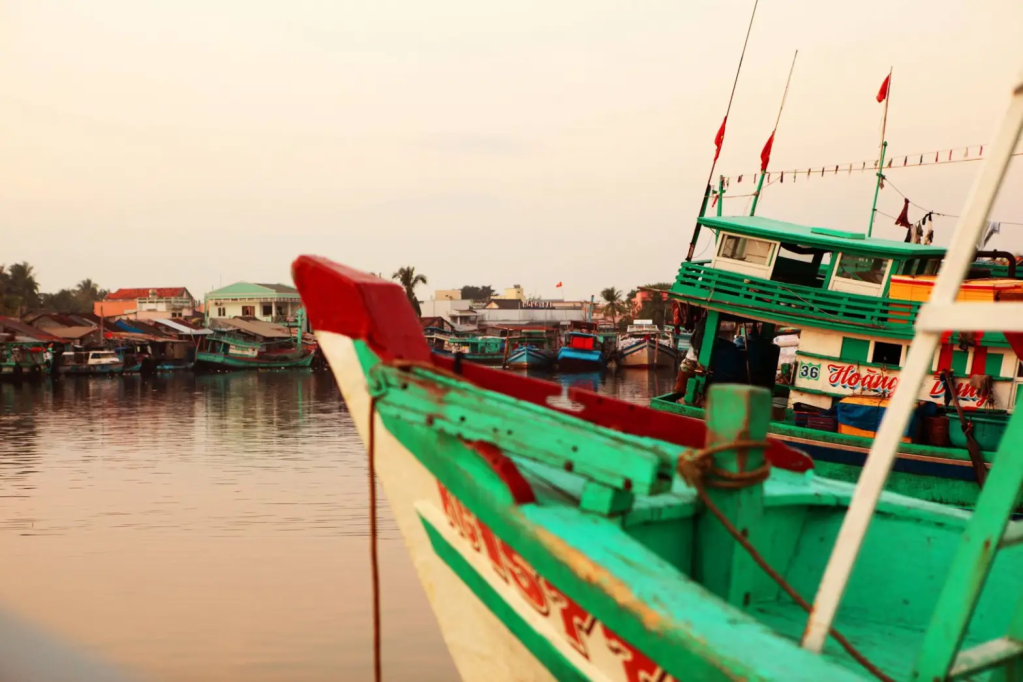
Phu Quoc, Vietnam. Photography: Nguyễn Thị Phương Trâm
A short story in Vietnamese by Mai Thảo
Translator: Nguyễn Thị Phương Trâm
[Tặng bản dịch này cho cậu Ly Doi , người động viên bất ngờ – cheers to the impossible!]
Picture a boat dock in a small town. A winter afternoon. Cement pillars damp with dew. The orange flicker of oil lamps spilling out from under the low grass huts. People huddled together on benches shoulder to shoulder like a wall looking out onto the dock. Girls in black pants, loose white sleeves under cardigans embroidered like a chess board, red and green woolen jumpers knitted with canarium, beehives, rope, ladles ladling food from deep yellow deerskin pots onto a plate the shape of a peach. Pork belly stew, sticky brown sauce, an abundant starry fat deposit floating on top, scattered with fresh green scallions, substantially textured fake soft-shell turtle dish with snails, green banana, galangal and yogurt, thinly sliced braised carp, each slice still holding a cluster of yellow fish eggs. The rain sprinkling. A shirtless Chinese merchant sitting under a make ship shelter at the end of the jetty gets up and steps down into his boat puffing on cigarette smoke.
And the boy stood there. He wears a white bucket hat with the strings tied securely around his chin. His bamboo cloth trousers rustling. His tunic far too big for him reached halfway down his ankles, he had to roll up his sleeves twice, otherwise they would have covered the tips of his fingers. The noisy meals at the end of the bench in the low grass huts are always warm and accommodating, a feast for both the eyes and tastebuds. The child wanted to sit down, and order food, pick up the bowls and chopsticks like the adults. But his mother had already packed an evening meal for him to eat on the boat. A parcel of roasted peanut and sesame seeds with salt, his mother had squatted on the floor to roast it in a wok on a tripod, in the cooking hut right next to the ox cage hay smoke leaving behind soot like layers of black moss on top of all the trusses, his mother crushing the roasted condiment in a small bamboo mortar and pestle before wrapping it in a banana leaf with an air bubble free compacted fist full of rice which was jasmine rice pounded down finely and cooked in a small earthen clay pot saved in earthen pot under the altar, with summer rain running into a moss covered water tank fed by an areca shaft from the top left down. And the child swallowed his saliva and diligently turned away, in his mind was the promise of the first delicious meal in the street somewhere on his first trip away from home. He continued on his way without much thought waiting for his time to start walking. Beyond the pond with long rafters of morning glory beneath the shadows of a fig tree, jackfruit, was a bed of taro with red leaves on the other side of the pond, snake fish swam at the foot of the foot bridge across the pond, shiny pale bulging stomachs of knight gobies the noon hours the sunlight noting each movement each thump of a fallen fruit in the garden, out from all that winding path of dewdrops and greenery, his fingers holding up a sling shot fashioned from a guava branch aimed at a starling perched each morning on a branch atop the neem tree, leaving a home divided like in nature, three leaves three room and two fruits two way to air an ancestral altar draped in cloth at the centre of the room behind a set of trường kỷ(wooden polished lounge set) where on the table is a tea set from Ninh Thái with bright red character on the teapot, the afternoon of that childhood, the child had walked along the rails buried deep beneath a sea of reeds, the surrounding area outside an auntie’s village at the beginning of the day before, to the foot of a wall as high as one’s neck spills the foliage of almond and dragon plum, paths full of coal and wagons, came the smoky textile mills behind towering grey walls, and he had stood there, waited for his first ferry ride ever in his whole life against the tides that will take him into the world that had appeared in his childish imagination a world apart far away that is Hanoi.
*
Picture a boat on the dock. It’s smoke stack black with soot, persistently blowing puffs of white smoke from its orifice. A very old boat, creaky, the shimmering water dripping from the river seeps in through the hull, half naked and bared chest porters taking turn day and night manually scoops out the water dumping plop plop one plop at a time into the river, as soon as the water was scooped up more water seeps in to replace what was just discarded. A thin plank in place as a bridge lead you down onto the watery boat deck. The frighten child held his breath as he approached the precarious bridge shifting dangerously along with the commotion in the river, his feet shaking, a cold chill runs down his back, one miss step and he would end up in the river. People were sitting everywhere, haphazard amongst piles and piles of consumable goods. Wet, soaked through hessian bags full of sea salt, each bag labelled with its produce. A bag of salt fell in a thud exploding all over the deck, tiny grains of salt, pink with hue of alluvial sediment sliding slowly across the deck merges with bigger piles of the same salt. A moldy musty smell floats from the bags of rice bran, corn and root vegetables. Bamboo baskets full of duck and chicken eggs tucked safely away from any human traffic. Yokes used by people to carry baskets, baskets stacked on top of each other, sails, calico totes tucked under the benches running the length of the ferry on both sides. The light was brilliant. The smoke stack huffing and puffing commands a huge space in the middle of the ferry delivers the rising smoke from the bottom of the vessel. Heat radiated from a magnificent coal stove in the hull. The child meandered his way toward the front of the ferry, picked a spot to settle on top of a pile of an assortment of goods, quietly and timidly he sits down. The gust of wind from the river slapping rain into his face snaps him out of the stupor of the excitement of his first adventure. The two alert round eyes of a bird wide opened, tilted, watchful, filled with images. A pile of chains wrapped over and over again around a shiny pillar. Numbered private cabins dominating the majority of the space of the vessel, the boat owner puffing on his pipe pacing back an forth on a small deck partitioned off by a low gate. All the while darkness and the rain drapes a blanket across the surface of the river. Four scuttering shirtless porters hunched over the shaft of the anchor, the anchor is pulled up slowly as though it us swallowed slowly by the bow of the ferry. The child turns his head to look back. The wharf now further away, the start of a separation. Blotches of yellow street lamps. Smudges of human form moving around more freely on the empty wharf sudden free from being held hostage by the ferry. Roaring on both side of the boat is the water floating in the opposite direction. Tilting his head to one side he watches the water leaves striking white streaks on the very black surface of the river. The boat floating against the flow of Sông Hồng, out of the province and deserted shores, to the beginning of quiet hamlets and villages.
*
Imagine that boat on that river. Sông Hồng. Like fresh blood pumping through all the wistful domains of one’s memory. A river as magnificent as one’s life. A landslide on one side. Rich alluvial soil on the other. The sound of waves amidst persistent endless songs. The sound of waves crashing the sound of boundless crashing at the beginning of the rapids where the left bank is sucked like a whirlpool into an endless void, water trickling excitedly pushing endlessly against the withdrawing mulberry fields, potato groves and ancient bamboo roots. The left bank, the waves in the floods are just as gentle from one season to the next. The child floating along with the boat on the majestic vast body of water suddenly takes him back to the herd of ox in a muddy swamp under a leaning bayan by the small but soft like silk, skinny rivers with pebble bridges that lead into the early morning market at the head of the village, with brick bridges that lead into streets and endless alleys, tumulus of couch grass, scutch grass over the tombstones, swinging bamboo handrails on precarious bamboo bridges, flickering fireflies night after night in the dark, carry away by rays of moon light are patches of Bát Tràng paving warm still with the smell of the first harvest. Buzzing sound of the farm fan, churning the husks, and evening pounding of bunches of new rice stalks on the pavement. Golden yellow glow of rice stalks swaying like reeds in the damp moonlight. Waves of giggles and laughter through the fields, simple pleasures of a satisfying peaceable time of the year for country bumpkins. As he walked with arms out stretched one light step after the other, the unforgettable impression of the rustling sound and texture of the grains of rice between his toes, and the pads beneath his feet, in his mouth is a fresh straw, he’s sucking on it as we walked amongst the harvesters coming from far and wide all around the surrounding area gathered in the village, carrying scythes on their shoulders on their way to the next field to cut and gather the next batch of crop. He thought they were truly funny, truly congenial, how they truly loved each other. And when these group of strange lads leave the village, he would stand there at the foot of the dike not wanting to leave, watched the young men go in a row grow smaller and smaller like a long cotton thread in the first light of dawn. He missed the pounding thumps of the village drums. Sound of courting evening church bells. Taps on the temple blocks at noon. Dogs barking in the dark. Missed the rustic rural sound that had been around forever that of the land, soil, fields, flowers, grass. Missed the croaking sound of frogs from the Japanese ponds covers in duckweed, loud and constant mournful cries of cicadas, whitling sound of kites flying in the wind against a boundless horizon, squeaky bouncing yoke loaded with goods on someone’s shoulder, đám tuần – steady beats on the wooden fish and heavy shuffling of a funeral procession at night after a week long of mourning for someone who had just passed away, the commotions, ragged, old and pure sound of the countryside, villages with welcoming lotus ponds, and rock wells by the food stalls, buses choking, puffing black smoke, taking its time at the top of a steep dike. The child residing in a time that was as innocent as it was green, all four seasons, an air where it sometime sunny sometime rain, he lives in a world of caged ox and coal fires, of whisps of lingered smoke curled up on cogon grass rooves, with the faint scent of ylang ylang through the trees, spicey cent of honey locust in someone’s hair. The child remembering his childhood like a tipsy firefly swaying satiated in a sea of sunlight, the inebriation of childhood, a childhood curled up perched on top of the world like a drop of morning dew, a childhood that could lull it to sleep swinging in time with the swing of a hammock, the smallness of childhood so small, so sweet, so gentle, as green as seedlings, the childhood in the same white bucket hat, the same rustling bamboo cloth trousers he has on, spiky hair sticking out like bamboo roots, of white skin patches and stretch marks, of his voice breaking, croaking like a rooster, the smallest age of all is the age when you are still pink, a childhood in the fields where there is no concept or understanding of light from a streetlamp, tar roads, intersections, street or district.
*
Imagine seeing that trip, on a boat, on Sông Hồng. The night spent in middle of a huge river with its vast watery body reaching all four corners of the world. A child’s heavy eyeslids falls onto a white bucket hat resting on his knees, soundly sleeps. A sudden gust of wind wakes him. The boat going against the tides without a care in the world slips across the surface of the water through the mist fast asleep like a dream. Then there is the honk of the boat horn. From the tip of the smoke stack, thrown towards the sky is a sound thicker than water, the sound is shot high in the air, a sound that quiver the moment just before it spits up into two heading for opposite directions, propelled higher, by an echo that eerilly reaches the surrounding shorelines to come back in ripples from the deadends, head of rapids, bend in the river, and intersections undefined by the dark. The sound of the horn echoes across the villages dead asleep, slips through the fields with their gates safely secured, seeps through the empty yards, coal stoves and cold ash, ponds blanketed in thick fogs, shifting endless space and time, shifting lost stars, rays of moonlight, endless rolling waves of an epic river, of vast shores beyond what the eye can see, mouths of the sea, far off places, mountains, jungles, trees through hamlets, villagers fending for each other, forever nostalgic forever in our hearts. The boat enters a different part of the river. But it leaves behind in Sông Hồng, forever, the sound of the horn. The child listens to the sound of the horn and the sound of the horn years later after that, the sound continues to haunt his very being, crystallized in a fading childhood memory the day he left his village for the city. Older, when he would pass a river, disembark from a ferry, stand at a spot where there is a stream and watch the water run, awakens in the child’s mind would be the mind blowing echoes of his first trip, the sound of the horn of his childhood on Sông Hồng. Lowered head, eyes closed, he listens, follows a sound that would forever remain within the flow of his recollection, he can see again and again painted in his eyes are the old images of the old boat, old wharf, together with all the dizzying images of his child, ghostly butterfly wings that are there and together not there at all in the fog of the past. It is a whirlwind that resides within the subconsciousness. The intense cry of childhood. The long sigh of the past when it takes shape and when the soul have changed have moved on. It is a sound that begins with a sequence of recollection from a long long time ago, when his desire is to be small again like that time, when he could suck on a fresh straw, run endlessly through the paths in the village that lead him toward an old heavenly place.
The recollection of a bleary morning. The boat finally reached the wharf in Hanoi. The huge city and its throbbing streets. A wide eye child disembarking. And Sông Hồng, and the sound of the horn and the boat that had been left behind with his childhood.
Mai Thảo [1927-1998] real name is Nguyen Dang Quy, another pen name: Nguyen Dang, he was born on June 8, 1927 in Con market, Quan Phuong Ha commune, Hai Hau district, Nam Dinh province (originally from Tho Khoi village, Gia Lam district, Bac Ninh province, the same hometown and related to the painter Le Thi Luu), his father was a merchant and wealthy landowner. Mai Thao absorbed his mother’s love of literature from Bac Ninh. As a child, he studied at a village school, went to Nam Dinh high school and then Hanoi (studied at Do Huu Vi school, later Chu Van An). In 1945, he followed the school to Hung Yen. When the war broke out in 1946, the family evacuated from Hanoi to Con market, in the “House of the Salt Water Region”, from then on Mai Thao left home to Thanh Hoa to join the resistance, wrote for newspapers, participated in art troupes traveling everywhere from Lien Khu Ba, Lien Khu Tu to the Viet Bac resistance zone. This period left a deep mark on his literature. In 1951, Mai Thao abandoned the resistance and went into the city to do business. In 1954, he migrated to the South. He wrote short stories for the newspapers Dan Chu, Lua Viet, and Nguoi Viet. He was the editor-in-chief of the newspapers Sang Tao (1956), Nghe Thuat (1965), and from 1974, he oversaw the Van newspaper. He participated in the literature and art programs of radio stations in Saigon from 1960 to 1975. On December 4, 1977, Mai Thao crossed the sea. After 7 days and nights at sea, the boat arrived at Pulau Besar, Malaysia. In early 1978, he was sponsored by his brother to go to the United States. Shortly after, he collaborated with Thanh Nam’s Dat Moi newspaper and several other overseas newspapers. In July 1982, he republished the Van magazine, and was editor-in-chief until 1996, when due to health problems, he handed it over to Nguyen Xuan Hoang; Two years later he died in Santa Ana, California on January 10, 1998.
Nguyễn Thị Phương Trâm, the blogger, poet, and translator, was born in 1971 in Phu Nhuan, Saigon, Vietnam. The pharmacist currently lives and works in Western Sydney, Australia.


 LatinosUSA
Deja un comentario