Across from my house lies our neighborhood park. From my front yard, I can see the small bridge that traverses the creek. We often see small herds of deer feeding on the grass in the park. One doe that lives in my brother’s back yard has borne many fawns in recent years, so we enjoy watching the fawns grow. Sometimes the deer visit our back yard to feed on our garden and eat the violets.
Occasionally fawns are found in the bushes in the park without their mothers, and people make the mistake of petting and holding the fawns. They don’t realize the mothers will return shortly. The fawns are told by their mothers to stay in their safe places until the mothers return. Handling the fawns may affect their bonding with the mothers.
My husband and I love to take drives to the local wetlands and count the deer we see on the drives. It’s so exciting to see huge herds, especially the newborn fawns and, on occasion, the bucks.
Where do people get their fascination with deer? I recall Disney’s movie, Bambi, which was about an orphaned fawn. I felt devastated for this little animal as well as for myself because at my young age, the idea of losing my parents and having to fend for myself was unimaginable.
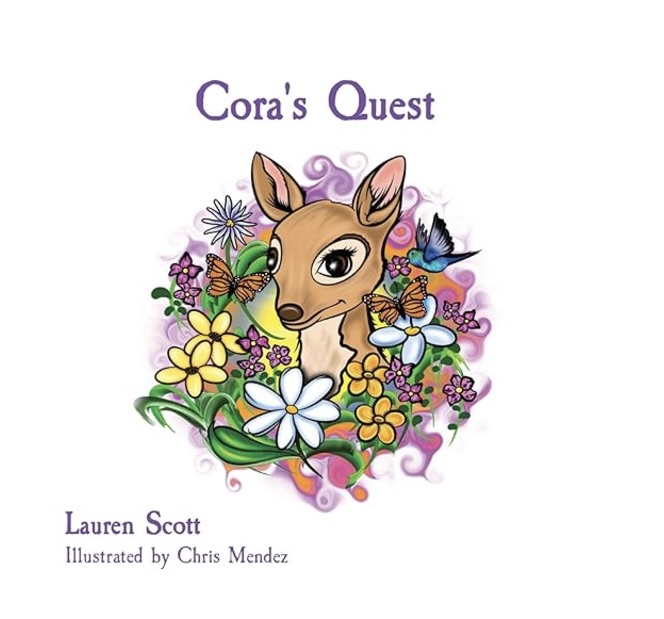
In Lauren Scott’s latest book, Cora’s Quest, a fawn, separated from her parents, must figure a way to survive. Will Cora find her parents or be orphaned by circumstance?
I invited Lauren Scott to visit with me about Cora’s tender story.
Barbara Leonhard – Lauren, I can relate to your subject matter, orphaned and lost fawns. What drew you to these animals in particular?
Lauren Scott – When the story unfolded about Cora and the words “wobbly legs” found their way on the first page, a fawn immediately came to mind. I know a young deer isn’t original – we’ve all heard of Bambi, but no other animal seemed to fit.
BL – What inspired the story line?
LS – Cora’s Quest was actually written years ago. My husband and I occasionally watch documentaries about wildlife – how mamas teach their young to hunt and survive on their own. Cora’s story began to flow.
BL – The theme of abandonment always tore me up as a child watching Disney movies, like Bambi (1942 film). Bambi’s mother was shot and killed by a hunter. In the Disney movie Dumbo(1941), the elephant’s mother was sold off because she lost her temper, leaving Dumbo alone and vulnerable. But Tim Burton’s version (2019) has her reunited with Dumbo in the wild. What are your thoughts on the theme of abandonment in children’s literature. How do you handle it in your books? And why would Burton change the story ending in Dumbo?
LS – When I was in the process of writing about Cora, the theme of abandonment hadn’t entered my mind. Young children can easily disappear from their parents’ sight, and this doesn’t mean they were abandoned. Fortunately, my husband and I didn’t experience losing our children when they were young, but it happens in the blink of an eye, traumatizing both the parents and the child.
What happens in Cora’s Quest is unintentional. It implies that both adults and children can become distracted. Reading about a child becoming separated from his/her parent for any reason is heart wrenching. So, my reaction matches yours, Barbara.
I didn’t see Tim Burton’s 2019 version of Dumbo, so I can’t speak to his reason for changing the ending. I can only imagine he wanted to give the viewers a reason to feel happy at the end, or even a sense of relief.
BL – Kids are so distracted by their devices. Of what value is children’s literature today? Why do your stories need to be told?
LS – I’m glad that computers and smart phones weren’t so prevalent until my daughter and son were in high school. Struggling to find the balance between technology and reading or playing outdoors when they were younger wasn’t necessary. They loved to read when they were little, and as adults, they’re even more captivated by books!
Reading is important and beneficial for children in so many ways: expanding their vocabulary, developing critical thinking, sparking their imagination, and aiding them in problem solving, to name a few.
Cora’s Quest is a short story, but it sends a vital message for all ages – not letting fear take control over us. I’m quoting Pete Springer: https://petespringerauthor.wordpress.com/about-me.
The line below is from his Amazon review:
“Poet Lauren Scott has written a wonderful picture book with an excellent lesson reminding children to think clearly in a crisis and not to become prisoners of fear.”
Along with his comment on my blog post: https://baydreamerwrites.com/2024/12/19/book-reviews-poetry-christmas-miracles-fiction-adventure/
“I thought your message to children through Cora was outstanding, a lesson that even adults wrestle with. Get out of our comfort zone because overcoming our fears is one of the most overpowering feelings in life.” ~ Pete Springer
Pete is a retired elementary school teacher who taught for over 30 years, so his words mean a lot to me.
BL – What would you like your readers to learn about family?
LS – In my story, a strong family foundation is underscored. Cora’s parents love their daughter very much, but they are not perfect. They make mistakes, acknowledge them, and are not afraid to say they’re sorry. Cora loves her parents just as much, so the reader knows that she is well cared for. Every human being needs a support circle, and every child needs a family to make her feel safe and loved. The definition of what constitutes a family may vary from individual to individual, but the bottom line is to care for each other so that each person, child and adult, has a safe haven to grow and learn.
BL – The theme of survival is strong. Would you elaborate on that?
LS – I refer back to my answer in Question #2 about mama animals teaching their young to hunt and survive on their own. Parents do the same thing with their children, teaching them how to live on their own so they can eventually “spread their wings and fly.” My husband is an avid hiker, camper, and backpacker, so he taught our son and daughter about surviving in the outdoors, taking them on backpacking trips where all necessities are carried in a pack on the back. He is an Eagle Scout, so he instilled his knowledge of the great outdoors onto his children. Camping and backpacking were new for me as well, but I’m grateful for him bringing the beautiful and wild outdoors into our family.
In addition to exploring the outdoors, learning to stay calm in an emergency situation is key. I’ll never forget when I was very sick years ago, and my husband had to call 9-1-1. I was in so much pain when the paramedics arrived that I started to panic. One of the paramedics just looked at me, telling me in a quiet voice to try to stay calm. Panicking offers no benefits in any circumstance because it depletes our capability to think clearly. So, staying calm is what I bring to the table in our family.
BL – How do you decide whether to write prose or poetry?
LS – All of my books, four prior to Cora’s Quest, are poetry collections. My third book is a memoir written in verse and prose. So I’m a poet first, but I’ve been challenging myself by writing in other genres such as fiction short stories, and now, a children’s book. It’s not something that I set out to do. The story surfaced years ago, marinating for many years to follow before Cora found herself in print. With this being said, I have two other children’s stories that I hope to publish as well. I believe it’s healthy to step of the box and try something new not only as a writer, but in any skill or talent. Otherwise, we become complacent, and the learning comes to a halt.
BL – The illustrations in Cora’s Quest are endearing. How did you find good illustrators? How did you work with the artist?
LS – I didn’t have a need for an illustrator until my children’s book was becoming a reality. And then I didn’t have to think too hard because my nephew is a fantastic artist. So, I asked him if he’d like to work with his Auntie Lauren, and he jumped at the chance. He has a day job, is a husband and a father of two daughters, and has his art business on the side. So, I knew he was busy, but he made the time, and it was a wonderful collaboration and experience for both of us that took over a year. I’m proud of our accomplishment.
BL – Thank you, Lauren, for visiting with me! I enjoyed learning about you and your writing process. I imagine many children will enjoy reading Cora’s Quest!
LS – Thank you for this opportunity, Barbara!
Kindle
Paperback
Author Biography
Lauren Scott is a poet and writer of fiction and memoir. She has authored three collections of poetry: New Day, New Dreams (2013), Finding a Balance (2015), and Ever So Gently (2023). In 2021, she released her memoir, More than Coffee. Lauren’s poetry and stories have been published in Spillwords Press, a literary Ezine where she was voted Author of the Month in May 2023. She is a contributing author in the anthologies: Poetry Treasures 2: Relationships (2022), This is How We Grow (2023), and Petals of Haiku (2024). Her poems are shared monthly on the online literary site, Gobblers and Masticadores. Her children’s book, Cora’s Quest, was released earlier this month. Writing inspiration comes from her love of family, spending time in the great outdoors, and finding joy in the simple things.
Learn more about Lauren below:
Blog: baydreamerwrites.com
Instagram: @baydreamerwrites
Facebook: www.facebook.com/BaydreamerWrites
Amazon: https://www.amazon.com/author/lauren-scott
Goodreads: www.goodreads.com/author/show/42498464.Lauren_Scott


 LatinosUSA
Deja un comentario