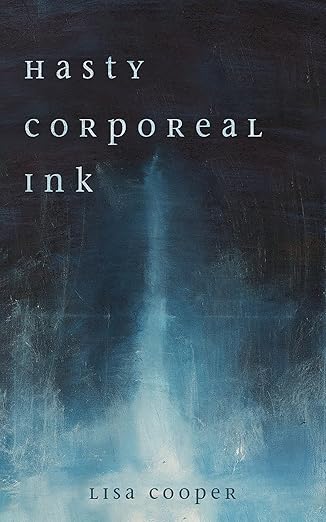
Hasty Corporeal Ink is a book of Christian poetry. Christ is all, as in the poems of Gerard Manley Hopkins in the nineteenth century U.K., and Vassar Miller in the twentieth century United States. It is a book of poems in traditional forms.
On one hand, the forms restrain, (in power lies restraint). On the other hand, they liberate the author to go to the heart of what she wants to say. Ultimately, they are integral to content, their topics God, nature, and humanity, a content reflective of John Milton’s “They also serve who only stand and wait.”
Power is an exercise in restraint. The book begins with a Shakespearean sonnet. Its title, “Sunrise Sings” is a synesthesia, as it combines sight and sound. The poem posits the idea that God is breath, the elemental life force. “The winds of midnight curl beneath the boughs, they twist, they spiral, flourish…” (14). Much could be said about imagery, and texture, but the active verbs evoke the tactile. The reader is up close, at the start of this panorama, in which the speaker is introduced (with a pun) “my eye,” in the third line. She, comes after, is subservient to, God, the “winds,” the omnipotent breath that thrives through the trees, over the horizon, over all.
So at the end, the unifying couplet is earned, and the synesthesia is sustained. “Glory be to God whose Word like light / shines bright into the darkness, bringing sight” (14). God’s power flourishes. It doesn’t topple trees or take roofs off houses. God’s power lies in God’s
restraint. (The antithesis of this poem is found in part two’s “The Tornado.”).
Form liberates, frees the poet. That liberation is evident in the sestina “The Ruins of the Monastery at Oybin,” a poem based on a painting by Carl Gustov Carus. The first stanza’s “frightened fly / away from wreckage” (43) connotes an imperative that leads to the question, “Would this willow willingly sow / on stone” “…though buds still glow / with life, forgotten?” (43). God is in nature, and nature, like God, persists in the absence of human life, but the speaker is here, among the ruins, her praise a continuum of the faith of those who prayed in the monastery. Faith, like nature, persists. “Yet dangling from its death, now glows / the phantom halls now full, songs fly / and echo…” (43). The stanza concludes “…and wrought / with verbose voices, by and by / and singing psalter, hope is sown” (43). What is ultimately liberated is the speaker’s voice. By her faith, she evokes beauty from these ruins.
The forms are an integral part of the content, as they should be. In “After My Death,” the sonnet that concludes the book, Cooper’s end rhymes posit and advance ideas, so that sense similarity complements sound. She differentiates between a picture on a wall, her likeness, and her essence. “Furthermore / life / implore / strife” (93) comprise the final quatrain’s end rhymes. While mortal lives consist of strife and suffering, love, emphasized in the final, resolving couplet, is a foil to misery and despair. The couplet connotes the joy in love, and the source of love is God, the creator.
While Cooper’s knowledge of forms is extensive and put to good use in this book, the book’s greatest asset, its most prominent feature, is her voice. She rings true, she takes her readers in, she makes them feel some of what she felt when writing the fine poems that comprise this original and memorable collection.
To purchase:
Paperback:
Hardcover:
Kindle:
Copyright © 2025 Pete Mladinic
All Rights Reserved

 LatinosUSA
Deja un comentario