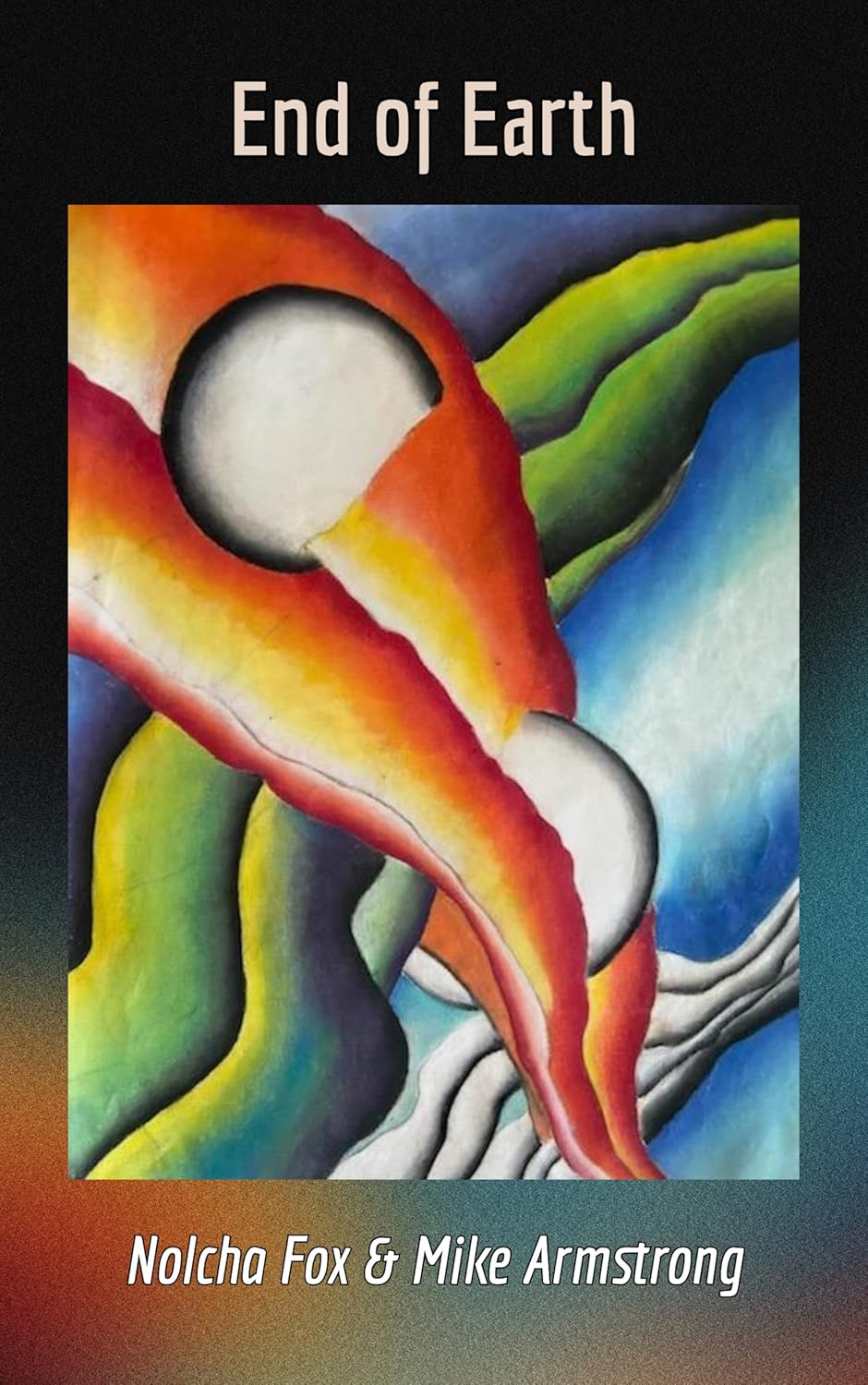
Recently, Mike Armstrong, the artist for «End of Earth,» responded to Lisa Tomey-Zonneveld’s interview questions.
L: Please tell us a bit about yourself and your journey as an artist. What inspired you to start creating art? How would you describe your artistic approach, style, and the themes you often explore in your artistic creations?
M: Long ago, I was born in Beautiful Birmingham Alabama. Fortunately, I received early art instruction. I threw my first pot in the 3rd grade. It was a mess. I have taught sculpture since.
Not being the greatest high school student, I was released by some of my teachers to go to the Art room where I never made less than an A.
At the University of Alabama, I majored in Painting/Ceramics. Also studied art and art history at Santa Monica College and UCLA.
I’m right brained and left-handed.
L: Congratulations on your latest poetry and art collaboration! Can you give us an overview of what readers can expect from it?
M: I hope that our readers will explore its depth and lightheartedness. In other words, I hope that they get it.
Rotate book cover to the left and see something different. NOT to be strange, rotate pages 22 and 24 left-I see you. Be afraid–
L: Could you walk us through your creative process when creating a new painting? Do you have any rituals or routines that help you get into the right mindset for painting? How do you know when a painting is finished?
M: The creative process requires both mental and physical energy. I have recently moved my studio from the commercial Brevard Art Guild, where painting and associating with other artists was a plus, to my home studio, which is convenient.
My non-representational work starts with adding a shape and a color to a usually blank canvas. Analyze, repeat. Finishing can be problematic-could take a week (record), or never. Yes, I have a lot of unfinished work.
L: Many artists infuse their work with personal experiences or social commentary. Are there any recurring themes or messages in your art? Are there any messages you hope readers take away from your art?
M: Although I do not aim for realism, I must be influenced by water. I grew up with a creek in my back yard and now live on the ocean. Also, many years of camping in the beautiful mountains of northern California are strongly remembered.
Named paintings are “Mountains” and “More Mountains.”
I often utilize a straight line, perhaps it represents sea line or–back to earth.
My work is spontaneous and has no intentional outcome. It is both mindless, reactive, and sometimes stressful.
L: Who are some artists who have influenced your work? Are there any other art forms or sources of inspiration that impact your art? How do you navigate the fine line between drawing inspiration from others’ work and maintaining your own unique voice as an artist?
M: I am a fan of Willem De Kooning.
I was very much influenced by high school teacher, Deliska Skinner who guided and tolerated me for 3 hours, 5 days a week. Angelic.
Alvin Sella often frightened his students into hard work at the University of Alabama. With me, he was kind and gentle. Check him out.
Santa Monica College provided me with years of world travel and museums. A great Art Department.
While at UCLA, I would have to leave the all-night sessions in the photo lab only because the janitor was coming to work, and I had his parking space. Don’t think that I was supposed to be there–
L: Who do you envision as your target audience for this book? What do you hope readers will gain or feel after viewing this collaboration? How do you handle feedback or criticism of your art, both positive and negative?
M: When being reviewed, I listen for sincerity. It’s great when a viewer sees something that I have not yet considered.
L: Any final words of encouragement or wisdom for aspiring artists reading this interview?
M: For encouragement?? Yes, I’ll take all you can give. Oh yes, practice, practice.

To purchase «End of Earth:»


 LatinosUSA
Deja un comentario